# workshop Building and imagining people’s AI infrastructures via Mud batteries December 2025
At ThingsCon Fieke Jansen, Kars Alfrink, and Sunjoo Lee will be holding a workshop on ‘Building and imagining people’s AI infrastructures via Mud batteries’. December 12th
Find out more: https://thingscon.org/events/things-2025/program#workshops
# talk - presentation - panel Infringing Infrastructures: Environmental Justice and Inequality in the Urbanising World December 2025
Date: 8 December 2025
Time: 10:30 – 16:30
Location: Wageningen Campus, Omnia (Quantum)
Registration deadline: 24 November → Sign up here
We are pleased to invite you to the seminar “Infringing Infrastructures: Environmental Justice and Inequality in the Urbanising World,” jointly organised by Wageningen University and the University of Amsterdam under the SSH Sectorplan Social Inequality and Diversity.
This interdisciplinary event explores how infrastructures—whether designed for sustainability, mobility, or adaptation—can unintentionally deepen existing inequalities or create new forms of marginalisation. From tidal parks and green corridors to renewable energy systems and smart technologies, the seminar asks: Who benefits, and who bears the costs of infrastructure-led change?
The day will feature presentations and discussions with leading scholars including Kei Otsuki (UU), Sumit Vij (WUR), Milan Babic (UvA), Jannes Willems (UvA), Karen Paiva Henrique (UvA), Stephanie Ketterer (WUR), Robert Coates (WUR) and Fieke Jansen (UvA).
The seminar is organised within the Urbanscapes cluster of the Centre for Space, Place and Society (CSPS) at Wageningen University and Research and the Amsterdam Centre for Inequality Studies (AMCIS) at the University of Amsterdam.
The event is free and open to all—students, PhDs, and staff interested in infrastructure, inequality, and environmental justice are especially encouraged to join. Lunch is included.
Organisers:
Martijn Koster (WUR) | Sumit Vij (WUR) | Wouter van Gent (UvA) | Milan Babic (UvA)
# talk - presentation - panel Keynote 1st INFRASTRUCTURE Workshop December 2025
Rethinking Cloud and AI Infrastructure — Environmental, Technical, and Governance Challenges
The 1st INFRASTRUCTURE Workshop brings together researchers from Computer Science, Science and Technology Studies (STS), and related fields to critically examine the material, environmental, and socio-technical foundations of today’s computing systems. It addresses:
- The growing environmental impact of datacenters and AI infrastructure,
- The illusion of infinite scalability and its socio-technical consequences, and
- The centralisation and governance of cloud infrastructure
The workshop emphasizes interactive discussion between communities, aiming to generate open questions and dialogue among participants.
Fieke Jansen will deliver the keynote address Governing infrastructures: keeping compute infrastructures within planetary boundaries
https://infrastructure.web.deuxfleurs.fr/2025/program/#keynotes-9301045-cet
# workshop Hands-on sessions at the critical infrastructure lab November 2025
The afternoon is organised as a work session where participants are invited to collaborate and hack on experimental projects at the critical infrastructure lab, ranging from programming through electronics and software defined radio. We start with an overview of experiments at various stages of completion, discuss their heuristic, critical and constructive potentials and possible development directions. Self-selected work groups then spend time improving the projects, take notes in a shared document and report back towards the end of the session. No technical skills are necessary, only motivation to look under the hood, and all kinds of soft and hard skills are welcome.
- 5G network (software defined radio / software defined networks / telecommunications)
- Mapping the electro-magnetic spectrum (software defined radio / data visualisation)
- Moonshot messaging (software defined radio / physics / protocols)
- Mud battery monitoring (gardening / electronics / programming / data visualisation)
- Organic data centre (mud batteries / embedded development / networking)
- Power consumption measurements (physics / electronics / data visualisation)
- Publication pipeline (programming / style sheets / automation)
- Reticulum community network (embedded microcontrollers / mobile development / packet radio)
- Telecommunications standards research (machine learning / data analysis / standardisation)
- Alternative option: Qiudanz Technique workshop with txiemonks
(see https://compudanzas.net/qiudanz_technique.html)
# talk - presentation - panel (De)Growing Infrastructures November 2025
A community evening about regenerative technologies, permacomputing and symbiotic energy systems.
An evening full of talks | Thursday, November 27 | 20:00–22:30 | Tolhuistuin
What if we could power computer systems in collaboration with living organisms? Are there ways to reimagine energy production, data storage and the re-use of waste streams through experimental regenerative art and design?
If these questions spark your interest and longing for alternative digital futures, you are warmly invited to join the evening programme (De)Growing Infrastructures on Thursday November 27 at WarmingUp Festival. Presented by Amsterdam-based FIBER and Waag Futurelab, various makers and thinkers share their work and how they experiment, build and dream about new computational futures.
Computing infrastructures and their daily use have a damaging carbon and material footprint across the planet. Yes, this includes your daily ChatGTP searches. These systems are extractive by design; they depend on huge amounts of coal, water and land. The rapid expansion of digital ecosystems is only made possible by exploiting natural resources, pushing the planet further into uninhabitable states.
Linked to the WarmingUp festival theme The Art of Coexisting, we come together to learn and share how to imagine, prototype, build, store and grow together with others (human and non-human) on regenerative digital futures. Can we collectively grow a new vision on computation?
Speakers: Leo Scarin, Mark IJzerman, Ola Bonati, Sunjoo Lee, The Critical Climate Computing Group (Wesley Goatley & Mariana Marangoni), Fieke Jansen, Rein van der Woerd, Marina Otero Verzier. Moderated by: Abdo (Abdelrahman) Hassan
Why should I join?
Expect an evening with short talks by artists and a more in-depth panel conversation, where various artists and researchers will shine their light on regenerative modes of computation through the application of microbial metabolism, permacomputing, waste energy and digital composting. In other words: redesigning digital infrastructures to operate in a kinder, less destructive way. And while doing so, prepare ourselves for an adapted form of computation, separated from Technofeudalism, within the reality of a climate emergency. The programme is open for everyone: newcomers and experts, we’ll make sure you will be introduced and get a good understanding of who is doing what (and why?!).
In addition to the talks, a workshop on the theme of Permacomputing will take place on 24 November, organised by Waag. More information here
FIBER is supported by the Amsterdam Fund of the Arts and the Stimuleringsfonds Creatieve Industrie. This programme is part of FIBER’s nomadic Reassemble Lab series
Background info
In late 2024, FIBER and the broader Permacomputing Community organized the first Dutch symposium on permacomputing and environmentally conscious media and networking technologies at the Tolhuistuin. Titled Practising Permacomputing, we explored how the theory of permacomputing can be put into practice by a wide variety of artists, designers and activists. Now, one year later, we return to Tolhuistuin with as many contributors as possible for one dynamic evening to pose the question: where is everyone at? What has happened in the meantime and which art and technology projects are currently underway?
Event Information
- Thursday November 27
- Tolhuistuin, Zonzij
- 20:00 – 22:30 (Drinks till 23:00) | Door 19:30
Tickets: https://shop.paylogic.com/d203f4cd12fe489db1f327cc65cc668f/
# talk - presentation - panel Social Media: We Can Change the Defaults November 2025
Christine Lemmer-Webber, best known as co-author of ActivityPub, the decentralized social networking protocol, will speak about the crisis technologists face. Why must we revise the default assumptions of the web 2.0 era? She will introduce the work the Spritely Institute is doing to make a positive future possible.
The most visible technologists tend to be those who shill for tech and who can be counted on to be into the latest hype. They are founders or CEOs of major tech companies or at least work in their employ. They are also the reason many people don’t have a lot of trust in technologists and their ability to think about the world in anything but the most narrowly technocratic—and ultimately self-serving—terms.
Other technologists, however, manage to stake out a position that takes a broader set of concerns into account. They are able to formulate a critique of the default modus operandi from within technical practice, writing code and building systems that call dominant norms and practices into question.
This event features one such technologist, Christine Lemmer-Webber. Best known as co-author of ActivityPub, the protocol underlying most federated social media, Christine will speak about the crisis moment technologists face and the work the Spritely Institute, which she co-founded, is doing to make a positive future possible. Getting to such a positive future involves a move away from the assumptions underlying the web 2.0 era, and it also challenges orthodoxies of the Free and Open Source Software movement and the wider hacker culture. This move is not just a matter of developing different technologies, but entails a joyful and collective learning process.
# talk - presentation - panel Alienation by Design November 2025
Longstanding concerns from hacker culture and activist communities are gaining renewed urgency. From governmental dependency on Microsoft systems and our university’s reliance on Google, to data breaches in medical information: there seems to be a breaking point in our concerns with the issues of data safety, privacy and trust.
Over the past two decades, decisions about our digital reality, such as the centralization of services, proprietary standards, and opaque data flows, have materialized ideological assumptions about efficiency, scale, and trust into the architecture of our digital infrastructures. Today, these assumptions are increasingly being questioned, as individuals, institutions, and even nation-states confront the consequences of outsourcing core functions to a handful of global tech providers.
Maxigas will discuss how issues like data sovereignty, surveillance, and digital dependency are not just technical challenges, but political and social ones. We’ll also ask: do we truly need ‘high tech’ to meet our everyday needs, or do we simply need better, more accountable tech?
# talk - presentation - panel Measuring the (un)sustainability of the AI industry October 2025
The enormous environmental impact of AI products and services has become a major concern. At the same time, researchers are still struggling to exactly measure this impact. Companies such as Microsoft and Google share numbers on their use of resources and energy but do so in strategic and sometimes confusing ways.
During this symposium, organized by the Special Interest Group Greening the Digital Society, we invite you to discuss these issues and hear from experts in the field. We will discuss the limitations of (current forms of) measuring and defining sustainability. We ask: how can we investigate the harms throughout the production line of the AI industry, as well as emerging forms of resistance? How do Big Tech companies who are part of this industry try to strategically shape debates? And how can institutions and regulatory bodies, such as the EU monitor, and address this impact?
Valentina Ochner will present her research on Big Tech, carbon emissions, and the Greenhouse Gas protocol: https://www.uu.nl/en/events/gds-symposium-measuring-the-unsustainability-of-the-ai-industry
# talk - presentation - panel Netherlands Media Studies Conference October 2025
RMeS will organise the first Netherlands Media Studies Conference. This one-day event will take place in Utrecht on Thursday 23 October 2025. It provides a space for media studies scholars and students to discuss their work and make connections with peers.
Media Studies is a flourishing field in the Netherlands and has a leading position internationally. Currently, ten universities that offer education and do research in the field are participating in the NetherlandsResearch School for Media Studies (RMeS). RMeS aims to bring the field together across universities, different strands, traditions and themes. This conference offers a stimulating space to cross bridges and have in-depth conversations through a range of formats.
Valentina Ochner will present her research on Big Tech’s influence in the re-negotiation of the GHG protocol: https://www.rmes.nl/netherlands-media-studies-conference-organised-by-rmes/
# event Infrastructural Ruptures: anxieties, borders, and clouds October 2025
Fieke Jansen, Andreas Baur, Corinne Cath, Niels ten Oever, and Nai Lee Kalema are organising a session at the AoIR2025.
The rapidly changing geopolitical landscape forces us to rethink the relation between infrastructure, politics, control, and power. This panel contributes to discussions on ruptures by exploring how digital infrastructures reconfigure the state, market, and citizen nexus and presenting research approaches that interrogate transnational networks by centring their materiality. Jointly, the papers showcase how infrastructures are used as a continuation of politics with material means.
The authors present five case studies from the global north and south, which foreground the delegation and transfer of power away from states and citizens and the anxiety resulting from this. The papers frame the leveraging of infrastructures in global power relations through the lenses of bordering, infrastructural anxiety, defamiliarization, financialization, and necropolitics. Together, the papers show how the transfer of power to third parties, with their particular agendas and interests, leads to a reconfiguration of control, bringing new challenges to states and citizens.
Jointly, the detailed case studies raise questions about initiatives surrounding digital sovereignty, digital public infrastructures, and global internet governance as means of citizen emancipation and their ability to serve the public interest. The panel invites engagement with the development of new infrastructural ideologies to underpin sustainable and equitable futures.
The panel is timely because it shows that countries have not (yet) developed an answer to the transition from privatization and globalization to predatory neorealism, which echoes 19th-century conceptions of power that assert that ‘might is right’.
Learn more: https://www.conftool.org/aoir2025/index.php?page=browseSessions&form_session=596&presentations=show
# event Platforms & Governments October 2025
Dmitry Kuznetsov is chairing a panel on Platforms & Governments at the AoIR2025.
https://www.conftool.org/aoir2025/index.php?page=browseSessions&form_session=301
# talk - presentation - panel Power, Platforms, and Participation: Reclaiming Our Digital Selves October 2025
In today’s digital world, young people are constantly engaging online — sharing content, ideas, and personal data — often without full awareness of where that data ends up, who profits from it, or how it shapes their digital identity and autonomy. But as surveillance intensifies and powerful tech corporations consolidate control over the internet’s core infrastructure, youth are increasingly disempowered in determining the terms of their own participation.
In response, governments across the Asia-Pacific have begun to tighten digital regulation — often in the name of national sovereignty. While these moves are framed as necessary safeguards, they raise urgent questions about personal freedom, access to information, and digital self-determination. For example, Nepal’s proposed social media law requires local registration or face platform blockage, chilling youth participation. Similar policies in Australia, Canada, and the UK mirror a growing global trend: the centralization of power at the expense of individual agency.
Meanwhile, tech giants from the U.S. and China continue to dominate the digital space — shaping content, collecting data, and deploying opaque algorithms that influence what youth see, think, and share. The lack of transparency and accountability in these systems makes it harder for young people to exercise informed consent, resist manipulation, or build alternatives.
This panel brings together youth leaders and regional stakeholders to explore these intersecting threats to digital autonomy. How do we balance regulation with rights? How can we push back against corporate consolidation? And what would it look like for digital policy frameworks to truly reflect youth voices, values, and leadership?
Date: Saturday, October 11, 2025
Time: 11:25-12:25 UTC
Format:
– Introduction (5 mins)
– Panel discussion (40 mins)
– Q&A and Roundtable discussion (10 mins)
– Closing remarks (5 mins)
Moderator
Nawal Munir, Strategic Content & Research Manager, NetMission.Asia
Speakers
Archit Lohani, AI Safety, Online Harms & Platform Governance Researcher
Dmitry Kuznetsov, Researcher at Critical Infrastructure Lab & NetMission Advisory Board member
Dr. Nur Adlin Hanisah Shahul Ikram, PhD in Data Privacy
Policy Questions
1. How can APAC governments protect children online while safeguarding their fundamental rights to digital participation and access to information?
2. As data localization and sovereignty efforts rise, how can APAC countries promote cross-border digital collaboration that supports youth education, creativity, and innovation without undermining national interests?
3. How should APAC nations coordinate their regulation of Big Tech to consistently protect youth data and rights, while overcoming the challenges of fragmented digital governance across the region?
https://yigf.asia/yigf-2025-themes-and-topics.html#content15-9c
Dmitry helped the Asia Pacific Regional Youth Internet Governance Forum during the capacity building Day 0 programme. The panel discussion focused on national/regional digital governance issues and the role of youth as a stakeholder group.
# event RUSSIAN INTERNET INFRASTRUCTURE IN THE AGE OF DIGITAL SOVEREIGNTY AND INFRASTRUCTURAL COERCION: THE CASE OF TSPU October 2025
Dmitry Kuznetsov will present this paper at the upcoming AOIR2025 conference in Brazil https://www.conftool.org/aoir2025/index.php?page=browseSessions&form_session=488#paperID379
This paper examines how the Russian state, following its 2022 invasion of Ukraine, accelerated coercive controls over internet infrastructure through the rapid deployment of Technical Measures to Combat Threats (TSPU). Building on Maxigas and ten Oever’s (2023) framework of infrastructural ideologies, the study introduces infrastructural coercion as a crisis-driven strategy, contrasting it with hegemonic models reliant on tacit compliance. The research combines analysis of legislative texts with an examination of sessions from the Conference of Russian Telecom Operators (КРОС, 2018–2024). Findings reveal operators’ strategies to mitigate coercive measures: exploiting legal ambiguities (e.g., license reclassification), adopting phased DPI implementation, and leveraging sanctions-driven import substitution. KROS discourse shifted markedly—from openly mocking “unworkable” laws in 2018 to framing post-2022 challenges as “temporary difficulties” within an optimistic techno-nationalist trajectory.
The study challenges state-centric narratives of digital sovereignty by centering infrastructural actors’ agency. It demonstrates that tools like DPI are neither neutral nor inevitable: their adoption reflects ideological priorities, while material constraints expose fissures in state control. Russia’s case illustrates that “great firewalls” can emerge rapidly using existing technologies. By foregrounding implementers’ negotiations, this research advances scholarship on infrastructural governance and the political valence of technical systems.
# event Deploying AI at scale across the Netherlands October 2025
As Europe races to scale up its AI capabilities, the Netherlands faces a pivotal moment. Will we replicate the US model of scaling up at all costs, or chart our own course that reflects European values, creates economic benefits for society, and retains value within the regions?
AI is rapidly becoming embedded across every industry, and we are told the solution is to build more, scale faster, and to subsidize harder. But the reality is: the infrastructure already exists – it’s just not being used effectively, and it’s mostly not European. An estimated €19 billion is extracted annually from European economies through AI infrastructure controlled by US tech giants. They use European energy, land, and resources while providing minimal economic returns through taxes or employment.
Too often, AI services consumed in Europe are bundled with non-European cloud infrastructure, locking in dependency, extracting economic value, and bypassing local providers. The result is a silent outflow of public value – from our energy systems, our land, our grid into the hands of a few dominant players who operate outside of our tax and policy frameworks.
This SDIA event brings together policymakers, regional leaders, infrastructure providers, and AI developers to answer one central question: How do we deploy AI infrastructure in a way that benefits the Dutch economy and society – rather than draining resources to foreign hyperscalers?
Let’s get it right – in a way that’s sustainable, sovereign, and good for people.
Do you have something to say? Then sign-up and join the conversation on October 1st, 2025 in Bushuis – Oost-Indisch Huis
# workshop Resisting deregulation of data centers in Europe: tactics and action September 2025
As software development is increasingly going cloud-native and the lore of AI efficiency gains are driving demand for computational power, data centers are a new frontier of environmental destruction and democratic deficit. While Big Tech companies acquire massive server capacity and energy resources, communities face the consequences: depleted water supplies, overwhelmed electrical grids, and degraded air quality. This expansion occurs alongside a coordinated deregulatory assault that strips away environmental protections under the guise of “competitiveness” and “innovation.”
Our workshop confronts this crisis head-on, examining how data center proliferation requires resilience and resistance against deregulation and for environmental justice. We will dissect the mechanisms through which tech giants circumvent environmental oversight, exploit regulatory gaps, and capture policymaking processes.
This begs the questions: what do we need all this computing for? At what cost are we subsidizing Big Tech? How can we keep our computing infrastructure within planetary boundaries?
The session will build on last year’s session “down with datacenters” [1] to explore three themes, what is a public interest policy agenda, how can we achieve the urgent need for transparency in European data infrastructure, and how to connect local resistance across Europe. The promise of cloud compute driven prosperity and competition masks a system that privatizes profits while socializing environmental and social costs. Current opacity allows corporations to hoard capacity while communities remain uninformed about local environmental impacts. We will examine proposals for mandatory disclosure of data center energy consumption, cooling water usage, and capacity allocation to Big Tech versus public services. This transparency framework represents a crucial tool for democratic accountability and environmental protection.
The panel will map concrete resistance strategies, from grassroots organizing against data center siting to policy advocacy for stronger environmental standards. We will map successful community campaigns that have challenged data center expansion and extract lessons for broader application. Our discussion will connect local environmental justice struggles to systemic questions about digital infrastructure governance and the right to a healthy environment.
[1] https://www.criticalinfralab.net/wp-content/uploads/2024/04/CIL007.pdf
Speakers / facilitators
- Max Schulze (SME) – Leitmotiv speaker / facilitator
- Max van Thun (Civil Society) – Technology policy advocate focusing on Big Tech accountability and infrastructure transparency Open Markets Institute speaker / facilitator
- One of the authors of the joint statement ‘Within Bounds: Limiting AI’s environmental impact’, this will either be Maya Richman (Green Screen), Jill McArdle (Beyond Fossil Fuels), or Fieke Jansen (Academia critical infrastructure lab) speaker / facilitator
- Corinne Cath (civil society) – moderator / facilitator
# talk - presentation - panel Guest teaching in the course “Electrifying Amsterdam” at the Amsterdam Academy of Architecture September 2025
Maxigas led a class on just urban energy transition, public values, and smart city infrastructures at the Amsterdam Academy of Architecture, sharing findings from studying 5G standardisation and its contestation, as well as field work findings from India on alternative technological trajectories.
# event The Politics of AI: Governance, Resistance, Alternatives September 2025
On 18th September 2025 the symposium ‘The Politics of AI: Governance, Resistance, Alternatives’ will take place at Goldsmiths, University of London. You can register for the symposium here. The symposium is part of the BRAID project Sustainable AI Futures, which is mobilising interdisciplinary perspectives on AI and the environment, including the social life of AI environmental governance tools.
The rapid expansion of AI and computational infrastructure raises critical questions on whether we are governing AI responsibly, and if that is even possible at all. Contemporary governance regimes reduce social and environmental impacts to mere issues of quantification of harms and management of resources. Even if we track down an elusive number for its carbon emissions or water usage, how can we reconcile that with AI’s complex, messy and highly uncertain social impacts? What are AI’s sociopolitical effects, and how do we begin to notice, imagine, manage, or measure these effects?
This symposium aims to consolidate researchers approaching questions of AI’s implications for sustainability, public interest technology, and economic justice across multiple disciplines. While there is a proliferation of research and public discourse around the central role that AI is playing in governance and infrastructure across multiple political contexts, the siloed approaches that exist across these disciplines have not been able to account for the complex global dimensions of AI politics and contestation across its value chain. This event invites researchers approaching these questions from different angles to propose ways in which we can come together to assess AI’s impacts in more systematic and comprehensive ways.
As a response to the current wave of AI development and deployment, concepts like responsible AI, sustainable AI, and AI governance have proliferated to manage these impacts at the point of design and consumption. We invite exploration of the nuances of these different approaches, as well as different national and regional contexts. However, despite the best intentions, these practices often end up reinforcing the very logics that they seek to question due to a lack of comprehensive assessment of global AI supply chains. As AI becomes more embedded in collective economic futures, how deeply are its core logics entangled with structural shifts – from green capitalism and the twin transition, to austerity, war, and accelerationism?
If alternative visions of AI are possible, what do they look like and what questions do they raise? What could AI look like if designed and operationalised outside dominant commercial and geopolitical frameworks? What possibilities emerge when we centre justice, sustainability, democracy, and decoloniality in AI development? How might the answers be different in different places around the world?
If AI should be resisted rather than governed, then where, how, by whom, with what resources and strategies? What precedents and projects of organising a resistance to AI exist, and what can we expect from the future? Where are the leverage points? If we reject the idea that AI is inevitable, what are the alternatives, and what new ethical, political, and epistemological questions do such alternatives raise?
We invite scholars who centre issues of power, equity, (in)justice, governance and resistance in AI infrastructures in their research to submit a 300-word abstract for this symposium. If accepted, you will be expected to give a 20-minute presentation.
# workshop Workshop on Quantum Standardization September 2025
# event ZEMALJSKI FORUM 2025 August 2025
Third edition of the biannual political and educational program, organized by the collective Ministry of Space, A11 – Initiative for Economic and Social Rights and SHARE Foundation, brings four days of lectures, workshops, discussions and exchange among 150+ participants from the region (Hungary, Slovenia, Croatia, Bosnia and Herzegovina, Montenegro, North Macedonia, Kosovo, Serbia, Bulgaria, Romania, Albania and Greece).
The desire for substantial social transformation will be our key driver in rethinking progressive policies and practices that demonstrate radically different social and production relations – we will share and (re)question existing struggles and experiments, our own roles and tactics in a common struggle for a just society within the planetary limits. Forum also aims to inspire meeting and collaboration among actors from different disciplines and fields of action – activists, civil society, political movements, academia, media, etc.
1001 Ideas for Sustainable and equitable Internet
Fieke Jansen & Niels ten Oever (Critical Infrastrukture Lab)
Day 2// August 25
12.30 – 14.00
Lithium mines in the Andes and e-waste dumps in Ghana seem far from clean data centers—yet one cannot exist without the other. This interactive session explores why climate and environmental impacts must be central to digital rights struggles. We’ll cover raw material extraction, land exploitation, and the extractive tech economy harming climate justice—then brainstorm how all this connects to your digital rights work.
Read about the entire programme here: https://ministarstvoprostora.org/zemaljski-forum-2025/
# exhibition Radioscapes Symposium at the Noorderlicht Biennale, Groningen August 2025
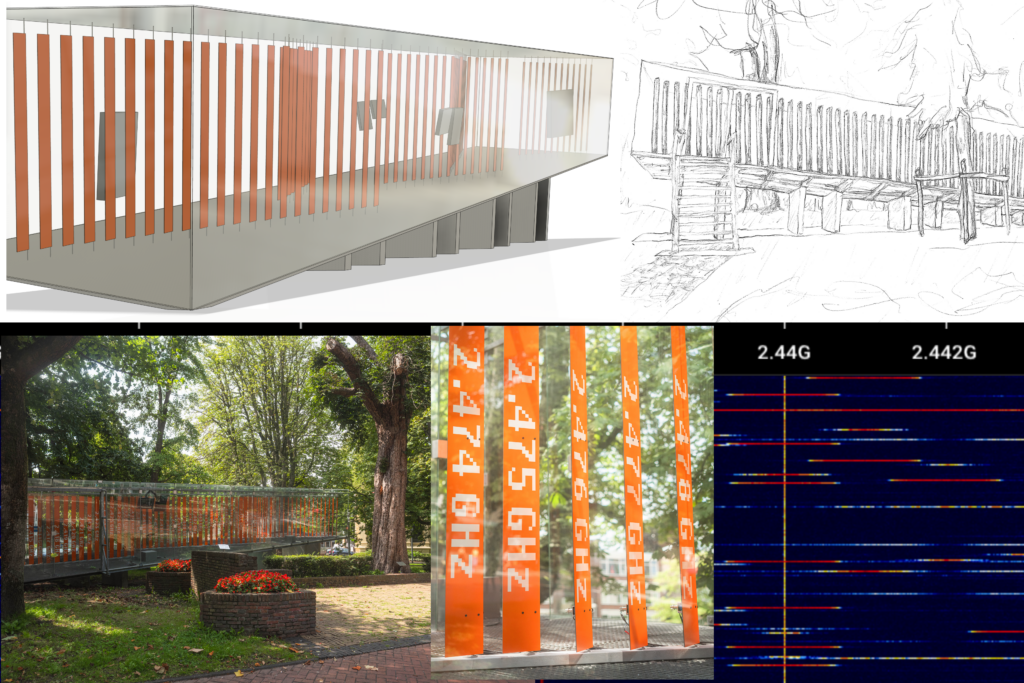
August 31, 2025 at Noorderlicht Biennale, Akerkhof 12, 9711 JB Groningen
Organisers
- Christy Westhovens
- Noorderlicht photography biennale
- critical infrastructure lab
- Kunstpunt Groningen
We constantly move through a sea of radio signals. Wi-Fi, Bluetooth, cell towers and satellites form an invisible landscape that permeates our everyday lives. These electromagnetic waves shape how we communicate, move and live together — and yet, we never see them.
With Signals of you, her installation at the Tschumipavilion, Christy Westhovens makes this hidden network tangible. The red panels respond to Bluetooth signals emitted by our devices, revealing how we continuously broadcast digital traces. The pavilion becomes an archive of daily presence, showing how infrastructure and behaviour together shape urban space.
The Radioscape Symposium offers a deeper exploration of this work. Bringing together artists, scholars and critical voices, we will reflect on how radio signals construct public space. What role do we play in these digital environments? Who has access to these invisible layers, and who is excluded? And what does it mean to render such ubiquitous but hidden signals visible?
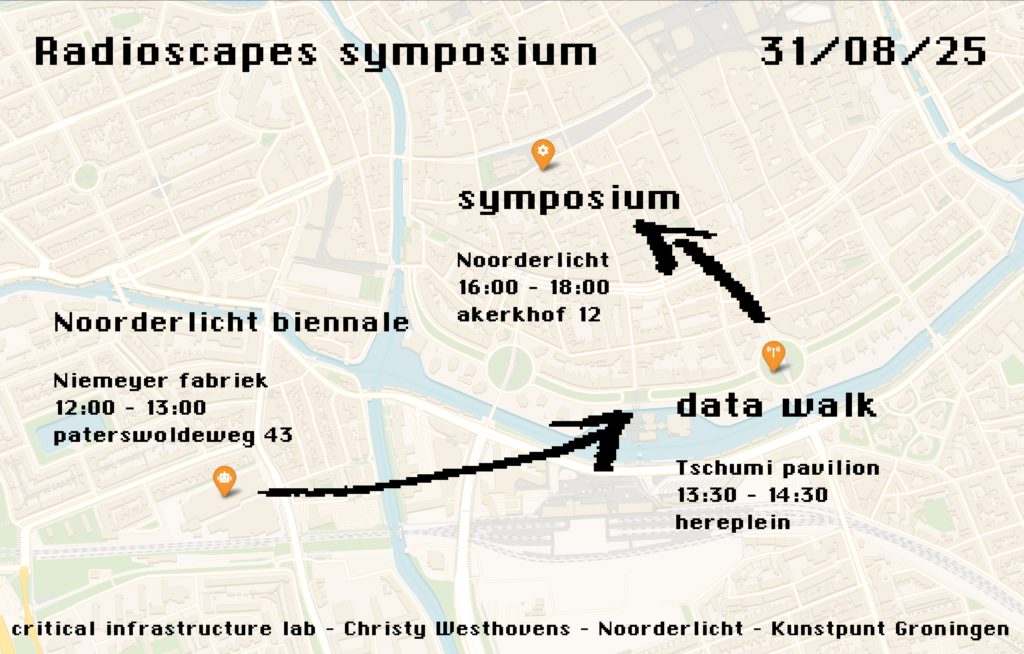
Programme
- 12:00—13:00 Visit: Noorderlicht Biënnale, Niemeyerfabriek, Paterswoldeweg 43, Groningen
- 13:30—14:30 Data walk and visit Signals of you, Het Tschumipaviljoen van Kunstpunt, Hereplein, Groningen
- 16:00—18:00 Symposium, Noorderlicht, Akerkhof 12, Groningen
- Introduction by Christy Westhovens
- Roundtable with artists, researchers and guests
- Discussion with Q&A
A manifesto has been released in conjunction with the event.
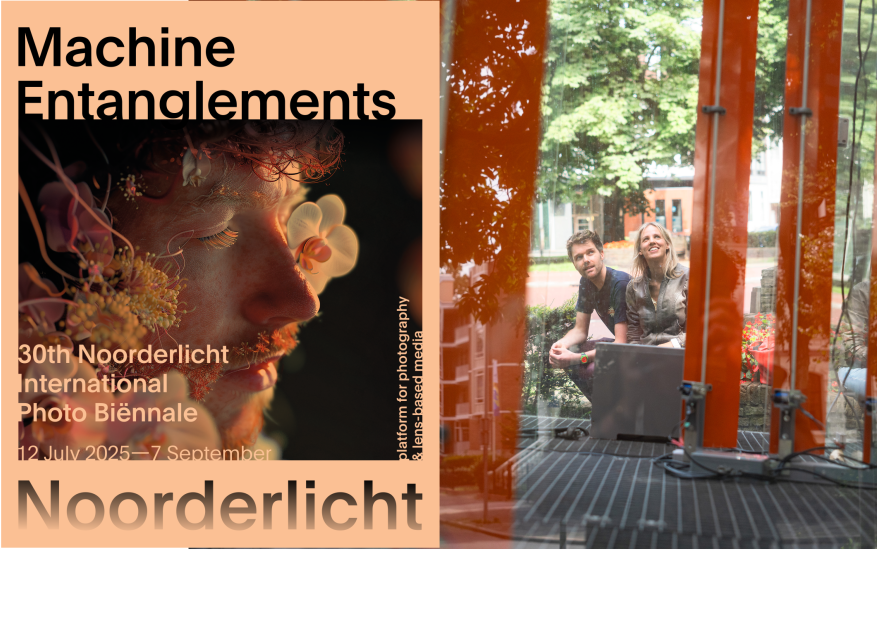
Photos by Sebastiaan Rodenhuis.
This program is made possible through funding of Mondrian Foundation, Fonds 21, Stimuleringsfonds voor Creative Industrie.
Lineup
- Arthur Elsenaar >> Artist and teacher at ArtScience Interfaculty,
Hogeschool der Kunsten Den Haag (KABK/KonCon)
- Christy Westhovens >> Artist and researcher, Technology, Performance and
Society research unit, University of Music and Theatre Munich (HMTM)
- David Gauthier — moderator >> Artist and Assistant Professor of
Computational Media and Arts, Utrecht University (UU)
- Gabriel Pereira >> Assistant Professor in AI & Digital Culture, University
of Amsterdam (UvA)
- Juli Laczkó >> Artist and teacher at HKU Media, Image and Media
Technology, Hogeschool voor de Kunsten Utrecht (HKU)
- Maxigas >> Co-principal investigator, critical infrastructure lab;
Assistant Professor of Computational Methods, Utrecht University (UU)
- Niels ten Oever >> Co-principal investigator, critical infrastructure lab;
Assistant Professor, European Studies, University of Amsterdam (UvA)
- Pawan Seshadri Venkatesh >> CTO, UrbanVind
Photos by Sebastiaan Rodenhuis.
# open call for fellows Become an infralab fellow for the 2025-2026 academic year! – deadline 15 August 2025
Become an infralab fellow for the 2025-2026 academic year! For fellows, we offer: an affiliation with the lab; participation in the (intellectual life of the) lab, the possibility to join us on lab research days; and have a space and platform to co-organize activities. We request that you join our reading groups, organize an activity, and (co-)author a paper with us. We welcome proposals from both researchers and practitioners at every stage of their career.
Submit a short statement of interest (max. three paragraphs) detailing your plan and motivation, and a resume to submission@criticalinfralab.net before 15 August.
# talk - presentation - panel Launch Event of the report ‘Standardisation with Chinese Characteristics? The Missing Pillar in Rebooting Europe’s Industrial Policy’ July 2025
We are pleased to invite you to the launch event of the report Standardisation with Chinese Characteristics? The Missing Pillar in Rebooting Europe’s Industrial Policy, commissioned by the China Knowledge Network (CKN), with the Ministry of Economic Affairs and Climate Policy as lead ministry.
The report explores the crucial yet often overlooked role of technical standardisation in European industrial policy. It argues for a more strategic orchestration of standard-setting by governments in cooperation with industry, offering a Blueprint for Action across five domains: (1) Programming; (2) Promoting; (3) Protecting; (4) Partnering; and (5) Process.
We are honoured to welcome lead author Alexandre Gomes to present the key findings. The presentation will be followed by a panel discussion with key stakeholders from government and industry. The event will conclude with a Q&A session with all participants, moderated by co-author Maaike Okano-Heijmans.The panelists will be announced soon.
Please note that a camera crew will record the presentation and the panel discussion. This video will be published online later on the CKN website. The Q&A will not be recorded, and only the authors and panellists will appear on video.
The report will be shared under embargo with the people that have registered, a day before the presentation.
We look forward to your participation in what promises to be a timely and forward-looking discussion on aligning European standardisation efforts with strategic industrial goals.
About the authors:
Alexandre Gomes is a Research Fellow at the Netherlands Institute for International Relations ‘Clingendael’ in The Hague, where he is part of the EU and Global Affairs Unit and of the ‘Geopolitics of Technology and Digitalisation’ programme. His research focuses on the role of technology in geopolitics.
Maaike Okano-Heijmans is a Senior Research Fellow at the Netherlands Institute for International Relations ‘Clingendael’ in The Hague, where she leads the ‘Geopolitics of Technology and Digitalisation’ programme. She is also a Visiting Lecturer in the Master of Science in International Relations and Diplomacy (MIRD) programme of the University of Leiden.
Miriam Sainato is a former Research Assistant at Clingendael’s EU and Global Affairs Unit, where she contributed to the Geopolitics of Tech and Digitalisation programme.
Niels ten Oever is an assistant professor in the European Studies department and co-principal investigator of the critical infrastructure lab at the University of Amsterdam. Additionally, he is a coordinator of the Tech, Power, and Policy theme group at the Amsterdam Centre for European Studies and a visiting professor at the Centro de Tecnologia e Sociedade at the Fundação Getúlio Vargas in Rio de Janeiro. His research focuses on how norms, values, and ideologies get inscribed, resisted, and subverted in communication infrastructures through their transnational governance.
Susann Lüdtke has an educationalbackground in China Business and Economics. She achieved her doctoral degree ineconomics and worked as a research fellow for Prof. Dr. Sebastian Heilmann atthe University of Trier and Prof. Dr. Doris Fischer at the University of Würzburg.Dr. Lüdtke was invited to Zhejiang University in Hangzhou (China) as a visitingscholar. After working as a consultant for the automotive industry, Lüdtke hasworked as a consultant for patent analytics and patent management since 2018. Dr.Lüdtke is frequently working as an external expert for projects on technicalstandards and quality infrastructure.
# talk - presentation - panel Brown Bag Session on Environment and Tech July 2025
We are at a critical threshold in our computational futures. Investment in artificial intelligence (AI) is booming, and its application across society is accelerating at an unprecedented scale. Meanwhile, we are crossing the boundaries of several life-supporting planetary systems. Devastating heat waves, storms, fires and floods remind us of how human activity impacts all life on this planet.
In this reality, a blossoming community is challenging the tech solutionist approaches from our political and industry leaders and advocates for actual change to ensure that our technologies stay within planetary boundaries. The Green Screen coalition is announcing a series of brown bag sessions to spotlight this work. We hope these sessions provide opportunities to discuss key topics on the nexus of environment and tech with experts, draw inspiration from their work, learn in the open and build pathways to sustainable futures.
Keep an eye on this page for new brown bag session
Upcoming brown bag sessions:
Extraction in the majority world: AI infrastructure and the raw materials that power it
July 7, 4 – 5 PM CET
On Zoom – Register now
In this session, Paz Peña will present on the work done together with the Decolonial Feminist Coalition of Latin American activists on Digital and Environmental Justice, with a particular focus on the environmental impact of data centers in the Latin American context, and Ahmed Isamaldin will discuss the organizing work he does with the Center for Environmental and Social Studies (CESS) on mining in Sudan.
About the speakers
Paz Peña is an independent senior consultant specializing in technology, gender, and social justice. She is a 2025 Mozilla Senior Fellow, currently researching the environmental impacts of artificial intelligence data centers in Latin America. In 2021, she founded the Latin American Institute of Terraforming to explore the connection between technology and the ecological crisis from a feminist perspective. Paz is the author of “Tecnologías para un planeta en llamas” (Paidós, 2023), an introductory book that examines the role of techno-capitalism in the climate and ecological crisis. She is also a journalist and holds degrees in social communication and gender studies. Paz is based in Santiago, Chile.
Ahmed Isamaldin is a multi-disciplinary artist and researcher from Khartoum, Sudan. He holds a degree in physics from the University of Khartoum and has studied graphic design, photography in Cairo, and visual communication at Weißensee Kunsthochschule Berlin. His work centers on themes of immigration, psychology, revolutionary processes, decolonial design, and technology. He is currently leading the communication team at the Center for Environmental and Social Studies (CESS) in Sudan.
# workshop Newsletter July 2025
To receive updates in your mailbox, you can sign up for our newsletter.
Read the past issues:
# event Building Thriving Digital Ecosystems: SDIA Progress Update & Regional Collaboration June 2025
SDIA in collaboration with the critical infrastructure lab is organizing an event on June 20th for the next chapter in our journey toward shaping thriving Dutch digital ecosystems — region by region.
Following our last event on operationalizing values in the Dutch digital infrastructure, we now turn our attention to building thriving digital ecosystems, ecosystems that are sustainable, transparent, and create positive local impact.
This event brings together regional policymakers, leaders, and innovators to showcase progress and concrete actions already underway, and to collaborate on next steps for digital ecosystems that benefit communities, businesses, and the environment.
Don’t miss this unique opportunity to join policymakers, IT infrastructure providers, and sustainability-focused customers in shaping the future of digital infrastructure in the Netherlands. Whether you’re a policy maker looking to stimulate regional development, a service provider aiming to gain competitive
advantage through sustainability, or a customer wanting to influence the market with your purchasing power – this event is for you.
June 20th 13:45 – 17:00
Sign-up here: https://www.sdia.io/events/thriving-digital-ecosystems-amsterdam
# talk - presentation - panel Mesh Networks Panel – How do we communicate when disaster strikes? June 2025
June 13 16:15 – 17:10
Western Europe is slowly coming to grips with the fact that all the digital infrastructures we depend on, may not be as dependable as we all thought. Network architectures come with their own infrastructural ideologies embedded in them. They are not just a medium for the circulation of digital messages, but also distribute power in particular ways. With the wars in Ukraine and Gaza intensifying, and the U.S. taking a more antagonistic approach than Europe had been used to, Europe is increasingly re-evaluating its choices with regards to our communications infrastructures.
Some community-led initiatives are gaining prominence that focus on implementing pilots or prototypes of mesh networks: communication infrastructures that are by design much more decentralised or federated than the centralised communications infrastructures we have become used to. Thereby pinpointing and highlighting key weaknesses in how we have come to depend on central providers that are not infallible. Perhaps it’s these mesh-type networks that are essential to becoming a more resilient society?
In this session, we hear from Radical Data and their mesh networks initiative, which participants of the conference can join themselves and experiment with. Next to that, Maxigas will describe the Reticulum protocol for building local and wide-area networks with readily available hardware, which comes with an anti-military licence and a bottom up user community also active in Amsterdam. It is an interesting example because of the attempt of its designers and users to embed social values into the technical choices of protocol design, implementation and deployment. Lastly, we learn about the Black-out Box, an initiative by Waag Futurelab which is part of the Meshtastic network, a network of hackers and organisations experimenting with a LoRa mesh-network that functions fully independent of the internet. And may be part of an emergency network in case all else fails.
Speakers
Rayén Jara Mitrovich, Performance Artist | Co-founder of Radical Data
Jo Jara Kroese, Co-founder of Radical Data
Marleen Stikker, Founding Director Waag Futurelab
https://conference.publicspaces.net/en/session/mesh-networks-1
# workshop Data Walk Workshop May 2025
May 12-13, 2025 at Utrecht
The purpose of the two day workshop is to bring together scholars and artists who have each engaged in developing data walks or similar projects, in order for them to reflect on the phenomena of data walks as a methodological approach to data power and critical infrastructure studies. The two day workshop will have space and time to explore the city of Utrecht, engage with like minded participants, and conduct a collective experiment in data walking resulting in a report/fanzine. The first day is dedicated to getting to know each other and exchanging perspectives in “show and tell” style presentations of prior work and the state of the art. The second day is for devising and conducting a collective experiment in data walk as a method. After the walk we discuss the experiment and document it in the form of a report/fanzine, with the help of facilitators in spontaneous experimental publishing.
The workshop is organised by the critical infrastructure lab, Institutions for Open Societies’ Open Cities research platform and the Data School, with [urban interfaces] at Utrecht University.
# workshop Reflections on Europe Day – interview with Niels ten Oever May 2025
‘Unequal societies will produce technologies that will reproduce inequalities’
Why do we give creative tasks to a technology that is statistically trained to give you the most mediocre answer? This question, posed by Dr. Niels ten Oever, one of the leaders of the ACES Theme Group Tech, Power, and Policy, sets the tone for a wide-ranging and critical conversation about Europe’s technological trajectory. To mark Europe Day on May 9th, ACES spoke with him about the Europe’s digital challenges the politics of infrastructure, and the values at stake in the continent’s technological future.
Read the entire interview here.
# news Celebrating Earth Day 2025: Innovations from the Internet Society Foundation’s Research Grant Program April 2025
The critical infrastructure lab was an Earth Day feature by our funder, the Internet Society Foundation, as a project that is helping shape a more sustainable future by building a greener Internet and using technology to address environmental challenges.
Read the entire post here.
# talk - presentation - panel The Digital and Analog Ramifications of AI at the Milton Wolf Seminar on Media & Diplomacy April 2025
Much attention has been given to the ways that AI threatens to supersede human intellectual processes and functions. AI, however, is driven by large language models and very real material resources. Almost every resource on the planet is fueling the AI juggernaut, with consequences for the power grid, nuclear energy, political structures, the production, trade, and trash of physical devices, human labor, and financial systems. The fast pace of AI’s technological advancement appears not so much to be leaving the materially tied world behind but feasting upon it. Panelists in this session will discuss such questions as: What is the reality behind the rhetoric of AI? What are the current and potential political and economic solutions to ameliorating AI’s role in the global system? What is the role of the media, diplomats, corporations, and activists in these decisions?
- Fieke Jansen, Head of the Critical Infrastructures Lab, University of Amsterdam
- Sandra Makumbirofa, Senior Researcher, Research ICT Africa
- Viola Schiaffonati, Professor, Politecnico di Milano
- Thomas Schneider, Director of International Affairs, Swiss Federal Office of Communications
Moderator: Kevin Blasiak, Postdoctoral Researcher, Vienna University of Technology
More here.
# talk - presentation - panel AI and Function Creep in the Policing of Public Space March 2025
Exploring how AI technologies reshape the boundaries of public space and security.
Organised by: Florence School of Transnational Governance
How does AI reshape the policing of public space, and what are the democratic risks of automation in law enforcement? This webinar explores the expanding role of AI in surveillance, predictive policing, and crowd control, raising urgent questions about function creep and its impact on civil liberties. Join us for a critical discussion with Gabriel Pereira, Linnet Taylor, and Fieke Jansen on the intersection of AI, policing, and democratic rights.
Speakers:
• Fieke Jansen (Critical Infrastructure Lab)
• Linnet Taylor (Tilburg University)
• Gabriel Pereira (University of Amsterdam)
Moderator: Stefania Milan (EUI)
Fieke Jansen is a postdoc researcher and a co-principal investigator with the critical infrastructure lab at the University of Amsterdam. Fieke’s research interest is to understand how the material impact of expanding infrastructures are shaping the management, distribution, and depletion of natural resources.
Gabriel Pereira is Assistant Professor in AI and Digital Culture at the University of Amsterdam (UvA), based at the Media Studies department and the Institute for Logic, Language and Computation (ILLC). His research focuses on critical studies of data, algorithms, and digital infrastructures, particularly those of algorithmic surveillance. www.gabrielpereira.net
Linnet Taylor is Professor of International Data Governance at the Tilburg Institute for Law, Technology, and Society (TILT). Her research focuses on digital data, representation and legitimacy, with particular attention to transnational governance issues. She led an ERC project on Global Data Justice (2018-23), aiming to develop a social-justice-informed framework for governance of data technologies on the global level.
Stefania Milan collaborates with the Chair in AI & Democracy at the Florence School of Transnational Governance (European University Institute). She is Professor of Critical Data Studies at the University of Amsterdam, and a Faculty Associate at the Berkman Klein Center for Internet & Society (Harvard University).
Register here.
# talk - presentation - panel The EuroStack Initiative: Digital Sovereignty in Europe March 2025
Join the new ACES theme group “Tech, Power, and Policy: Europe’s Strategic Balancing Act” for a roundtable discussion on the EuroStack Initiative.
The idea of the Eurostack gained traction after a conference at the European Parliament last year, followed by a pitch-paper from a group of contributors including Cristina Caffarra. The conversation now continues with a report by Francesca Bria, Fausto Gernone, and Paul Timmers. The latest report offers an analysis of Europe’s current technological dependencies and provides a vision for building an alternative European digital technology stack. The authors advocate for an industrial policy to realise the EuroStack components in order to achieve increase digital sovereignty. This proposal comes at a time when the US administration and digital tech oligarchs openly push back on Europe’s regulatory autonomy and European values.
Based on these proposals, there will be a discussion about Digital Sovereignty, the merits of the proposals, and the risks and challenges that lie ahead. Some of the challenge lies in managing interdependence, striking a delicate balance between maintaining global connectivity and open digital markets while safeguarding Europe’s strategic interests and values. The group will ask whether it is possible in geopolitically unstable times to produce a coherent technology policy map, and how this could integrate industrial, digital, and competition strategies.
UvA employees may register here.
Opening talk
- Zuzanna Warso (Open Future; Fellow, Critical infrastructure lab, UvA) – ‘Digital Public Infrastructure and the digital sovereignty we need’
Panellists
- Jamal Shahin (European Studies, UvA)
- Kristina Irion (Institute for Information Law, UvA)
- Nora von Ingersleben-Seip (RegulAIte, UvA)
Moderator
- Niels ten Oever (Critical infrastructure lab, UvA)
# talk - presentation - panel 122th meeting of the Internet Engineer Task Force March 2025
Meeting of the working group on Human Rights Protocol Considerations (HRPC) of the Internet Research Task Force at IETF 122, Bangkok
2025-03-21 1500-1630 local time
Sofia Celi and Mallory Knodel, co-chairs
Agenda:
– Welcome and Introduction: Intro and Note Well – 10 min
– IPV draft – Sofia Celi – 10 min
– Talk: “Indigenous 5G in India: On an Alternative Technological Trajectory” – Maxigas, critical infra lab – 30 min
– Talk: “Ethics in Digital Public Infrastructure” – Anita Gurumurthy, IT for Change – 30 min
All other RG business – remainder
# interview Deciphering AI Water Consumption: How Amazon Hides How Much Water Its Cloud Consumes in Spain March 2025
In the last few years Spain has become an appealing destination for big tech companies willing to expand its physical infrastructures. Amazon Web Services (AWS), one of the world’s leaders on cloud computing and AI services, is in many senses acting as an advance. In 2022 it started to operate three new data centers in the northeast Spain through a hub that will grow into its biggest cloud region in south Europe by 2030.
While internet giants like AWS make big efforts to promote their environmental commitments with the communities where they operate, opacity keeps surrounding their use of natural resources to run their server farms. One of them, the water used for cooling down servers, is of special concern in Spain, a land in the midst of a climate emergency due to recurrent periods of droughts.
The following report, published in EL PAÍS, reveals undisclosed data and new information about the water usage and the environmental footprint of AWS facilities in Spain. It also sheds light on the lack of real accountability mechanisms by public authorities responsible to monitor these investments and its costs for the territories where new data centers are built.
Read the article here.
Descifrando el consumo de agua de la IA: así oculta Amazon cuánto bebe su nube en España
La regulación no obliga a las empresas a informar sobre los recursos usados en sus granjas de servidores. Datos obtenidos por EL PAÍS permiten estimar cuánta agua utiliza una de las instalaciones de AWS en Aragón
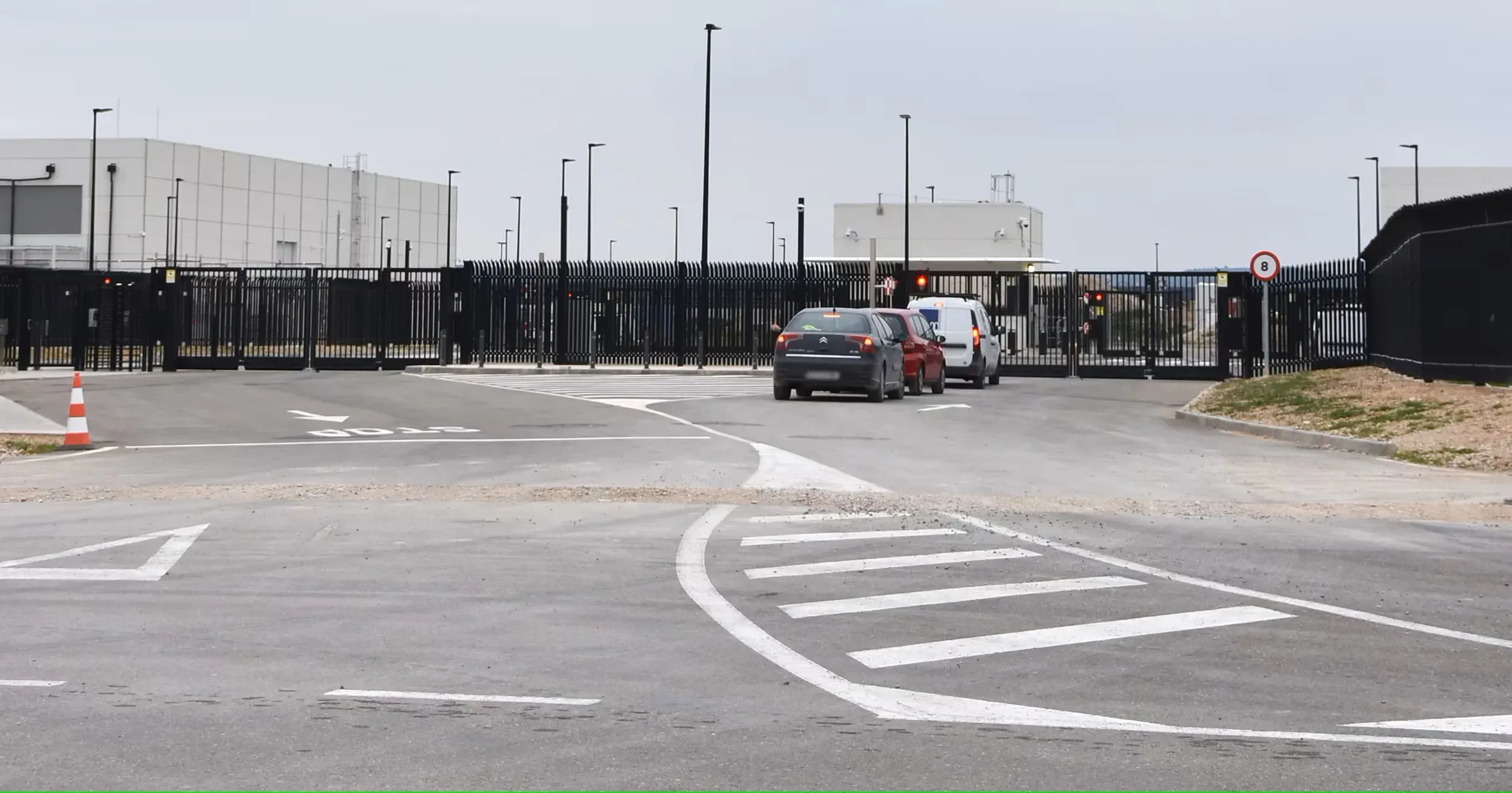
El aspecto exterior de cualquiera de los tres centros de datos que Amazon Web Services (AWS) opera en España desde 2022 es el propio de una base militar. Una primera valla de varios metros de altura con postes y cámaras de vigilancia protege cada una de estos complejos. Una segunda, ya dentro del recinto, confirma la sensación de seguridad extrema que rodea a estos edificios repletos de servidores.
Hace ahora dos años que Amazon, a través de su filial de servicios de computación AWS, abrió en España su primer clúster (agrupación de empresas) regional en el sur de Europa. En total, tres centros de datos separados por menos de 80 kilómetros en las provincias de Zaragoza y Huesca. En mayo pasado la empresa anunció sus planes para ampliar los tres complejos y añadir otros dos a su red, mediante un megaproyecto que la tecnológica estadounidense considera clave para su negocio global.
Pero la carrera por entrenar, alojar y ejecutar modelos de inteligencia artificial (IA) cada vez más grandes tiene un precio. Las enormes infraestructuras que los gigantes de internet se están apresurando a construir requieren unas cantidades de recursos inéditas. Entre ellos sobresale la energía, pero en contextos climáticos como el español también preocupa el uso intensivo de agua. Unos impactos medioambientales en torno a los que cada vez más voces están emitiendo señales de alarma.
Sin embargo, poner cifras a ese impacto es una tarea ardua. Las grandes tecnológicas no informan sobre cuánta energía y cuánta agua usan en sus diferentes centros de datos repartidos por el planeta. Tampoco lo hace AWS para sus complejos en los municipios aragoneses de El Burgo de Ebro, Villanueva de Gállego y Huesca.
Con el ánimo de ofrecer una foto realista de cuál es hoy la huella medioambiental de este sector en plena expansión, durante varios meses EL PAÍS ha solicitado a diferentes administraciones datos sobre la sostenibilidad de los centros de AWS en Aragón en su primer año de vida. Las respuestas obtenidas y las fuentes consultadas en esta investigación reflejan la opacidad que rodea a una industria millonaria y sedienta de recursos. Pero también la falta de mecanismos por parte de las autoridades para fiscalizar al sector privado.
Agua de abastecimiento público
Por su aspecto exterior parece que los centros de datos de Amazon en Aragón quisieran pasar desapercibidos. Aunque el tamaño de sus edificios los delata fácilmente, ninguno cuenta con grandes carteles con el nombre o el logo en forma de sonrisa que identifica a la empresa.
Ubicados en polígonos industriales con amplias parcelas vacías, los centros de El Burgo, Villanueva y Huesca cuentan con una estructura parecida hecha por grandes naves. Junto a estos edificios, que alojan a los servidores, están adosados varios tanques plateados. Dentro de ellos se almacena el agua, un elemento crítico para su buen funcionamiento.
Demasiado calor en las tripas de un centro de datos puede provocar el sobrecalentamiento de los ordenadores y un fallo en los equipos. Para evitarlo, AWS utiliza ventiladores que captan el aire del exterior y lo impulsan hacia el interior del complejo. En climas como el de Aragón el problema está en las altas temperaturas de los meses de verano, cada vez más sofocantes.
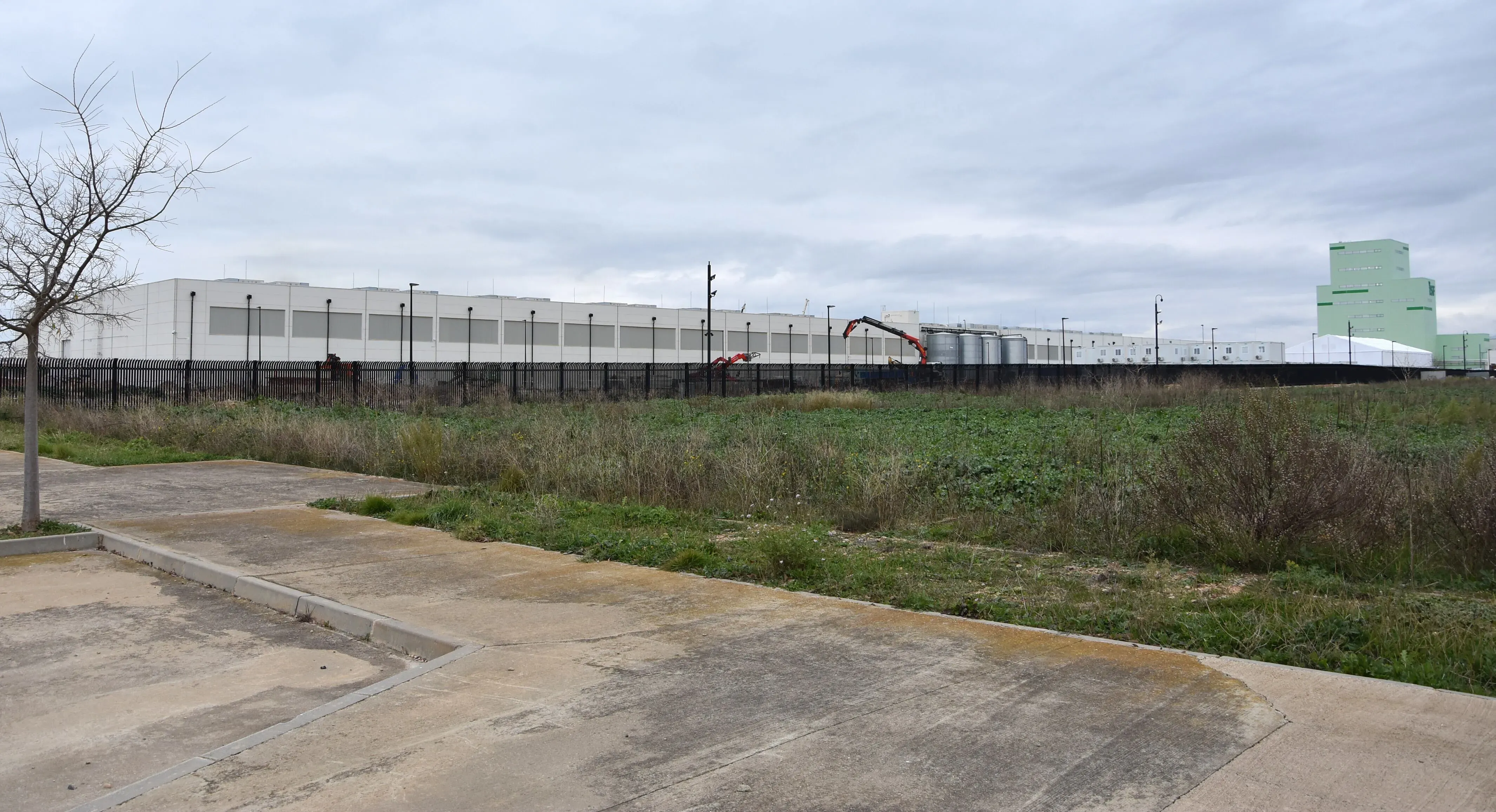
Según la documentación de la empresa, cuando en el exterior se superan los 29.4 grados se hace imprescindible activar el sistema de enfriamiento por evaporación de agua. Es entonces cuando por las tuberías de estos centros corren litros de agua tratada que llegan hasta los ventiladores responsables de la climatización. Desde su encendido en noviembre de 2022, los tres complejos están conectados a la red de abastecimiento municipal de agua potable.
A través de la ley de transparencia EL PAÍS ha solicitado a los tres municipios datos sobre la evolución reciente en el consumo de agua industrial. Únicamente el consistorio de Huesca ha ofrecido cifras. Desde el inicio de operaciones del centro de AWS, el consumo hídrico para uso industrial en la capital oscense ha aumentado anualmente en 62 millones de litros (62.000 metros cúbicos), según los datos obtenidos por este diario.
Una cifra superior a las estimaciones que la empresa publicó en los informes previos a su construcción, que pronosticaban un uso de 36 millones de litros anuales. El padrón municipal que recoge el volumen de agua para uso industrial no discrimina entre los clientes conectados a la red. Pero las fuentes locales consultadas confirman que en el periodo analizado (2021 a 2023, último año con datos) AWS fue la única industria intensiva en uso de agua que se instaló aquí.
“Un clavo más en el ataúd”
¿Son estas cifras elevadas para un territorio como Aragón? Ricardo Aliod es investigador en la Fundación Nueva Cultura del Agua. Cuando se le enseñan los datos, este experto los pone en contexto frente a otras industrias muy presentes en estas tierras, como la porcina, muy demandantes de agua. O frente a cultivos agrícolas muy comunes aquí como la alfalfa y el maíz.
“Este aumento supone un uso elevado respecto a los usos urbanos. (…) Pero las cifras palidecen frente al regadío”, asegura. A continuación deja claro que cualquier uso nuevo es un problema en un territorio en situación de alto estrés hídrico, según los criterios de la UE. “Estamos consumiendo más agua de la que disponemos. Así que cualquier uso de consumo nuevo es un clavo sobre el ataúd. Es una nueva presión”, advierte.
Con todo, estos datos son solo una pequeña aproximación a cuál puede ser a día de hoy la huella hídrica real de estos centros. Las cifras obtenidas sólo corresponden al agua usada para refrigeración, pero no contemplan por ejemplo cuánta agua se utiliza para la producción de energía que precisan.
Otro punto clave ayuda a entender la dificultad para conseguir información de primera mano en torno a estas infraestructuras. Desde su aterrizaje en Aragón, AWS ha exigido a las diferentes administraciones con las que trabaja la firma de estrictos acuerdos de confidencialidad, según reconocen varios cargos públicos de la región. La firma de estos documentos es una práctica muy extendida entre las tecnológicas estadounidenses, que en ocasiones incluso impide conocer la verdadera identidad de la empresa detrás de los proyectos.
Una regulación europea en curso
EL PAÍS también ha llamado a la puerta de otras administraciones en busca de respuestas. El pasado año la Comisión Europea aprobó, como parte de su directiva de eficiencia energética, un reglamento específico sobre estas infraestructuras. La norma insta a las empresas del sector a aumentar su transparencia y pide a los Estados miembros que recopilen, directamente de los operadores, datos sobre sostenibilidad. Como su consumo total de agua o el porcentaje de fuentes renovables sobre el total de energía usada.
Sin embargo, ante una solicitud dirigida al Gobierno español para acceder a estos datos sobre las instalaciones de AWS, desde el Ejecutivo aseguran no contar con esta información. Y remiten la petición a las autoridades comunitarias. A su vez, desde el dirección general de Energía de la Comisión esgrimen el carácter confidencial de estos datos y los “intereses comerciales” en juego para no hacerlos públicos.
Este departamento trabaja hoy en la creación de una base de datos europea con la información aportada por las compañías. Grupos ecologistas han criticado que en la práctica las empresas no están hoy obligadas a ofrecer esta información, señala Fieke Jensen, investigadora de la Universidad de Amsterdam. Y que además es responsabilidad de cada Estado el nivel de transparencia que se aplica a un sector en pleno crecimiento y sobre cuyo impacto la propia Comisión ha mostrado su preocupación.
Así, estados como Países Bajos cuentan ya hoy con una plataforma pública que permite acceder a los datos aportados voluntariamente por las empresas. España carece a día de hoy de una plataforma de este tipo. Fuentes del ministerio de Transición Ecológica, a preguntas de EL PAÍS, no aclaran si está entre los planes del Ejecutivo crear un portal similar.
Jensen añade un punto más para explicar las limitaciones de esta normativa. Cuando esté disponible la base de datos europea publicará datos agregados a nivel país, pero no el detalle sobre el consumo de recursos en una región concreta. Lo cual impedirá usar esta información “para crear y discutir sobre políticas locales o nacionales”, opina. “Si se publicara por ejemplo cuánta energía consumen todos los centros que hay en Ámsterdam, se podría abrir un debate público sobre el tema”.
Garantías ante un escenario límite
A apenas 20 minutos del centro de Zaragoza está el polígono de El Espartal (El Burgo). Aquí se ubica uno de los centros de Amazon en Aragón. Un trajín constante de obreros y maquinaria se mueve hoy alrededor del recinto. Detrás de las dos naves ya activas se está levantando un nuevo edificio con varios tanques anexos de gran tamaño.
En julio pasado AWS pidió al Gobierno autonómico permiso para “modificar la estrategia para la gestión del agua” en sus instalaciones. Estos cambios suponen ampliar la capacidad de los tanques de agua. Desde estas torres, que en El Burgo se han trasladado a una nueva ubicación, viaja hasta las unidades de refrigeración de aire en los meses más calurosos.
Para justificar estos cambios AWS reconoce que “el cambio climático provocará unas condiciones medioambientales cada vez más variables y extremas” en este territorio. Y que por tanto se hace imprescindible “reducir la dependencia” del suministro público ante contextos de escasez.
Una de las preguntas que sobrevuelan el megaproyecto de Amazon es qué ocurrirá en periodos de falta persistente de lluvias. “En tiempos de sequía, ¿a quién, de quién y de dónde se van a detraer los caudales necesarios para alimentar estas instalaciones?”, preguntó en junio pasado el diputado autonómico de Izquierda Unida Álvaro Sanz a la consejera de Economía.
Varios meses después Sanz asegura a EL PAÍS que todavía no ha obtenido una respuesta del Ejecutivo y critica la falta de “estimaciones serias de caudal y de las necesidad de abastecimiento de estos centros”. Tampoco, añade, de los acuerdos firmados con la empresa para garantizar los suministros en todo momento. “No se está haciendo ningún análisis serio de las necesidades de recursos ambientales que esto supone”, advierte.
Ante el evento de una hipotética sequía prolongada, fuentes del Gobierno aragonés, responsable de los permisos medioambientales del proyecto, descargan la responsabilidad de marcar las restricciones pertinentes sobre los ayuntamientos. Por su parte, desde el consistorio de Huesca —único municipio que ha respondido a las preguntas de EL PAÍS— mantienen que el suministro de agua está “asegurado” gracias a las mejoras hechas en los últimos años en la red.
Los representantes de AWS en España no han respondido a la pregunta de si los centros adaptarán su funcionamiento o tomarán alguna medida excepcional ante un escenario de este tipo. Tampoco han ofrecido datos relacionados con la sostenibilidad de sus complejos desde el inicio de operaciones.
Aurora Gómez es la impulsora de Tu Nube Seca Mi Río, un grupo activista que nació como respuesta al centro que la multinacional Meta planea construir en Castilla-la Mancha. Junto a varias entidades ecologistas más este colectivo presentó en enero una lista de alegaciones a la expansión del clúster aragonés de Amazon. Criticando, entre otros puntos, las elevadas necesidades de recursos expresadas por la compañía, pero también las dificultades para acceder a datos independientes sobre sus usos.
“Nos están negando el acceso a la información”, apunta Gómez. Para esta activista existe una “intencionalidad clara” en el cerrojo informativo que aplican las grandes empresas del sector, el cual dificulta la implicación de la sociedad civil en el debate. “Si no hay una ciudadanía informada no se puede actuar”, sentencia.
# workshop Operationalizing Values in Dutch Digital Infrastructure February 2025
Join the Sustainable Digital Infrastructure Alliance for their upcoming event on operationalizing values in Dutch digital infrastructure. Building on our successful first get-to-together, we’re bringing together providers and purchasers to showcase real progress in implementing sustainability, transparency, and local impact in the digital infrastructure market.
Through debates, an interactive workshop and case studies, you’ll gain practical insights from market leaders who are already benefiting from this shift. Whether you’re a regional provider looking to gain a competitive edge or a purchaser wanting to shape a more sustainable market, this event offers concrete steps to transform your organization.
Don’t miss this opportunity to be part of a growing community that’s actively reshaping the digital infrastructure landscape in the Netherlands. Together, we’ll explore how transparency, sustainability, and local impact can become foundational market values.
We are organizing this event in collaboration with the critical infrastructure lab.
Date: February 25th
Time: 13.45 – 18.00
Registration required
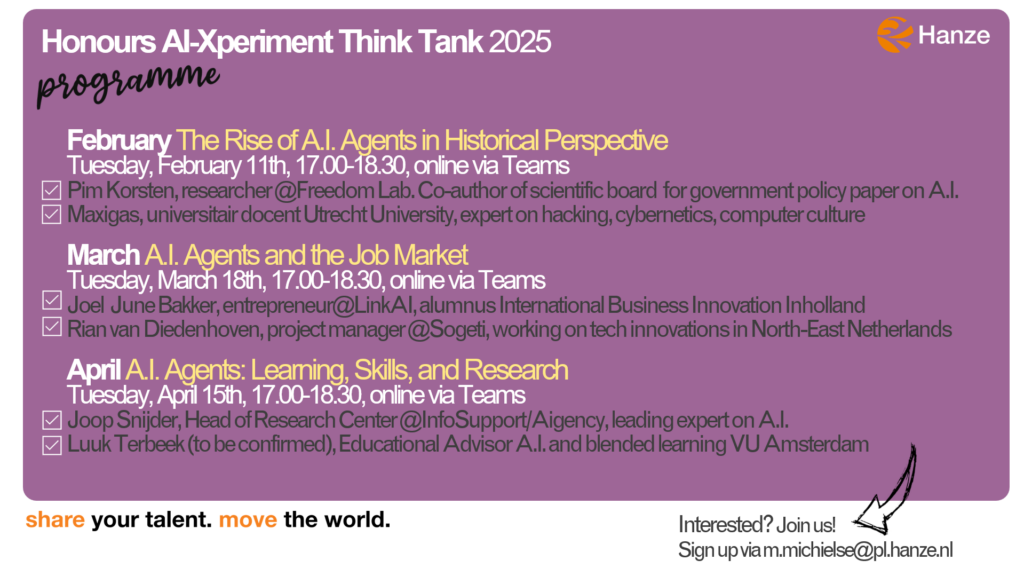
# talk - presentation - panel The Rise of A.I. Agents in Historical Perspective February 2025
Guest speaker(s):
- Pim Korsten: Researcher at Freedom Lab. Co-Author of a key working paper on A.I. in historical perspective, written for the Dutch Scientific Board for Government Policy.
Background in philosophy and economics.
https://www.freedomlab.com/team-members/pim-korsten - Maxigas: International expert on hacking, cybernetics, computer culture, and old social media. Universitair Docent Universiteit Utrecht.
Has a critical perspective on the current hype around A.I. and can help us think critically about the promised autonomy of these supposedly new A.I. systems.
https://www.uu.nl/staff/PDunajcsik
Topics we explore in this session:
– What are A.I. Agents? What is happening with the hype around A.I. Agents currently? What does it mean to have computers act autonomously? Is this problematic or dangerous?
– How new is this idea of autonomous intelligent computers? What has happened in the past around smart computer technologies? What kind of previous technologies have existed that are comparable?
– What kind of issues around inclusion/diversity/sustainability might we want to be critical about when it comes to the current hype around A.I. Agents?
# infrastructure walk data center walks and infrastructure walks February 2025
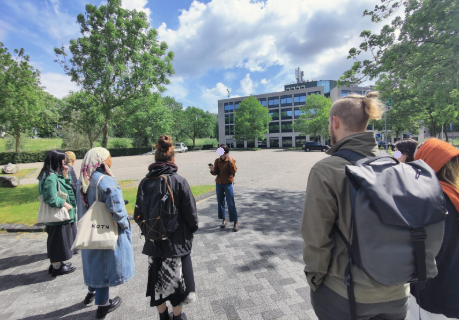
Join us for amateur exploration into the visibility of wireless equipment and services dotted around the city! We collectively map, observe and measure the techno-diversity of digital infrastructure in urban spaces. Data and infrastructure walks are a creative method and a social practice, which can be used to reflect on data power through critical infrastructure studies. It serves a variety of purposes, from public engagement, education, and artistic research to empirical studies.
Data center walks
We started data center walks with a simple question about how to make the invisible visible. People tend to forget about the infrastructure that lies beneath the data. For instance, the cloud remains a concept reduced to a depiction of a cloud, stripping data from its materiality. We usually do not see data centers, nor do we think about them in a material sense. By taking groups into data centers with us, we explore the resources, politics, and human labor that sustains them. To do so, we walk around and inside the data centers, observing physical traces as well as user-generated information online.
Infrastructure walks
We hold a series of “infrastructure walks” in Amsterdam and Berlin, exploring the visibility of digital infrastructures deployed in public spaces. The experience allows us to uncover data flows and to study datafication in urban areas. By engaging with the infrastructures around us, we seek to expose reconfigurations of power relations in the city through emerging technologies and protocols. Infrastructure walks address the question of what media technologies may mean “after all”, that is in the context of the life world, lived experiences and action possibilities of end users as embodied citizens. Insights can countermap the spatial control exercised through the electromagnetic spectrum in urban spaces. Often, us and the groups find that infrastructures should be (1) noticeable, (2) observable, (3) contestable or programmable to their users.
Upcoming walks and related events: Data Walk Workshop: Sensing Digital Materiality in Urban Public Spaces
Walking the infrastructure walk and dancing the frequency dance — You only see it when you get it
# project mud batteries and regenerative infrastructures February 2025
Living Infrastructures and Organic Data Centers: Toward Ecological and Post-Extractive Computing
The environmental costs of computation have become impossible to ignore. Data centers, AI models, and communication infrastructures demand vast amounts of energy and minerals, intensifying extractive relations with both human and nonhuman worlds. In response, sustainability discourses in the technology sector promise greener energy, circular economies, and digital efficiency. Yet these solutions remain anchored in the same paradigm of accumulation that drives the ecological crisis in the first place.
In our lab, we take a different approach. We explore how computing might be reimagined from the ground up—literally—by engaging with living materials such as soil, microbes, and kombucha SCOBYs. These experiments aim not to optimize computation, but to decenter it, to ask what infrastructures might emerge when we take ecological entanglement rather than extraction as a design principle. On this page you will find impressions of our experiments.
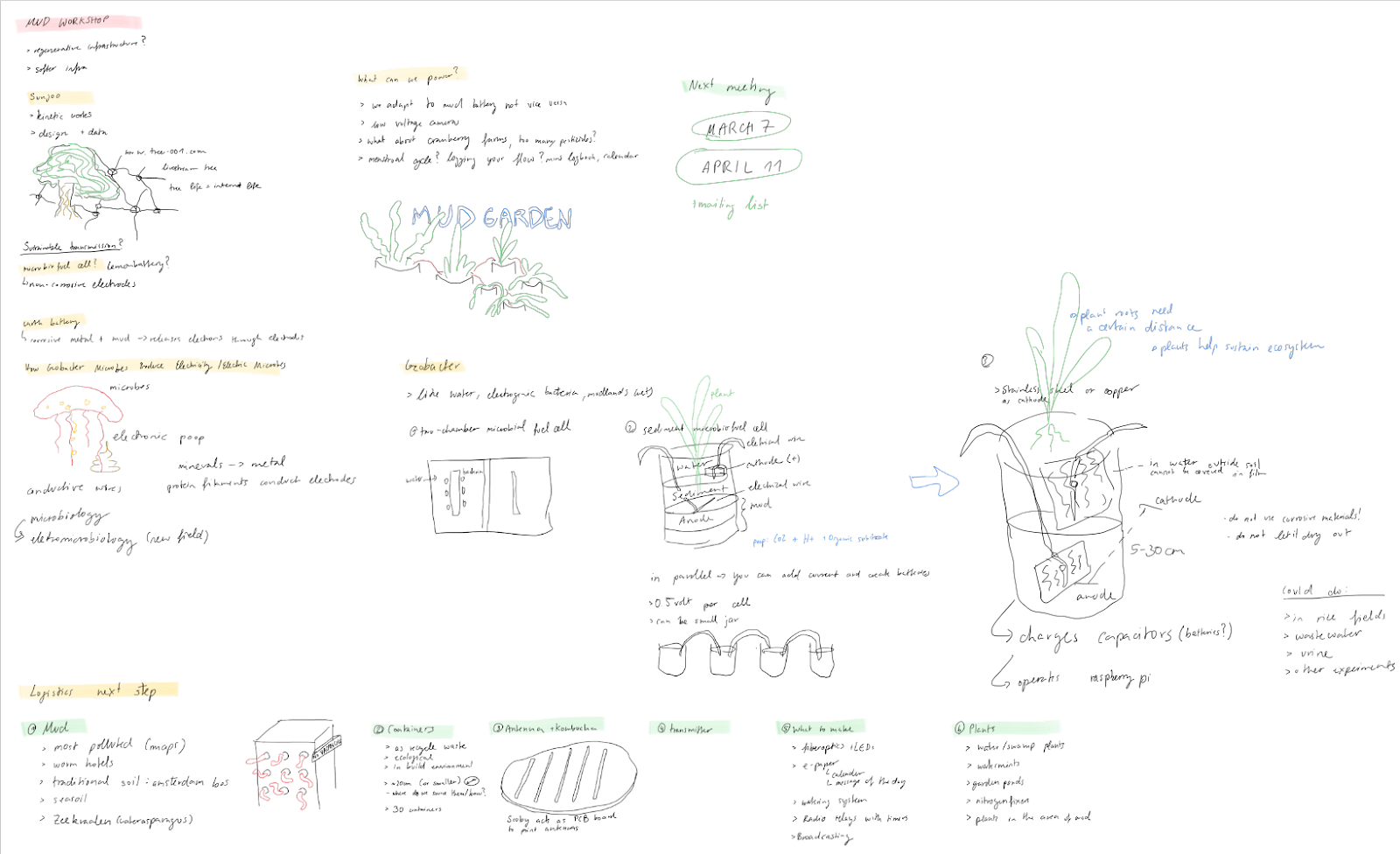
Biological Power: Mud and Microbial Batteries
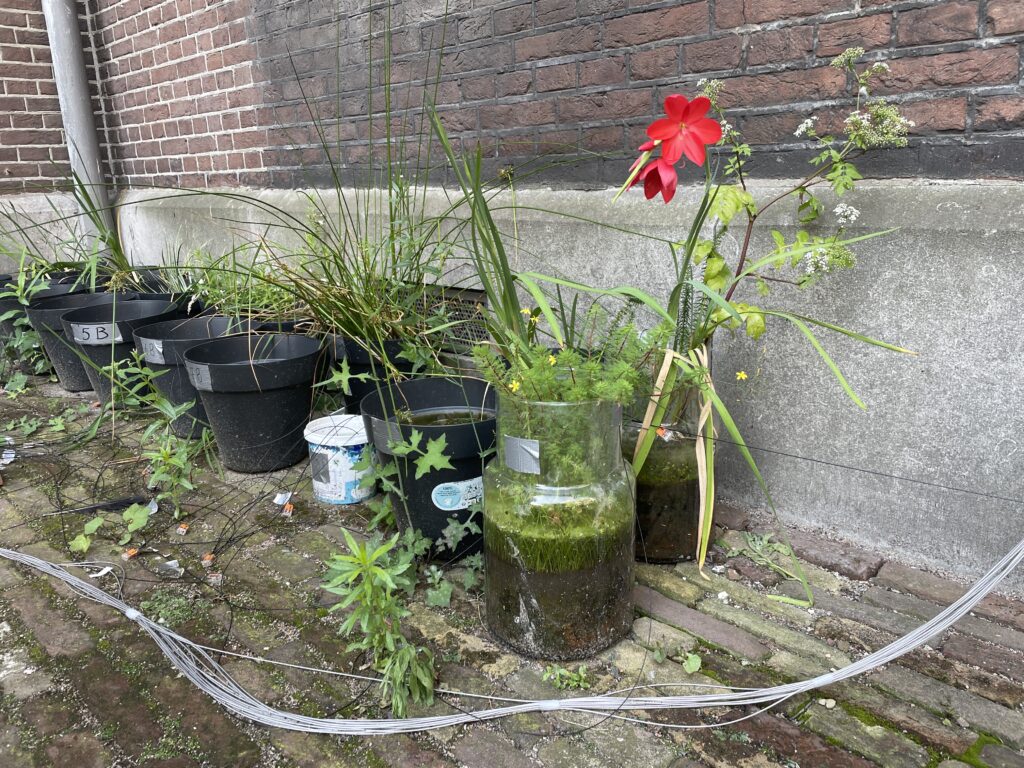
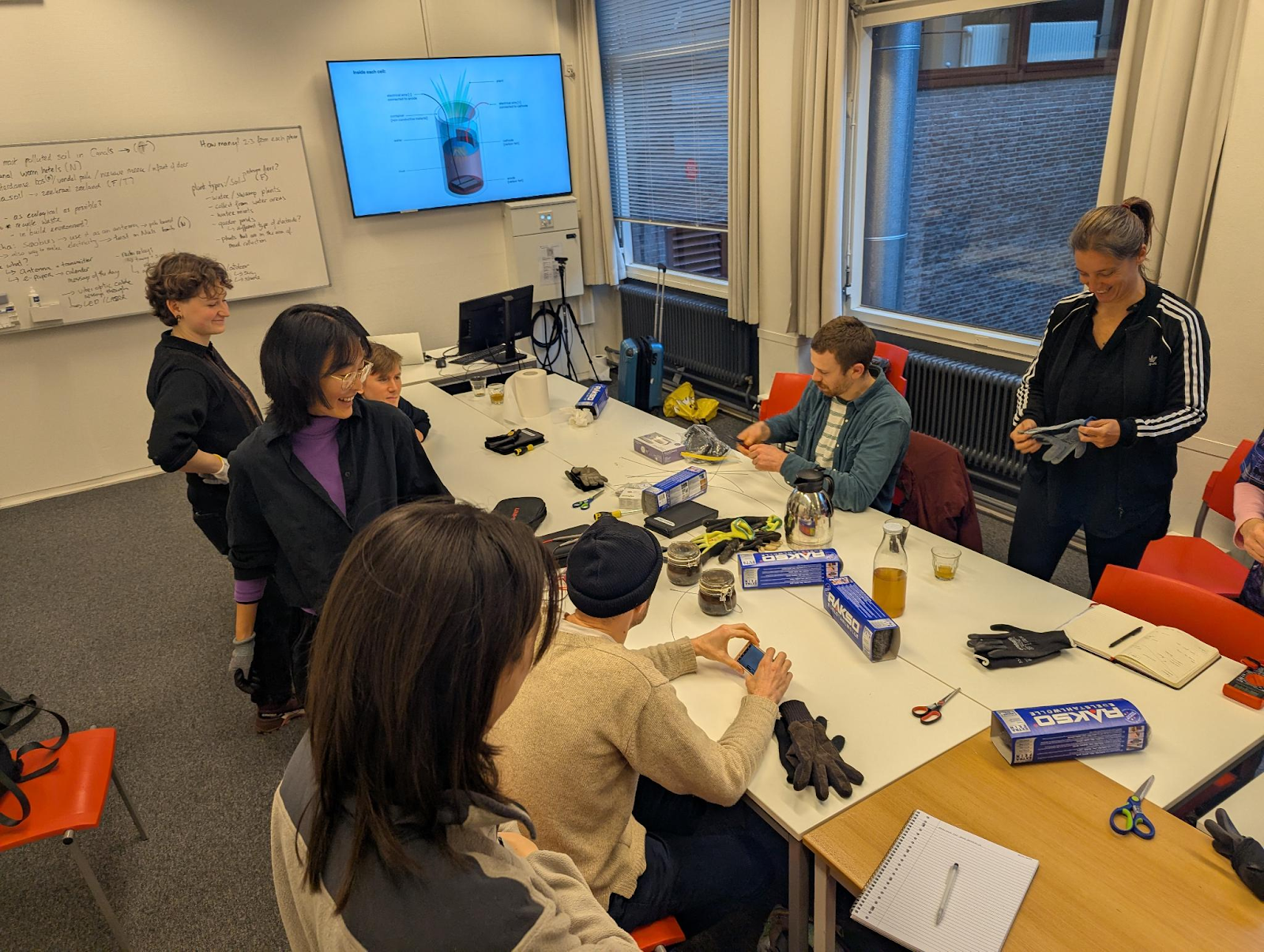
Together with artist Sunjoo Lee, we created an electrical gardan on the docks of the UvA. A series of mud batteries generate electricity through microbial fuel cells. These cells capture electrons produced by anaerobic bacteria in wet soil as they metabolize organic matter. The voltage is minimal—often between 0.3 and 0.7 volts per cell—but continuous, depending on the vitality of the microbial community. The continuous fluctuations in energy intensity sparked our curiosity — beyond the idea of mud as a power source — toward a space where voltage itself becomes an organic expression of computation. The soil thus becomes both the site and the medium of computation: energy is produced only as long as the ecosystem remains alive.
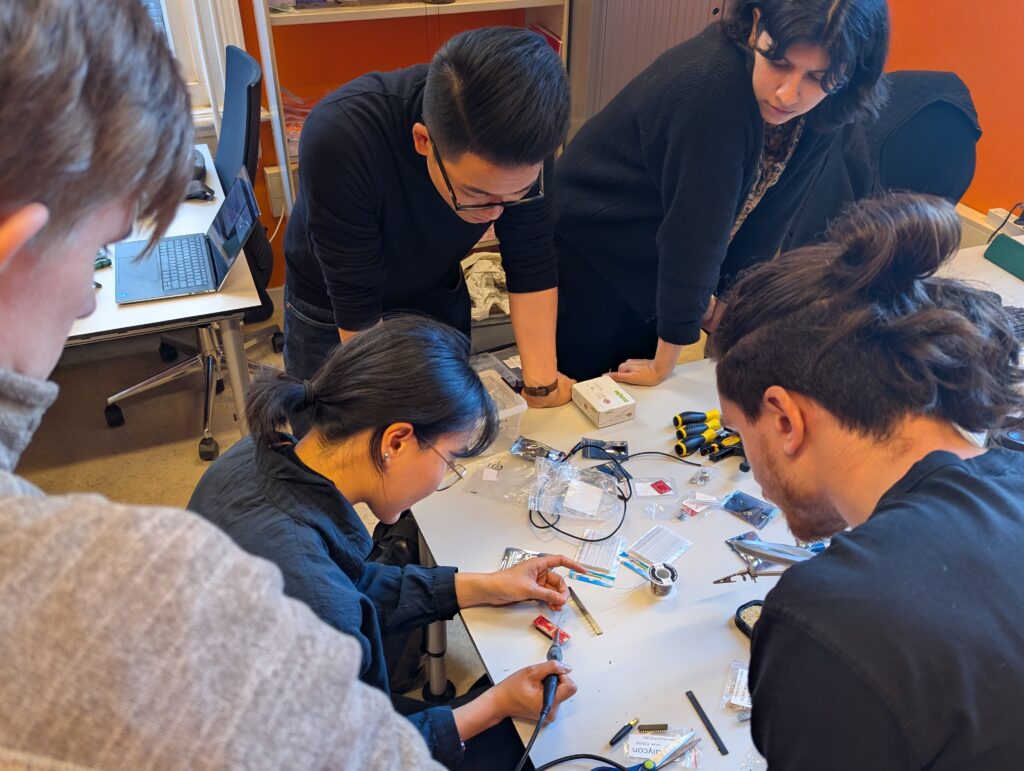
This project extends earlier artistic and scientific explorations of microbial electricity, but reframes them within the question of ecological infrastructures. Rather than treating biology as an alternative energy source to power existing systems, we ask how it could inspire new relations of maintenance, temporality, and dependency in digital systems.
Organic Substrates: Kombucha and Clay
We are also exploring kombucha SCOBYs—symbiotic cultures of bacteria and yeast—as living materials for circuit design. The cellulose-rich surfaces of dried SCOBYs are conductive when infused with certain electrolytes and can host sewn or printed traces. Alongside this, we draw inspiration from clay-based printed circuit boards, which uses local soil as both substrate and metaphor: the ground becomes circuitry. These material practices invite us to rethink electronics as earthbound and circular, materials that will eventually returning to the soil.
Sensing, Powering, and Communicating
To connect these experiments, we use a LabJack U3 interface to continuously measure voltage and current across the microbial and SCOBY cells. Our goal is to power a small web server directly through this living power source—a website whose uptime literally depends on the health of its microbial community. The fluctuating readings are logged and visualized in real time, making the metabolism of the mud and SCOBY visible as a communicative process.
Beyond measurement we see soil as the medium of computation. A first step is to enable distributed communication through the Reticulum Network Stack between the microbial and SCOBY cells. This stack enables resilient, peer-to-peer data exchange without reliance on central servers or the global internet. In a next phase, we plan to integrate the sBitx v3 transceiver to transmit microbial compute over shortwave radio. The Hermes.radio protocol, allows us to link biological power, local measurement, and planetary communication through low-power open infrastructures.
Computing Otherwise
These prototypes are small in scale but large in implication. They suggest that computing need not depend on extraction, nor sustainability on efficiency. Instead, we experiment with ecological computation as a mode of care, reciprocity, and coexistence—where systems live and die with the materials that sustain them.
By experimenting with mud, microbes, SCOBYs, and clay, we seek to develop new relations to computing and to decenter dominant theories of technological progress. This work aligns with broader debates in science and technology studies on digital sovereignty, infrastructural power, and ecological media, asking how infrastructures might evolve beyond capital’s logics of expansion toward restorative and regenerative practices.
In short, our aim is to imagine what computing could become if it were not only in the world, but also of it.
# exhibition phase shift: the antennas and us February 2025
an interactive art intervention
Together with the artist collective weise7, we produced an exhibit called “antennas and us” in the OBA Amsterdam public library. The artistic intervention, phase shift, is an interactive representation of a 5G antenna. It follows library visitors through motion sensors in a similar way that 5G antennas do in a process called ‘beamforming’. The antenna representation drew visitors into conversations with us about the experience of communication infrastructures in their everyday lives.
Visitors were also intrigued by the low tech guides against high tech surveillance created by fieke jansen in collaboration with design collective idiotēs. The guides framed the exhibit and provided a rich context for it. The guides display information on Wifi-tracking, Thermal imaging and Facial recognition, which can be used to become a digital explorer of your city. The artistic interventions travelled the library of Amsterdam, the “frictions and frequencies” exhibition in Berlin, our office, and hopefully, your neighbourhood.
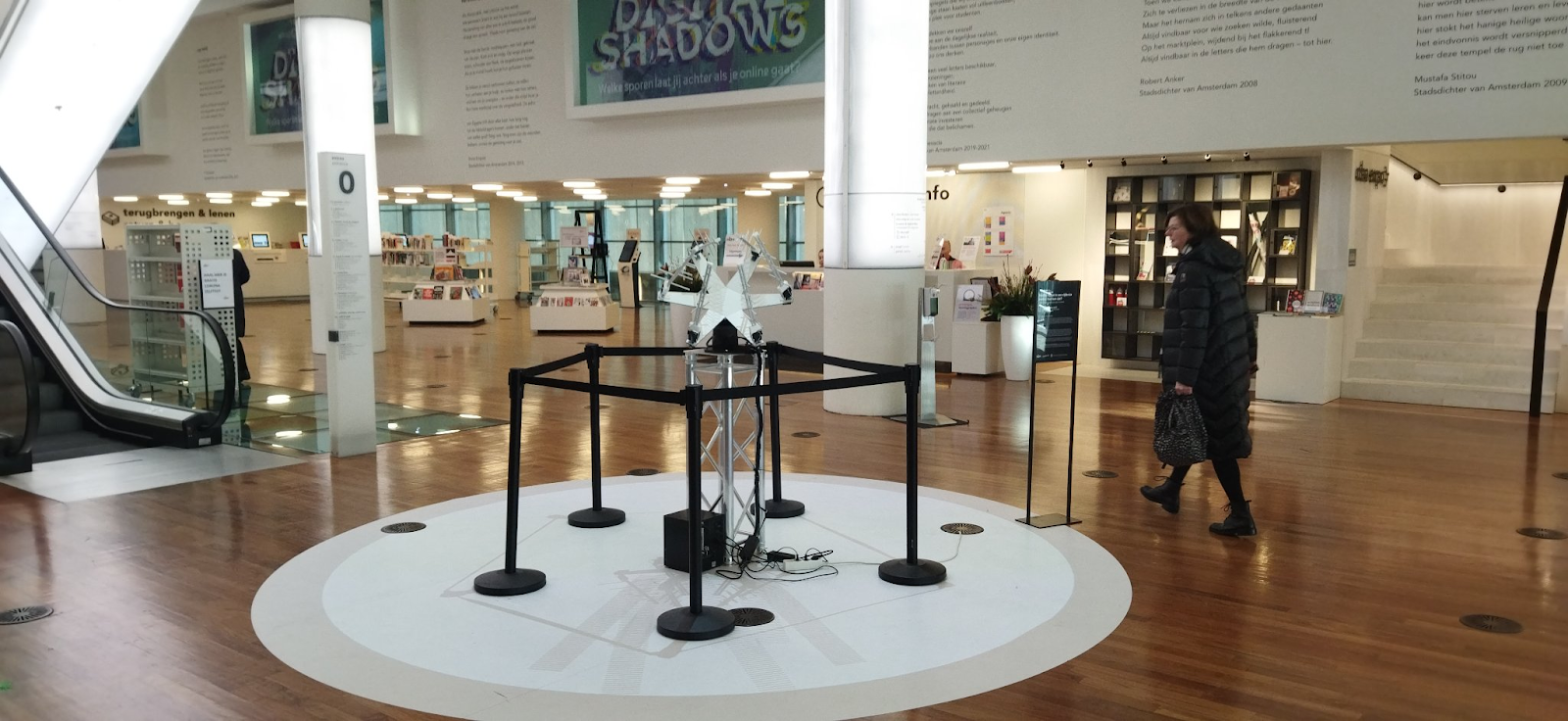
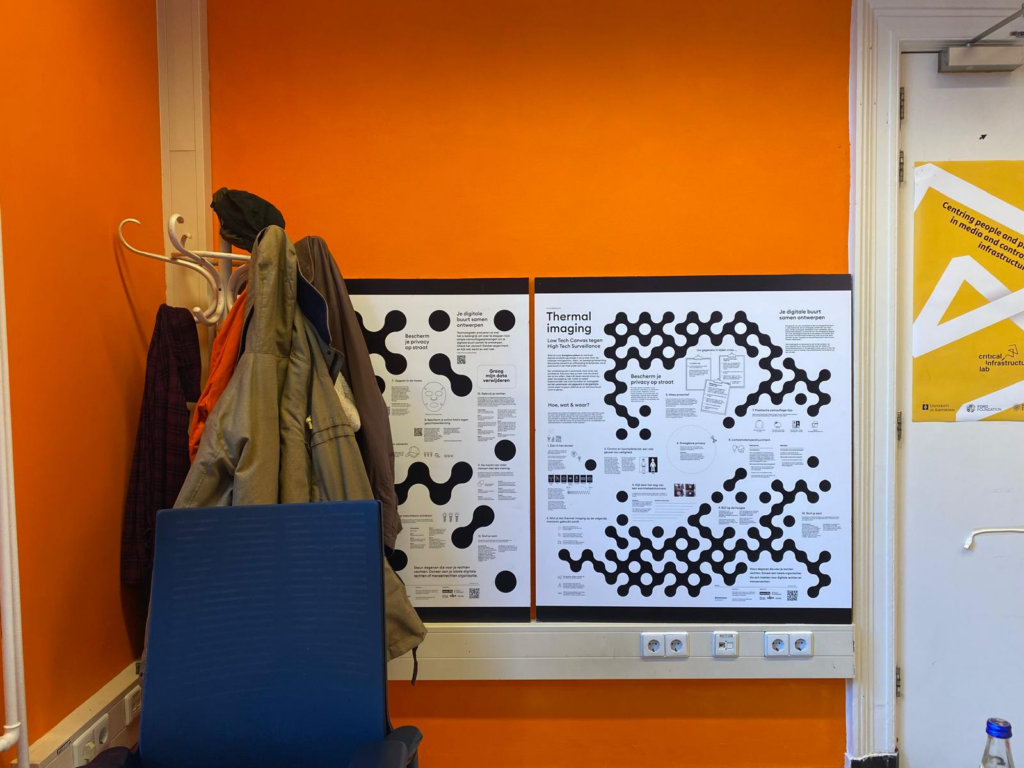
# event Research Qolloquium: Where things are and aren’t – Policy logics and geopolitical anxieties in the standardisation of quantum technologies January 2025
During the last 5 years, emerging from Europe to gradually cascade to other corners of the world, the standardisation landscape of quantum technologies has started getting shape. But what is actually being standardised in a field that is still in search for its ‘killer’ use-case? Who is at the table and who is leading the standardisation discourse? How are traditional geopolitical antinomies play out in the nascent – and highly sensitive – field of quantum tech and what is the role of Europe therein? Is it really too early to standardise quantum tech? This study represents the first empirical exploration of the emerging field of quantum standardisation. Through active observation of the workings in the CEN-CENELEC JTC 22 and the ISO-IEC JTC 3 as well as through interviews with relevant stakeholders, this research projects illustrates aspects of a field where the (very early) science of quantum technologies (including and especially quantum computing) meets the (very eager) policy demand for security and commercialisation.
This lecture will discuss findings of a year-long empirical study of the field of quantum standardisation. The talk will be hosted (in person, with the possibility to attend remotely) by the Law and Governance of Quantum Technologies group, Institute for Information Law in collaboration with the Asser Institute and the critical infrastructure lab, University of Amsterdam.
Practical details:
Date: 14 January 2025
Time: 15.30-16.45 (followed by drinks reception)
Location: IViR Room, Institute for Information Law, Roeterseilandcomplex, Building A, 5th floor, Nieuwe Achtergracht 166, 1018 WV Amsterdam
Interested in attending, or receiving updates about future events?: REGISTER HERE