# talk - presentation - panel Paper ‘Opening telecommunications to critical insights and public engagement’ on panel: ‘The Politics of Open Infrastructures: expanding knowledge through activist, participatory, and research-based initiatives’ at STS Austria November 2023
Opening telecommunications to critical insights and public engagement
Maxigas, Critical Infrastructure Lab, University of Amsterdam
Abstract of paper for the panel “The Politics of Open Infrastructures”
I focus on opening up programmable infrastructures to critical insights, transposing
digital methods from platforms to infrastructures, the case in point being the next gen-
eration 5G mobile phone networks. In comparison with the information infrastructures
of the Internet, telecommunications infrastructures are notoriously inaccessible. Internet
infrastructures benefit from open standards, elegant protocols, revolutionary imaginar-
ies, public debates and ample civil society engagement. In contrast, telecommunications
infrastructures are rendered inaccessible by standards processes conducted by industrial
consortia, over-engineered protocol stacks, bland visions, regulatory capture, and the
absence of digital rights activists. The convergence of Internet with telecommunica-
tions networks renders this situation increasingly problematic, because as computers
and networks merge in programmable infrastructures, the future of communication and
control will be determined by telecom companies without public debate or civil society
participation.
In order to address such a research problem and provide an adequate response to the his-
torical moment, I propose, promote and develop the “People’s 5G Laboratory”, a rebuilt
mobile phone network for parallel operation and public experiments. The purpose of
the research infrastructure is to open telecommunications to critical insights and public
engagement through the innovative methodology of “dissection”. Dissection refers to
an analytical but experimental approach to gaining a materialist understanding of the
medium in which cultures grow. While dissection has been practiced during the Dutch
Golden Age as a means to advance science, in particular anatomy, and thus medicine, it
has also been instrumental in transforming the societal norms and values, promoting en-
lightenment ideologies through public experiments and debatable spectacles. By taking
a similar approach to telecommunications standards, implementations and deployments,
the Critical Infrastructure Lab aims to inject a critique of cybernetics into contemporary
debates on emerging technologies of media and culture.
Conference Programme
# workshop Digital Materialities and Infrastructural Futures in Smart Cities: hands-on research day November 2023
Hands-on research day about smart cities with Maxigas from the critical infrastructure lab for qualitative and quantitative researchers. Featuring datasets on programmable infrastructures such as 5G and its implementation in the OpenRAN software/hardware project. Discuss and analyse how infrastructural ideologies materialise in code bases, critique and propose alternative infrastructural futures!
Feel free to drop by any time.
friday 24 november 2023, 12:00 – 16:00
deakin downtown, melbourne, australia
# event How do we survive the Internet? – November 23 18:00 @ De Brakke Grond November 2023
Register here
Join us on November 23rd for a conversation about the future of the Internet, what we get wrong about how it works today, and why the future of the tech industry is determined by computing infrastructure not data.
About the speakers
Geert Lovink is a Dutch media theorist, internet critic and author of Uncanny Networks (2002), Dark Fiber (2002), My First Recession (2003), Zero Comments (2007), Networks Without a Cause (2012), Social Media Abyss (2016) and Sad by Design (2019). In 2004 he founded the Institute of Network Cultures at the Amsterdam University of Applied Sciences. His centre organizes conferences, publications and research networks such as Video Vortex (online video), Unlike Us (alternatives in social media), Critical Point of View (Wikipedia), Society of the Query (the culture of search), MoneyLab (internet-based revenue models in the arts). Recent projects deal with digital publishing and the future of art criticism. He also teaches at the European Graduate School (Saas-Fee/Malta) where he supervises PhD students.
Corinne Cath is a cultural anthropologist studying the politics of Internet governance, AI and cloud computing. She currently works as a postdoc at the University of Delft in The Netherlands with Dr. Seda Gürses and Dr. Prof. Linnet Taylor. She works on questions of computational infrastructure (cloud computing and mobile devices) in the context of the administration of justice. Her current research focuses on how cloud computing and AI are transforming society, the consequences of these transformations for public institutions—and the adequacy of existing technology policy efforts that touch on cloud computing. She is a research affiliate at Cambridge University’s Minderoo Centre and a fellow at the critical infrastructure lab at the University of Amsterdam.
# event Common Sovereigns: amidst digital infrastructures November 2023
Keynote at symposium organised by Deakin University’s Critical Digital Infrastructures and Interfaces research group in Melbourne, Australia. Take a closer look at how our interactions with digital technologies are shaped by the common ‘sovereigns’ that construct the infrastructures of daily life!
“Featuring a keynote by Maxigas of the Critical Infrastructure Lab, and bringing together bright emerging voices researching the social and political implications of contemporary digital technologies, this symposium will examine what matters across diverse topics such as the platformisation of music culture, new ways of understanding digital territories, hearing technologies driving health and wellbeing economies, and the feminist technoscience of humanitarian labour.”
Wednesday 22 November 2023, 09:00 – 14:00
Deakin Downtown, Melbourne, Australia
# event Do labs have politics? November 2023
Join Maxigas in discussing the role of academic labs in bringing about desired futures. The “science shop” movement pioneered in the Netherlands directly linked academic institutions with social movements to counterbalance techniques of management tied to capital. These moves have reverberated through the growth of ‘labs’ of science technology and society with normative goals. The Citizens Lab (U of T), Critical Infrastructures Lab, and in some ways ADM+S, reflect modes of thinking through ways to affect wider cultural, political, technological changes, with the limited capacities and budgets of public academic modes of engagement. We ask what do the examples of working in an academic setting with an institutionalised mandate for social change map to, feel like, and what can we learn from them? If you’d like join discussion and reflection on the continuing evolution of ‘labs’ please mail Luke.h@Deakin.edu.au .
Monday 20 November 2023, 12:00 – 13:30
Deakin Downtown, Melbourne, Australia
# talk - presentation - panel Open panel “Overcoming Sociotechnical Imaginaries: Infrastructural ideologies and materialities?” at 4S conference, Hawaii November 2023
Open panel at the annual meeting of the Society for the Social Studies of Science, the professional society of Science and Technology scholars.
The concept of sociotechnical imaginaries is very popular in STS research, yet we suggest that has reached the limits of its explanatory powers. Sociotechnical imaginaries insufficiently account for power imbalances in the design, standardisation, production, and maintenance of infrastructures and their governing institutions. To overcome this problem, we invite contributions that foreground power and technological materiality, and do not solely, or mainly, take identities, opinions, and visions as a starting point for arguments. Technological materialities are not merely a reflection of aligned interests, expertises, or identities. Material affordances of technology can subvert the influence of actors. Such a process is not necessarily intentional, but can emerge in the use and maintenance of a technology. The concept of ideology can explain who exerts power, how such power is exerted and subverted, and what is at stake in social conflicts around material configurations. We build on Althusser and Humphrey in saying that ideology is not simply a linguistic phenomenon; it also appears in material structures, discourses, institutions, and practices. We want to further explore what this notion can do to explain how social conflicts are articulated through struggles over shaping materiality, often under the guise of a (co-)production process. We call for contributions from researchers who are interested in exploring conceptual frameworks that can better account for the role of materiality and power in the social conflicts around technological innovation, standardisation, deployment, and maintenance, including but not limited to renewed interest in ideology as a conceptual framework.
# talk - presentation - panel Open panel “Ecological crises and the role of technologies: harm, violence, and the quest for accountabilities” at 4S conference, Hawaii November 2023
Open panel at the annual meeting of the Society for the Social Studies of Science, the professional society of Science and Technology Studies scholars.
Political and industrial narratives present technology as the solution to the multiple ecological crises society is confronted with, without engaging with the material consequences in terms of minerals, land, labour, and energy (Crawford, 2021; Cubitt, 2016; Hogan et al., 2022). As Dr. Max Liboiron traces out in ‘Pollution is Colonialism’ (2021), extraction and pollution are legitimated through threshold theories of harm, which set arbitrary limits on harmful practices and allow ‘acceptable’ amounts of pollution to continue. Liboiron demonstrates how this approach to managing harms obscures the institutions and actors that perpetrate violence in the first place, foreclosing possibilities to resist and transform power relations. With this open panel, we invite contributions that engage with Liboiron’s call to move from ‘a question of harm that asks ‘how much’ … to ‘how’ and ‘why’ questions about violence’ (Liboiron 2021). We bring this question to the context of digital technologies and their social and environmental implications, asking what such a switch of perspective might look like with regard to ‘Big Tech’ monopolies, the distributedness and scales of networked computing infrastructures, and their entanglements with extractive industries (c.f. Arboleda 2020). How can systemic violence and questions of accountability be addressed in this context? Contributions can range from papers unpacking how a narrow economic lens on climate change (‘green capitalism’) perpetuates violence; to explorations of research methodologies putting feminist, anticolonial, critical race, and solidarity epistemologies into practice; to projects that develop alternative sociotechnical imaginaries (Jasanoff and Kim 2015) for the principles that organise internet infrastructures.
# talk - presentation - panel Open panel “Russia’s War on Ukraine – Environments, Imperialism, Infrastructures” at 4S conference, Hawaii November 2023
Open panel at the annual meeting of the Society for the Social Studies of Science, the professional society of Science and Technology Studies scholars.
The Russian aggression against Ukraine and the violation of its people and territories have a long history. Situated between a number of colonial powers, Ukraine and its people were imaged and imagined as a component of material exchange, while the anti-imperial resistance is systematically ignored. In this panel, we question the material consequences of the war in Ukraine, the imperial forces at work, and the resistance against them. We want to explore different angles of the conflict through theoretical concepts and the analysis of the material conditions. For instance, the production of terror environments (Matviyenko), resourcification (Bazdyrieva, Richardson), erasure as a tool of imperialism (Tsymbalyuk), etc. We invite contributions that explore and expose the socio-material aspects of the war across topographies and topologies, such as sea (through gas pipelines, submarine cables, and bridges), sky (through satellites and drones), and land (electrical grids and trenches). The long-term slow and fast violence against the people and environment of Ukraine shapes an ecology that is not just endangering people or/and the ecology itself, but the ability to recognize subjectivity and agency at the “peripheries” of imperial powers. This panel aims to bring to the fore different kinds of spatial, environmental, and ideological reconfigurations that have led to the current moment. We aim to center Ukrainian scholars and their experiences, while also inviting other scholars to contribute.
# event Eaten by the Internet: power and the future of the digital society – Oct 31st 17:30 @ Spui25 October 2023
Sign up here: https://spui25.nl/programma/eaten-by-the-internet
Our world is eaten by the Internet. This means that those who control the Internet control the bounds of public speech, economic production, social cohesion, and politics, making its infrastructure a core political terrain in the networked age. This evening we honor a new book about the power of Big Tech and the future of the digital society, Eaten by the Internet. The discussion with the book’s authors and editor will make Internet infrastructure visible as a key force of political power and urge us to ask how can we ensure the Internet will sustain us, rather than consume us?
To understand power in the contemporary Internet industry, we must look closely at its often invisible infrastructure. This is made of material components such as cell antennas, clouds, chips, data servers, and satellites, but also less tangible, equally crucial standards and software components, including the operating systems, browsers, and computing power that enables connectivity. All these components rarely attract our attention unless something breaks down. And even then, many Internet users won’t ask why.
Eaten by Internet makes Internet infrastructure visible as a force of political power, demonstrating how it is transforming the social world. Four of the original contributors of the book will be present to discuss their chapters, taking on thorny topics, such as power consolidation in the advertisement and cloud industry, online censorship in Asia, the role of Internet infrastructure in governmental and corporate surveillance in the city of Amsterdam, and tech’s environmental impact – amongst others. In doing so, this event will root contemporary technology debates in the politics of digital infrastructure and help us design an Internet that answers to public values.
About the speakers
Corinne Cath is a post-doctoral researcher at the University of Delft funded by the Algosoc consortium, a fellow at the UvA’s critical infrastructure lab, and a research associate at the Minderoo Centre for Technology and Democracy at Cambridge.
Gurshabad Grover is a technologist and legal researcher based in Delhi, India. Gurshabad’s research focuses on network security, censorship, and surveillance.
Fieke Jansen is the co-founder of the critical infrastructure lab and a post-doctoral Researcher at the University of Amsterdam. She also coordinates the Green Screen climate justice and digital rights coalition.
Michael Veale is an Associate Professor in digital rights and regulation at University College London’s Faculty of Laws. His research focuses on understanding and addressing challenges of power and justice that digital technologies and their users create and exacerbate, in areas such as privacy-enhancing technologies and machine learning.
Niels ten Oever is an Assistant Professor of AI and European Democracies at the European Studies Department and co-founder of the critical infrastructure lab at the University of Amsterdam.
# project a visual identity for the critical infrastructure lab October 2023
The visual identity of the critical infrastructure lab is the result of a collective thought and creation process between the lab’s co-leads Fieke Janssen, maxigas, Niels ten Oever, and the communication designer Ulrike Uhlig.
For a week, Ulrike not only observed the work of the lab, she also conducted several workshops during which several questions and subjects were researched, the two most important ones:
- who are we?
- how do we want people to see/feel/understand the critical infrastructure lab?
the result of these workshops produced several phrases which served as visual clues for the design. “we are a transformative and decentering force” was our most important guiding principle.
we knew we wanted to use a font family which works in print and on screen and which came with an open license. Ulrike conducted tests with several candidates, before we collectively decided to go with the Source font family (Sans, Serif, and Code Pro)
but which color would be infrastructural? some things in the design process are the fruit of hasardous reading. we talked about ingrid burrington’s “networks of new york”, and there we found the colour that we deemed infrastructural: the neon orange used to mark network equipment in the street. this colour then reminded niels and maxigas of the color coding of UTP cables which use the ‘‘25-pair color code’’ industry standard. the lab operating through three different lenses—geopolitics, environment, and standards—it seemed interesting to reuse this color code to subtly mark produced publications, a clin d’œil as well to the color coded tubes of the Parisian Centre Pompidou which can be either esthetically appreciated without explanation.
while discussing how infrastructures are temporary, how antennas work, ulrike stumbled on the evolved antenna produced for NASA using genetic algorithms. even though we strongly question cybernetic principles of optimisation, we thought it interesting to involve a process reminding us of nature into the design. even though we did not rewrite the algorithm, principally because we lacked a fitness function—a function which would test how well the antenna works—the logo of the critical infrastructure lab is based on this evolved antenna. in the digital realm, on the website, we generate a new one every time the page is loaded to remind you—and us—that infrastructures are temporary.
a comma like trait in the logotype is inviting to ask if we are talking about the critical infrastructure—pause—lab or the critical—pause—infrastructure lab? the logotype, the text in the logo, is based on the very geometrical inter font.
there are some more subtle questions being asked through the design:
- on the website for example, a white trait is drawn, until we click somewhere, symbolising that when creating infrastructures, we are leaving traces—after all, it’s these traces that we interrogate in our work.
- in some of the print publications you might notice that page numbers subtly move, the further one advances in the publication. again, we are decentering, transforming, and marking progress.
We published our publication pipeline as well as our website theme under the GNU GPL v3 license.
# talk - presentation - panel “Digital infrastructures and environmental justice: policies, practices, and visions” session at AoIR conference, Philadelphia September 2023
| Janna Frenzel1, Sophie Toupin1, Jenna Ruddock2, Jen Liu3, Fieke Jansen4, Shawna Finnegan5, Jennifer Radloff5 1Concordia University, Canada; 2Harvard Kennedy School, USA; 3Cornell University, USA; 4University of Amsterdam, The Netherlands; 5Association for Progressive Communication Environmental media scholars have long drawn attention to the physicality of digital systems, situating their work as part of the infrastructural turn (Larkin, 2013; Parks & Starosielski, 2015; Star, 1999). Contrary to the prevailing “cultural imagination of dematerialization” (Starosielski, 2015), digital supply chains – from data centers to AI systems to consumer electronics – depend on minerals, water, land, labour, and energy (Crawford, 2021; Cubitt, 2016; Hogan et al., 2022). This growth-based model of digital technology is based on assumed access to resources, implicating it in the extractive global economy shaped by ongoing colonial violence (Liboiron, 2021; Spice, 2018). Transdisciplinary scholarship on the intersection of digital technologies and the environment has looked at online organizing and digital climate change action (McLean & Fuller, 2016; Pearce et al., 2019), indigenous resistance and data sovereignty (Duarte, 2017; Kukutai & Taylor, 2016), the environmental impacts of large-scale data centers (Hogan, 2015; Velkova, 2016) and alternative social media (Laser et al., 2022), and what “responsible digitalization” could look like (Dwivedi et al., 2022). Building on already existing work that critically examines the material implications of digital infrastructures, this panel asks what environmental justice means in relation to digital technologies. Turning against the language of revolution that too often gets leveraged by Big Tech to describe the latest “disruptive” technology that is allegedly going to solve the world’s problems (Geiger, 2020; Tabel, 2022), we foreground subversive practices, regulatory interventions, and grassroots organizing and vision building as emancipatory alternatives to a for-profit, monopolized internet. From a theory of change that seeks to understand and challenge the extractive nature of digital technology production from all angles, we shed light on reform, repair, refusal, and resistance as paths for transformation. Zooming in on Southeast Louisiana where hundreds of petrochemical processing and manufacturing facilities are located, the first paper examines how Internet access can be reimagined in landscapes shaped by extractive economies. The paper analyzes the challenges that activist and research groups face when using Internet of things (IoT) devices for real-time environmental sensing of air quality due to underdeveloped Internet infrastructures in a region that is becoming increasingly vulnerable to climate change. The second paper engages with the material footprint and environmental implications of computing hardware production. It looks at the “Right to Repair” as one approach that challenges corporate control over design and obsolescence of electronic devices. By comparing examples of recent legislation in the EU, India, and the US, and analyzing them through the lens of design justice and discard studies frameworks, it argues that Right to Repair needs to be complemented by a substantial change in industry norms and practices rather than simply attempting to delay the disposal through repair by consumers. The third paper examines community resistance to data centers in the United States. In the past years, activists have framed their resistance to data centers along three critiques, namely noise pollution, resource consumption, and lack of public input to permitting processes. The paper investigates how environmental justice activists use formal legal and regulatory processes such as public meetings, petitions, lawsuits, public records requests to organise against new data center developments, and the challenges they meet as part of their organising. The fourth paper presents a “feminist principle of the internet on the environment” that was developed over several years in transnational collaborative work by practitioners. It addresses the interconnections between gendered online violence against land and environmental defenders on large social media platforms and on-the-ground resistance to extractive industries and outlines a new emancipatory vision for a different internet that centers planetary care and justice for communities and ecosystems. The fifth paper presents an analysis of the Internet Architecture Board’s (IAB) workshop on “Environmental Impact of Internet Applications and Systems”, held online in December 2022. It uses an infrastructural lens to analyze which politics are embedded and missing from industry responses to the sector’s environmental harms. While international regulatory bodies are slowly coming to terms with the environmental impacts of distributed digital networks, the paper argues that the proposed sustainability solutions are as of yet too narrow in scope. |
https://www.conftool.org/aoir2023/index.php?page=browseSessions&form_session=328#paperID183
# talk - presentation - panel “Infrastructural Insecurity: Geopolitics in the Standardization of Telecommunications Networks” presentation at AoIR conference, Philadelphia September 2023
Niels ten Oever, Christoph Becker
University of Amsterdam – critical infrastructure lab
This paper argues that the production of ‘infrastructural insecurity’ is an inherent part of the standardization of information networks. Infrastructural insecurity is the outcome of an intentional process within infrastructural production, standardization, and maintenance that leaves end-users of the infrastructure vulnerable to attacks that benefit a particular actor. We ground this analysis in an interrogation of the responses to the disclosure of three security vulnerabilities in telecommunications networks, namely (1) a security flaw in Signaling System No. 7 (SS7) that allows for the data interception and surveillance, SMS interception and location tracking by third parties, (2) the lack of encryption of permanent identifiers that allowed for the deployment of rogue base stations, which allowed for man-in-the-middle attacks, resulting in interception of all voice and data traffic in a physical signal vicinity, and (3) the lack of forward secrecy between user-equipment and the home network, which allows for the decryption of current encrypted data stream if credentials were obtained in the past. To research the shaping of communication and infrastructure architectures in the face of insecurities, we develop a novel approach to the study of Internet governance and standard-setting processes that leverages web scraping and computer-assisted document set discovery software tools combined with document analysis. We bring these methods into conversation with theoretical approaches from material media studies, science and technology studies, and critical security studies. This is an important contribution because it asks fundamental questions about the adequacy and legitimacy of standardization processes.
https://www.conftool.org/aoir2023/index.php?page=browseSessions&form_session=375#paperID219
# exhibition frictions and frequencies by weise7 September 2023
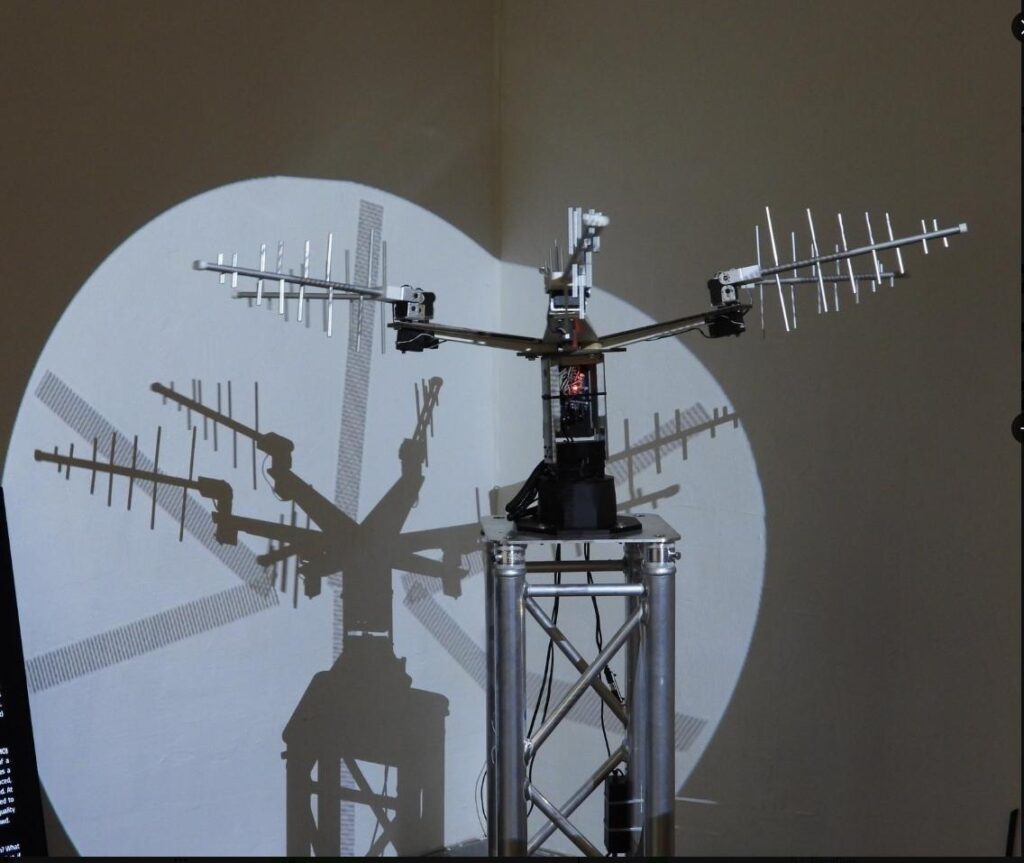
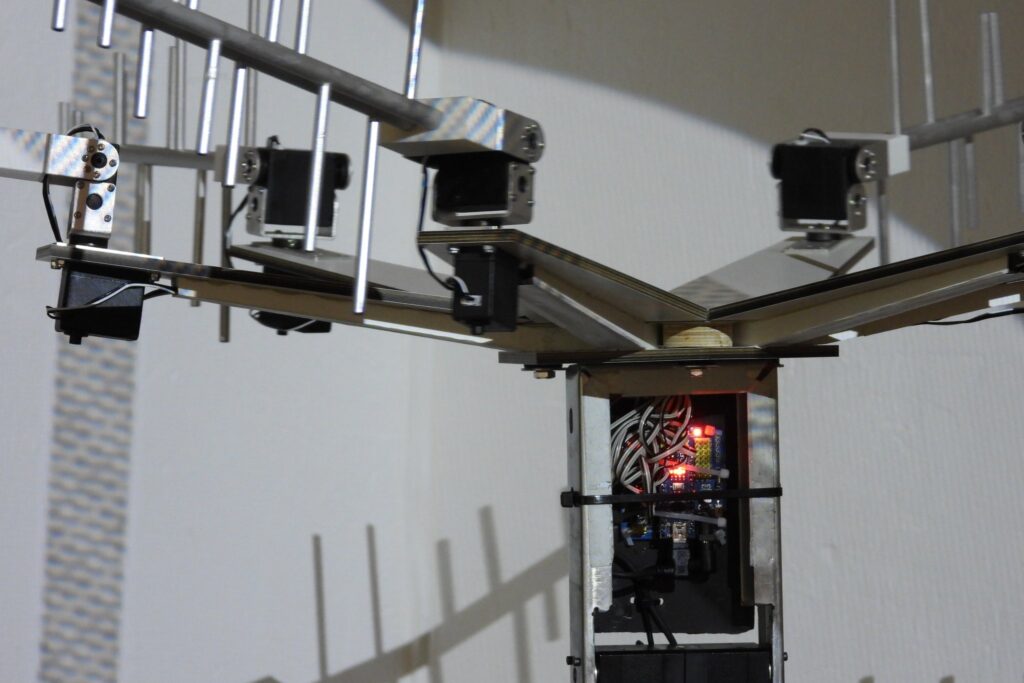
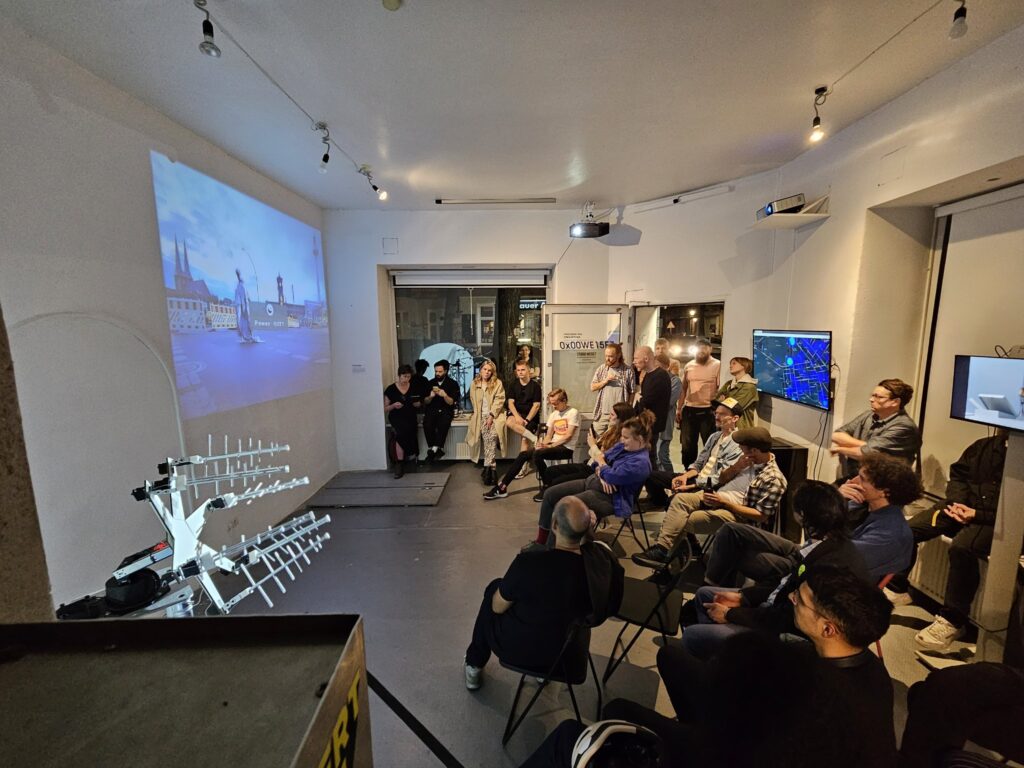
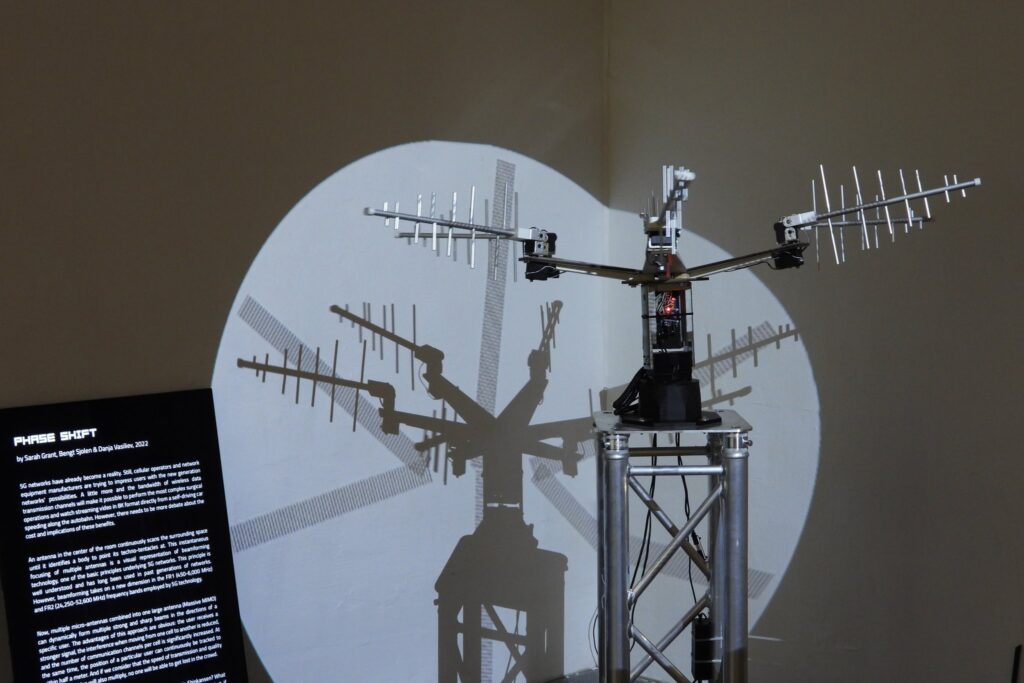
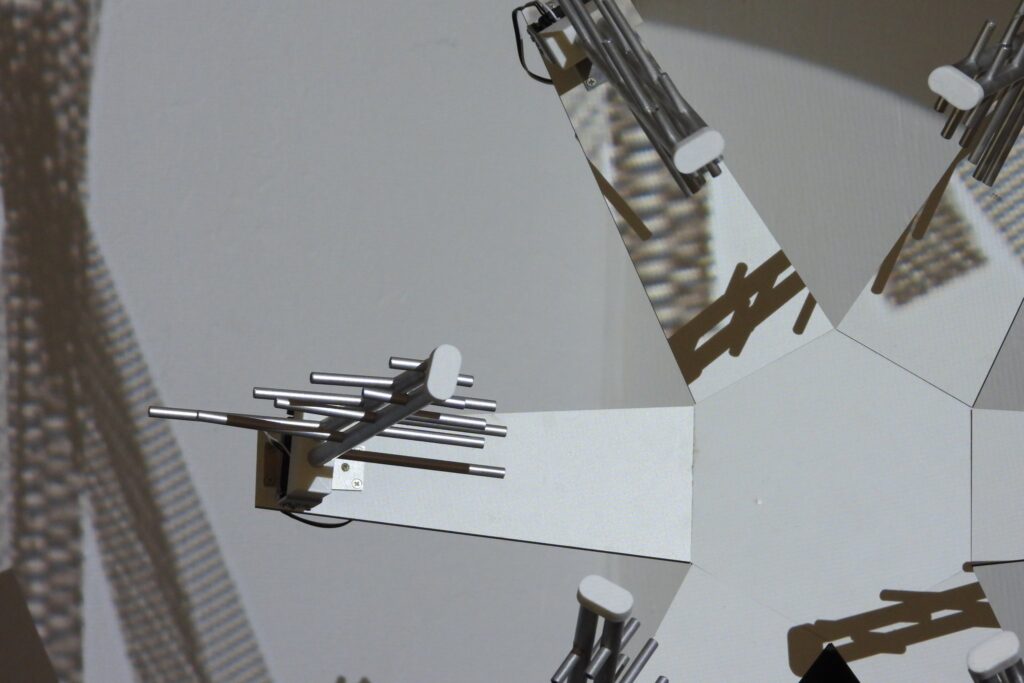
weise7, the home to critical engineering, is exhibiting phase shift, a work in collaboration with the critical infrastructure lab. the exhibition “frictions and frequencies” opened on 28 September by a demonstration of the work and a talk entitled “In Your Aerial” by Teresa Dillon, artist, researcher and Professor of City Futures, School of Arts, UWE, Bristol. the work has been on display at the amsterdam public library (central station) previously.
# event NL IGF event – “Future-Proof Internet Governance: The Power of Multistakeholder Collaboration” September 2023
Organising and chairing session on standards and infrastructure at the Netherlands Internet Governance Forum.
# workshop Workshop on international standard-setting for the Dutch Ministry of Foreign Affairs, Interior Affairs, and Economic Affairs and Climate September 2023
# talk - presentation - panel “Dialectics of hacking” book launch August 2023
How does capitalism integrate hackers? Can hacking flourish outside capitalism? Why anti-capitalist movements need hackers? What connects hackers’ movements, scenes and projects to past and future struggles against capital?
Launch of monograph Resistance to the current: the dialectics of hacking in MIT Press’ Information Policy series in a session at the Chaos Communication Camp.
# workshop Hack Smart Cities August 2023
Session at the Chaos Communication Camp
# talk - presentation - panel 5G networks and the public interest August 2023
Session at the Chaos Communication Camp
# talk - presentation - panel The People’s 5G Network July 2023
Presentation and discussion at the tbd.camp hacker convention on the politics of 5G standardisation, implementation and deployment.
# workshop infrastructural imaginaries workshop – montenegro July 2023
# event Standards, Protocols, Ecosystem roundtable June 2023
Round table discussion organised by Open Future and the critical infrastructure lab at the university of amsterdam, department of media, bringing together experts from the academia, civil society and industry
# workshop green screen climate justice and digital rights workshop – costa rica June 2023
# talk - presentation - panel the global harms of powering ai – towards a sustainable future of data use and governance @cpdp May 2023
Artificial Intelligence relies on data. Currently, we see a “bigger is better” mentality in both AI research and AI business models. This leads to ever more complex AI systems and massive data sets. But are they sustainable? Currently, the ensuing environmental, social and economic harms are ignored both by established data governance regimes and regulatory approaches such as the DSA/DMA, Data Act or AI Act. We have yet to find data governance approaches that adequately respond to the unsustainability of extractivist AI data collection and data processing and their underlying technical infrastructures. In this panel, we will discuss the global harms of AI systems and shortcomings of established data governance approaches, as well as new ideas for regulations geared towards more sustainable data governance and AI policies in an age where Artificial Intelligence is becoming a general-purpose technology.
the global harms of powering ai – towards a sustainable future of data use and governance @computers, privacy, and data protection (cpdp). View the panel here.
# workshop digital green society – serbia May 2023
THE GREEN/DIGITAL/SOCIETY is a conference that gathers key actors who discuss the ecology, technology, human rights and policy in europe. see more: digital green society
# talk - presentation - panel Exploring Protocols & Interoperability to Support a People-Centered Digital Future May 2023
Talk at workshop organised by the Missing Layers collaborative and Open Future, bringing together academia, civil society, and industry players.
# event launch event programme March 2023
programme download [pdf] // data centre walk flyer [pdf]
day 0 – april 13 – singel library, singel 425, 1012 wp amsterdam
09:00 coffee + registration
- 10:00 welcome and opening
- marieke de goede – dean of the faculty of humanities
- critical infrastructure lab
11:00 morning workshops: infrastructural futures
- sustainable computing infrastructures – michelle thorne
- identifying infrastructure gaps to shift power in the data economy – lisa gutermuth
- imagining the future: what should the next european commission do? – alek tarkowski, zuzanna warso and paul keller
12:30 lunch
13:30 afternoon workshops: maps and models
- data centre walk: the materiality of connectivity, centralization, data centers and data – yan cong
- mapping the network; critical mapping and new perspectives on internet infrastructure and standards – silke steets, nadine schabét, rené tuma, dinah van der geest
- semente – co-designing community-based digital policy – felipe schmidt fonseca & bernardo schepop
- free software user unions? – decentral1se
- permacomputing: are you working in the dark? introduction to permacomputing through a guided visualization and interactive game – ola bonati and lukas engelhardt
16:30 documentation, continuation and report back
17:30 surprise appearance
18:15 walk to waag
18:30 dinner and drinks (waag)
day 1 – april 14 – oude manhuispoort + bushuis
11:00 – 17:00 diy electronics jewelry workshop https://jewelryhacker.org/
09:30 welcome and opening – critical infrastructure lab
10:00 keynote 1 – standards – ksenia ermoshina
11:00 coffee break
11:15 morning panels
geopolitics: shifts, conflicts, and infrastructures
- migration information infrastructures: power, control and responsibility at a new frontier of migration research – fran meissner & linnet taylor
- “dongshuxisuan” (east-to-west computing resource transfer project) in china: an evolutionary reform on data infrastructure construction – chengbao jin
- the eu and internet standards – beyond the spin, a strategic turn? – clément perarnaud
standards: norms and methods
- data walking in the unheard city: sampling infrastructured devices with mobile apps – iain emsley
- the good infrastructures lab: user agency within, through and against infrastructures – thomas berker
- standardization as ethico-political project. dealing with the tension between the value of equal quality of standards and pluriversality – paula helm
environment: maintenance and resistance
- permitting/resisting the cloud: a comparative legal analysis of community resistance to fossil fuel infrastructure and data centers – jenna ruddock
- reuse commons: a toolkit to weave generous cities – felipe schmidt fonseca
- washout! environmental synchronization and infrastructural maintenance in the northern rocky mountains – sam p. kellogg
12:30 lunch
13:30 keynote 2 – environment – svitlana matviyenko
14:30 coffee break
14:45 report presentations
- exclusionary cultures of internet governance – corinne cath
- open source software as digital infrastructure – thomas streinz
15:45 keynote 3 – geopolitics – yu hong
16:45 coffee break
17:00 afternoon panels
geopolitics: european infrastructure politics
- eu digital diplomacy – digital technologies, standards, and regulation in times of geopolitical upheaval – julian ringhof
- reaching european stars with american clouds: rooting european digital sovereignty in gaia-x – andreas baur
- the russian conflict and its impact on the web pki – alexandra dirksen
standards: network paradigms
- rearticulating the digital public good: aesthetics and technics of the fifth internet – mila samdub
- digital technologies and sustainable development: the missing link – raúl zambrano
- an overview of internet censorship in eu – vasilis ververis
infrastructural futures
- on-line federation as a sociotechnical architecture – roel roscam abbing
- towards a historical, multi-dimensional, relational model of digital infrastructure – lai yi ohlsen
18:15 closing
20:30 drinks (ot301)
# exhibition antennas and us – exhibit at the amsterdam public library February 2023
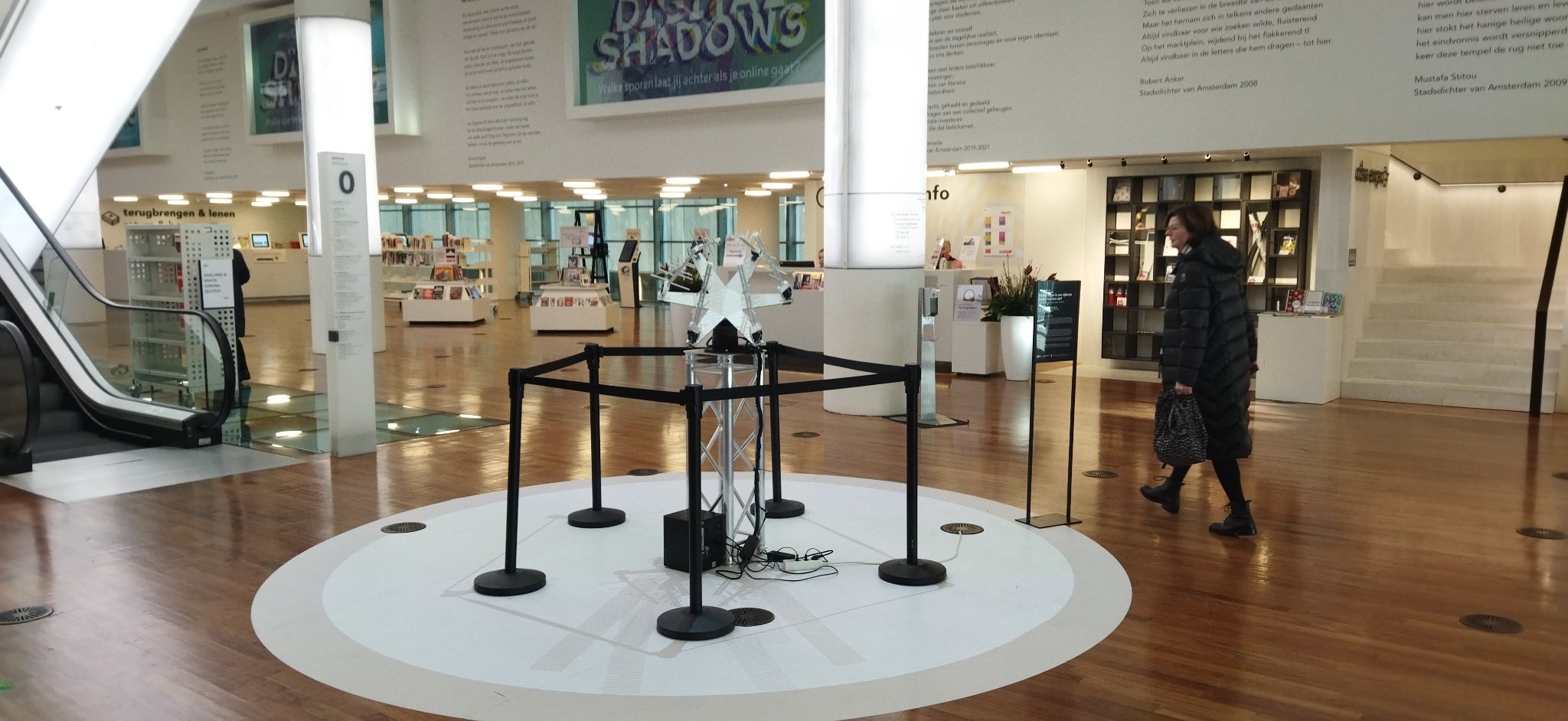
exhibit at the amsterdam public library (centre location), november 2022 – february 2023.
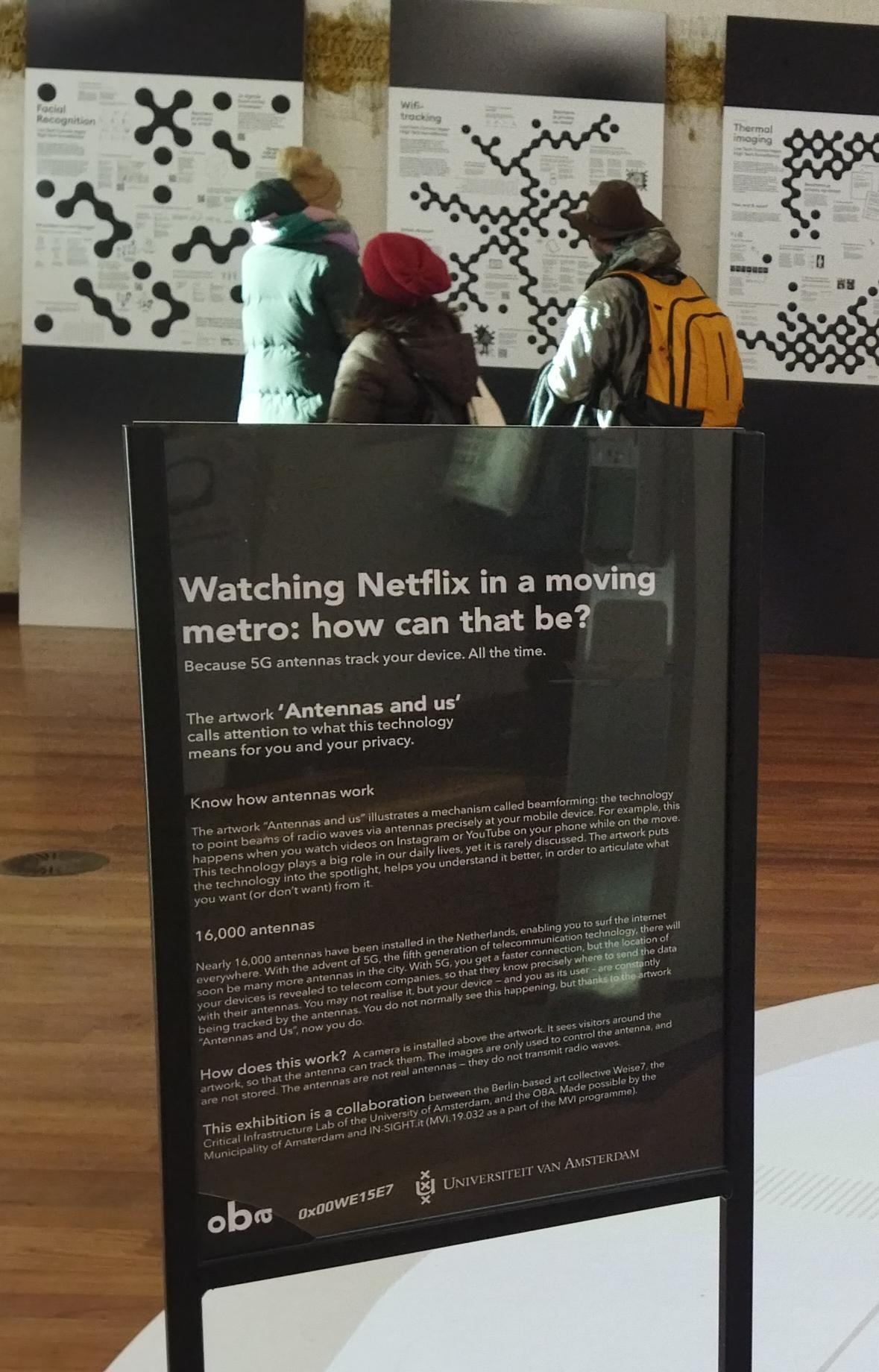
together with weise7 we organized an exhibit called ‘antennas and us’ in the amsterdam public library to show the invisible workings of telecommunications networks, and beamforming in particular. the exhibition runs from november 2022 until march 2023.
also shown at the exhibition are the low tech guides against high tech surveillance created by fieke jansen in collaboration with design collective idiotēs. use these low tech guides to become a digital explorer in your own city. see your neighborhood in a new light while exploring issues around facial recognition, thermal imaging, and wi-fi tracking.
The work was subsequently exhibited in Berlin in October 2023.
# talk - presentation - panel politics of (dis)connection February 2023
The possible establishment of a sovereign internet in Russia, European initiatives on ‘Digital Sovereignty’, and the conflict between China and the United States over Huawei equipment are rekindling the discussion on splinternets and the limits to global interconnectivity. This is an online event and is co-organized by Giganet.
Can the internet, the original network of networks, resist the contemporary strain, or was it built to accommodate these differences? In this talk three expert scholars on this topic, Daniel Lambach, Francesca Musiani and Fernanda Rosa, will give their views on the politics of global connection, its limitations, its future, and its discontent. Their talks will be discussed by one of the founders and prominent researchers of the fields of internet governance, Milton Mueller.
recording: politics of (dis)connection
# call for papers launch event January 2023
you can find the schedule here
executive summary / tl;dr
- the critical infrastructure lab launches on april 13-14, 2023 at the university of amsterdam
- send in your session proposals for interactive workshops on april 13th (the lab day)
- send in your extended abstracts (academics) or position statements (practitioners) for the panel sessions on april 14th (the research day)
- send submissions to submission@criticalinfralab.net by march 1st (750-1000 words)
°º¤ø,¸¸,ø¤º°°º¤ø,¸,ø¤°º¤ø,¸¸,ø¤º°°º¤ø,¸¸,ø¤º°
“infrastructure makes worlds” — ned rossiter
°º¤ø,¸¸,ø¤º°°º¤ø,¸,ø¤°º¤ø,¸¸,ø¤º°°º¤ø,¸¸,ø¤º°
dear colleague, friend, comrade,
communications infrastructures constitute the invisible scaffolding of social life. largely concealed to their end-users, they are becoming the main stage where local and global economic, social, environmental, and geopolitical conflicts are played out. once established, infrastructures shape societies for decades to come.
on the 13th and 14th of april we will launch the critical infrastructure lab to discuss and develop visions of how communication infrastructures can serve the public interest — and we want to do that with you!
work in the critical infrastructure lab will focus on the development of new infrastructural futures that center people and planet over profit and capital. hosted at the university of amsterdam and led by fieke jansen, niels ten oever, and maxigas, the lab will bring together activists, advocates, scholars, policymakers, and industry actors. three analytical lenses of standards, geopolitics and environment will be applied to built an evidence base, investigate and develop infrastructural imaginaries, and create actionable research for infrastructures that serve the public interest.
about the launch event
the two-day event at the university of amsterdam will take place on the 13th and 14th of april. it will be a mix of keynote speakers, hands-on workshops, infrastructure walks, and panel discussions. both days will be in person, but day 1 will be streamed. for both days, we invite session proposals from activists, advocates, scholars, policymakers, and industry.
day zero, 13th of april, will be a hands-on lab day. it will offer space for interactive sessions on geopolitics, environment, and standards. we invite proposals for sessions of 2.5 hours. for instance, workshops, infrastructure walks, policy challenges, simulations, etc. pretty much everything that is not a panel or paper presentation.
day one, 14th of april, will have a more academic structure. it will kick off with three keynote presentations followed by panel sessions. the keynote speakers – ksennia ermoshina, svitlana matviyenko, and yu hong – will inspire and challenge us. the keynotes are followed by corinne cath, who will present her research on exclusionary cultures of internet governance.
the afternoon will be dedicated to simultaneous panel sessions in the areas of infrastructure and geopolitics, infrastructure and environment, and infrastructure and standards. academics can submit an extended abstract (research question, theory/literature, method, data, preliminary findings) and practitioners can submit a position statement. these contributions should be between 750 and 1000 words.
want to submit
do you have an idea you want to workshop, a discussion you want to host, or some research that you want to present?
state clearly in an email:
- your name and affiliation,
- whether you are submitting for day zero or day one,
- the research area (infrastructure and geopolitics, infrastructure and environment, or infrastructure and standards)
- include an abstract, position statement or a blurb for an interactive session!
send your submission to submission@criticalinfralab.net by march 1st.
the lab and its research is supported by the ford foundation, the internet society foundation, and omidyar network.
# workshop giganet’s workshop on internet standard setting research methods January 2023
This workshop showcases the broad range of research methods used by Internet governance scholars from multiple disciplines to study Internet standard-setting bodies, such as the IETF, IEEE, W3C, WHATWG, 3GPP, ITU-T, ITU-R. more information and recording: https://www.giga-net.org/12-january-2022-giganets-workshop-on-internet-standard-setting-research-methods/