# call for contributions Call for Position Papers September 2026
Deconstructing Infrastructural Expansion: Circulation across Sea, Land, and Sky
critical infrastructure lab at the University of Amsterdam
Centre for Internet and Society at CNRS
Inria
University of Lille
In the geopolitical race for technological hegemony, regimes are using digital sovereignty policies to enact control and grow their own digital economy. A central element of these industrial policies is the creation of an enabling environment for infrastructural expansion: targeted investment in the technology sector, deprioritization of environmental and social protection, and creation of new electricity infrastructures are all meant to underwrite the build-out of submarine cables, data centres, telecommunication infrastructures, and satellite constellations. Industrial policies are proposed to derisk supply chains on which national and economic security depend. Infrastructure space itself becomes a medium of statecraft (Easterling 2014), where power is reconfigured through design, finance, technology, and circulation.
The world becomes ever further enmeshed in a circulation complex that both encases nature and society for generations to come. In this workshop, circulation offers a lens to understand both the workings of the entire market and its relation to that of specific industries (Kjøsen 2018). It allows for theorization about how the externalisation of costs, regulatory capture, corporate power, and the generation of financial power that propels infrastructural expansion outward and downward, from the seabed to low earth orbit, and how these dynamics are encoded into routing decisions, protocol design, and systems architecture.
Topics of Interest
In this second infrastructure workshop, we are interested in thinking through the consequences of the increasing private ownership of expanding communication infrastructure from the sea to the sky and methods of measuring it. We attend to the territories, people, natural resources, and environments being sacrificed in the name of progress, economic growth, and control (Mollen et al. 2026), the violence that circulation and logistics carry with them (Cowen 2014), and critical quantitative and qualitative methods to foreground underpinning patterns. We ask what technical inquiry can reveal that other approaches cannot: how the measurement of interconnection and autonomous systems exposes the concentration of ownership; how the materiality of compute, spectrum, and orbit decides who gets to build and who does not; and how shifting ownership structures and modalities translate, operationally, across submarine cables, data centres, and low-orbit satellites. We therefore welcome contributions that bring network measurement, systems design, and security research into contact with political economy and critical theory, alongside work that asks how people engage with and contest these configurations, whether alternative architectures are possible, and what it is that we want from our communication infrastructures in the first place.
Themes and topics
The 2nd INFRASTRUCTURE Workshop brings together researchers from Science and Technology Studies (STS), Political Economy, Social and Human Geography, Computer Science, and related fields to critically examine the material, environmental, political, and socio-technical foundations of today’s computing systems. We invite contributions that address, but are not limited to:
- Sea, land, and sky as infrastructural frontiers: submarine cables, terrestrial data centres, and low-orbit satellite constellations as sites of expansion, and how the three domains are being knitted into a single circulation complex.
- Infrastructure as asset class: the financialisation of connectivity and computation; firms as financial instruments and infrastructures as investment objects; venture capital, private equity, and the conditions of public listings.
- Externalisation and its costs: the environmental, territorial, and labour costs displaced onto people, ecologies, and resources; energy and water demand, mineral extraction, and land use; regulatory capture and algorithmic control as mechanisms of cost-shifting.
- Digital sovereignty as industrial policy: state investment, deregulation, and subsidy regimes that build an enabling environment for expansion; the US-China race for technological hegemony and its peripheries.
- Circulation as concept and method: theoretical and empirical engagements with circulation (Kjøsen 2018; Dyer-Witheford and Mularoni 2025); the circuit linking labour, data, advertising, logistics, and the production of desire; and what the concept reveals that other frames miss.
- Logistics, ownership, and the state: logistical power and the violence of global trade (Cowen 2014); shifting ownership structures across cables, data centres, and satellites; public, private, and hybrid arrangements; and the material limits of sovereignty claims.
- The stack as a site of power: routing and peering, protocol standards, autonomous systems, and default configurations as the places where ownership and control are quietly enacted; and what network measurement, interconnection analysis, and the study of traffic and dependency can reveal about concentration, chokepoints, and the limits of sovereignty at the technical layer.
- Counter-infrastructures and building otherwise: how engineers, communities, and publics contest, repair, and reimagine these systems; commons-based, federated, and decentralised architectures; and the technical and political conditions under which alternative designs become viable or are foreclosed.
Submission
We are looking for short position papers of about 3-pages (maximum 1500 words) that engage with infrastructural expansion and circulation. In general, a position paper outlines a stance on a particular issue or topic and provides arguments and evidence to support this view. There will be no formal presentation of the papers, but they will shape the agenda and the discussion. Following the workshop, we will discuss the possibility of a joint publication that can serve as an intervention into the field.
Submit your position papers as PDF by sending it attached to an email to submission@criticalinfralab.net with the subject line ‘[sea|land|sky] paper title’
Important dates
- Short Position Paper Submission Deadline: 30th September 2026
- Notification of Acceptance: 1st of November 2026
- Workshop: 28 – 29th of January 2027
Other information
This 2nd Infrastructure workshop is hosted by the critical infrastructure lab at the University of Amsterdam. It builds on and follows from the 1st INFRASTRUCTURE Workshop organized by LS2N and CNRS.
Please note that we have limited funds to support people travelling to Amsterdam. This option is intended to support those who could not otherwise participate in the event, especially early career researchers.
References
Cowen, D. (2014). The deadly life of logistics: Mapping violence in global trade. University of Minnesota Press.
Dyer-Witheford, N., & Mularoni, A. (2025). Cybernetic circulation complex: Big tech and planetary crisis. Verso.
Easterling, K. (2014). Extrastatecraft: The power of infrastructure space. Verso.
Kjøsen, A. M. (2018). Circulation. In A. Pendakis, I. Szeman, & J. Diamanti (Eds.), The Bloomsbury companion to Marx (pp. 281–288). Bloomsbury Academic.
Mollen, A., Jansen, F., Kannengießer, S., & Velkova, J. (2026). AI infrastructures and sustainability: Expanding perspectives on automation, communication and media. Springer. https://doi.org/10.1007/978-3-032-09748-4
Steinhoff, J., Kjøsen, A. M., & Dyer-Witheford, N. (2024). Stagnation, circulation, and the automated abyss. In J. Fehrle, M. Lieber, & J. J. Ramirez (Eds.), (De)Automating the future: Marxist perspectives on capitalism and technology (pp. 288–310). Brill.
# talk - presentation - panel Digital Arctic Futures September 2026
Shaping Sustainable and Sovereign Digital Futures in the Nordic and Arctic Region
Resilient Infrastructure Futures: Keeping Compute Within Planetary Boundaries
AI is driving demand for more and more data centres – and that is creating resource conflicts around the world. In her talk, Fieke Jansen asks how the data centre industry could be governed differently, treating compute as a finite resource that needs to be kept within planetary boundaries and distributed fairly. She looks at who gets access, on what terms, and in whose interest – and what policies could ensure that computing serves the public good, not just those with the deepest pockets.
# talk - presentation - panel Beyond Academia: translating research into practice September 2026
Masterclass guided by Fieke Jansen, University of Amsterdam.
Join us for a masterclass for early-career researchers on translating research into practice, guided by Fieke Jansen (University of Amsterdam). The event is a collaboration between the Center for Tracking and Society and DALOSS. More information on the agenda and Fieke below.
Times are a-changing. Next to research and publications, researchers are increasingly expected to demonstrate how their work contributes to society beyond academic publications. This might sound easy, but how do we actually achieve impact, what are the challenges in making our research applicable, and where are the opportunities?
In this masterclass, Fieke Jansen will start by reflecting on her and the Critical Infrastructure Lab praxis of doing socially relevant research and how she tries to get research insights into public debate and policy work. After Fieke’s reflection, participants will work in small groups to discuss their own experiences, opportunities, and difficulties in making research socially relevant. There will be an open discussion on what prevents researchers from translating academic knowledge into practice and how those obstacles might be overcome.
All early-career researchers interested in research impact and doing socially relevant research are welcome.
# talk - presentation - panel More compute for a burning planet September 2026
Talk by Fieke Jansen, assistant professor, Media Studies department and a co-principal investigator, University of Amsterdam.
We are living in an ecological crisis. Devastating heat waves, storms, and fires remind us of how human activity impacts the planet and all life on it. Yet, policymakers and industrial leaders continue to bank on the promise that technology will save us in some distant future, ignoring the direct environmental impact of this industry and delaying critical action on proven climate solutions.
In this talk, Fieke will argue that data centres are the Achilles heel of the AI industry. The unbridled expansion of data centres to meet the needs of AI is leading to resource conflicts around the globe. The economic logic that those with the deepest pockets can secure privileged access to critical raw materials, land, water, and energy is increasingly met with fierce resistance and declining trust in technology companies and political leaders alike.
Fieke will start by unpacking the infrastructural ideologies that underpin Europe’s technology policy, that of economic growth through the infinite expansion of data centres and mitigating environmental harms through narrowly defined sustainability efforts that are tech solutionist at heart. She will conclude by exploring pathways towards non-extractive, restorative, and regenerative infrastructural practices. Rather than blindly investing in more, bigger, and faster computing, Europe needs to rethink what technological progress is for and who it should serve. This means recentering people and the planet over profit and control in the governance of technology and AI infrastructures.
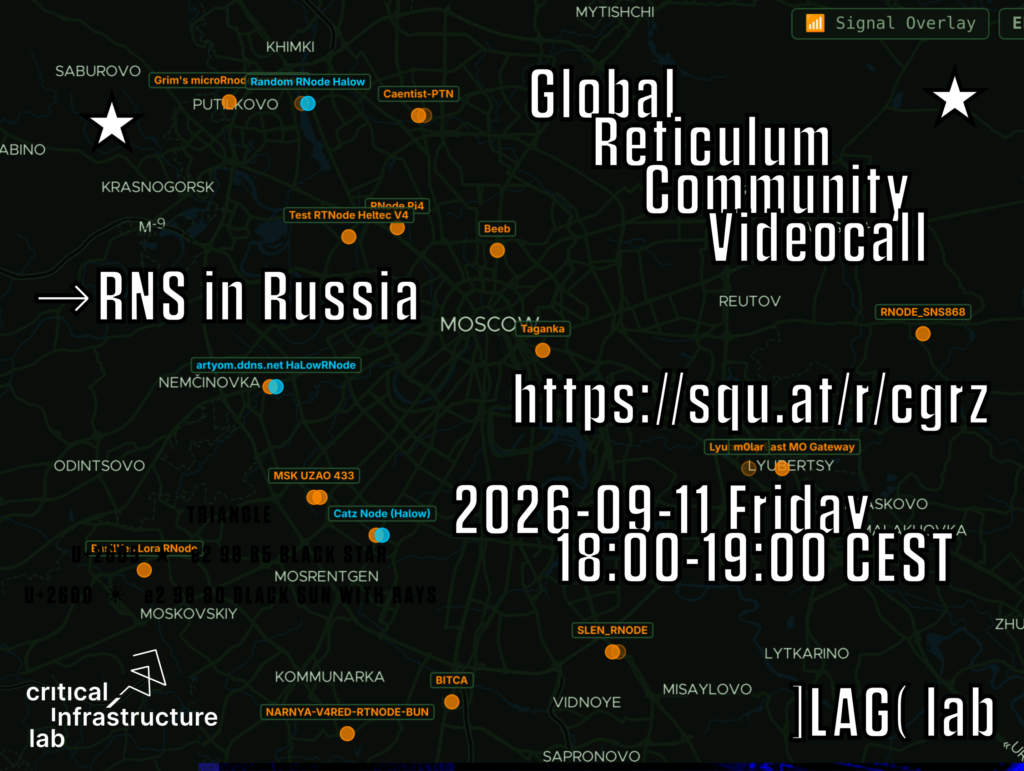
# community call Global Reticulum Community Videocall No.7 September: RNS in Russia September 2026
The seventh Global Reticulum Community Videocall to connect local communities building autonomous networks using the versatile networking stack and its rapidly expanding ecosystem of software and hardware. This edition is featuring a scene report on Russia by Pavel. It is one of the most prolific territories where this type of mesh network is deployed, as you can see on rmap or rns.moscow. The format of the event is presentation and discussion.
Location: this is a videocall anyone can join on https://lecture.senfcall.de/max-41z-bmj-j1g with code “538521” and some will be at the ]LAG( lab in Amsterdam. Facilitated by the critical infrastructure lab.
# infrastructure walk Sept 4th data centre walk September 2026
Join us on Sept 4th at 16.00 for a(nother) data centre walk to the controversial Equinix hyperscaler under construction in Amsterdam Zuid Oost. Infrastructure walks are like guided tours of the city, or birdwatching expeditions – but instead of pointing out noteworthy architectural details of historical buildings or showing participants how to best observe particular species of birds, we will explore the digital infrastructures deployed in public spaces. In this case, a piece of land undergoing an infrastructural transformation into a speculative cloud factory. A transformation that places significant strain on the community of Amsterdam Zuid Oost, Amsterdam’s land, energy, and water systems, and the city’s housing aspirations.
Sign up for the data centre walk here.
The weather forecast is looking quite humid and it’s quite possible that there will be rain during the walk. Please bring an umbrella and appropriate clothing. We will walk only on paved surfaces, so mud won’t be an issue.
There are two meeting point options. Be on time to not miss the start of the walk:
City centre/University: 16.00 at UvA Bushuis, Kloveniersburgwal 48.
Amsterdam-Zuidoost: 16.30 at Bullewijk metro station, northern entrance (the one closer to Bijlmer ArenA)
The walk will include different stops and interactive activities around the data centre development area. We will end around 18.30 (and no later than 19:00) at Bullewijk metro station. After the walk, there is the option for self-organised drinks in the local area or in the city centre.
# event Memory, fantasy, and technology September 2026
Join us on Thursday evening, September 3rd, for the first try out of Green Clouds, followed by a lecture on Sci-fi, fantasy, and Marxism.
Try out: Green Clouds, Remember To Forget Me
Can we still be forgotten? In this immersive lecture, Mamamess takes you on a journey exploring the tension between fragile human memory and the permanence of digital data storage. She asks: What happens to us when machines no longer forget—even after we are gone? Can forgetting become an act of resistance against today’s surveillance economy, where data about us is continuously collected, stored, and analysed? Set against the backdrops of a hospital waiting room, data centres, and outer space, this collective experience invites us to contemplate the meaning of forgetting and to reflect on the collective right to be forgotten.
Sci-fi, Fantasy, and Marxism
Following the immersive lecture, Jelle Klaas explores what science fiction and fantasy can teach us about capitalism, class, feminism, and racism. Through images and film clips, he examines how imagined worlds shape our political imagination and everyday lives, and how popular culture helps us imagine alternative futures and negotiate social change.
About the event
September 3rd from 19.00-21.00
University Library UvA
Places are limited, please register here
About the speakers
Nirit Peled is an independent filmmaker and writer based in the Netherlands. She weaves stories across multiple media to examine societal structures, both intimate and institutional. Educated as an artist at the Rietveld Academy and a designer at the Sandberg Institute, she has also worked as a concept developer and script writer for commercial agencies and public broadcasters.
Jelle Klaas is a human rights lawyer at PILP, working on cases concerning the right to protest, anti-discrimination, privacy and socio-economic rights on behalf of NGOs, communities and activists. With an activist and Marxist background, he draws inspiration from science fiction and fantasy, genres he has followed passionately through his life as a consumer, Dungeon Master, player, fan, and critical observer.
# event AI, Infrastructures and Sustainability September 2026
Why are we rapidly expanding AI infrastructures? What is the social and environmental impact of rapidly expanding AI infrastructures? Who benefits from the AI–hype and who bears the costs? How do metaphors used to describe technology restrict our understanding of these questions?
Join us for the book launch ‘AI, Infrastructures and Sustainability’, an event that explores the material, political, and environmental realities behind today’s AI systems. The book explores critical issues, such as the environmental degradation, economicconcentration, and social justice of AI infrastructure, areas that have often been overlooked in discussion on sustainability.
The environmental impacts of data centres, the factories of AI, have been extensively documented. Despite this, the European Commission aims to triple the number of data centres operating within the EU, relying primarily on efficiency–based measures to control environmental harm. This “sustainability through optimization” approach flawed and does not account for AI’s supply chain of violence. So why are we deepening conflicts across the globe to build places where machines thrive?
During this event, editors Anne Mollen and Fieke Jansen, will introduce the ideas and motivations behind ‘AI, Infrastructure, and sustainability’, reflecting on what the material nature, political economy, and governance of AI reveal about its broader societal consequences. Contributing authors Anne Mollen, Patrick Brodie, and Gerwin van Schie will further explore the power structures, environmental impact, and knowledge implications of AI infrastructures.
Speakers
Anne Mollen is a postdoctoral researcher at the Institute of Communication Studies at the University of Münster. She conducts research on automation, algorithms and “Artificial Intelligence“, specifically on the sustainability of AI, automation and public opinion formation, and the use of automated decision–making systems in the workplace.
Patrick Brodie is an Assistant Professor and Ad Astra Fellow in the School of Information and Communication Studies at University College Dublin. His research focuses on the political ecology of digital infrastructures. He is the co–author of From the Bog to the Cloud: Dependency and Eco–Modernity in Ireland (Bristol UP, 2025).
Gerwin van Schie works as an Assistant Professor in the Media and Culture Department at Utrecht University, where he investigates how plant, soil, flower, and tree metaphors are operationalised in various forms of algorithmic culture, ranging from government data systems to academic discourse on platform infrastructures.
Fieke Jansen is Assistant Professor at the Media Studies department of the University of Amsterdam. She is the co-PI of the critical infrastructure lab and her research focusses on how the material impact of expanding infrastructures is shaping the management, distribution, and depletion of natural resources.
https://spui25.nl/programma/ai-infrastructures-and-sustainability
# talk - presentation - panel Big Tech and AI Systems in Global Climate Governance August 2026
Screens and Streams in the Age of Climate Crisis
26+27 august 2026
Vrije Universiteit Amsterdam
panel 5: junior scholars
Ischa Borger, Vrije Universiteit Amsterdam
Carbon Capture Capitalism: Against the Aesthetics of Profitable Post-Apocalyptics
Tessa Holscher, Utrecht University
“Whatever is Capable of Breaking our Hearts is also Capable of Moving us to Change”: Invoking the Eco-Eschatology of Honeyland and “From Atop A Mountain”
Valentina Ochner, Vrije Universiteit Amsterdam
Big Tech and AI Systems in Global Climate Governance
# talk - presentation - panel Securing the Market: AI, Predicting Hazards, and Managing Vulnerability August 2026
Screens and Streams in the Age of Climate Crisis
26+27 august 2026
Vrije Universiteit Amsterdam
panel 2: digital
Fieke Jansen, University of Amsterdam
Securing the Market: AI, Predicting Hazards, and Managing Vulnerability
Michał Pabiś-Orzeszyn, University of Lodz
Intertwining Scopes: Assessing the Environmental Footprint of an AI-Driven Art Project
Hunter Vaughan, Emerson College, Boston
Sustainable Digitalisation? The Social Threats and Environmental Costs of a Digital Screen Culture
Fieke will present a paper titled ‘Securing the market: AI, predicting hazards, and managing vulnerability‘. This paper is part of a research project with Iliana Depounti.
# talk - presentation - panel Russia’s National Internet Filtering System — CIL report preview August 2026
critical infrastructure lab invites you to an online preview of two forthcoming reports on Russia’s national internet filtering system, known as TSPU (Technical Means of Countering Threats).
Drawing on two years of research, we will discuss how TSPU works, what sustains it, how it blocks and disrupts online services, and what this means for civil society and technical communities.
We hope you can join us!
The session will take place on Friday, 21 August 2026, at 11:00 a.m. EDT / 17:00 CEST.
Registration link: https://uva-live.zoom.us/meeting/register/dlzASp1CSMapbsHFfIr0nw
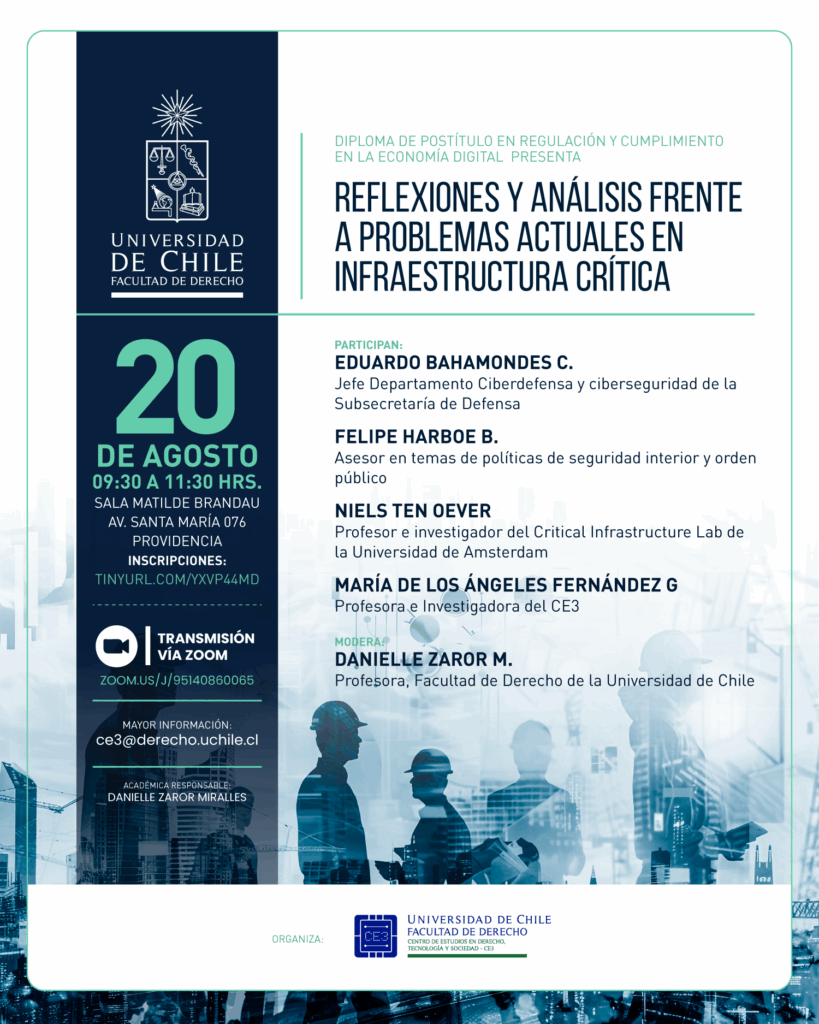
# talk - presentation - panel Reflexiones y análisis frente a problemas actuales en infraestructura crítica August 2026
Inscripciones / Registration: tinyurl.com/yxvp44md
Opción transmisión Zoom / Join via Zoom: zoom.us/j/95140860065
# call for contributions Workshop Announcement and Call for Position Papers June 2026
Deconstructing Infrastructural Expansion: Circulation across Sea, Land, and Sky
critical infrastructure lab at the University of Amsterdam
Centre for Internet and Society at CNRS
Inria
University of Lille
In the geopolitical race for technological hegemony, regimes are using digital sovereignty policies to enact control and grow their own digital economy. A central element of these industrial policies is the creation of an enabling environment for infrastructural expansion: targeted investment in the technology sector, deprioritization of environmental and social protection, and creation of new electricity infrastructures are all meant to underwrite the build-out of submarine cables, data centres, telecommunication infrastructures, and satellite constellations. Industrial policies are proposed to derisk supply chains on which national and economic security depend. Infrastructure space itself becomes a medium of statecraft (Easterling 2014), where power is reconfigured through design, finance, technology, and circulation.
The world becomes ever further enmeshed in a circulation complex that both encases nature and society for generations to come. In this workshop, circulation offers a lens to understand both the workings of the entire market and its relation to that of specific industries (Kjøsen 2018). It allows for theorization about how the externalisation of costs, regulatory capture, corporate power, and the generation of financial power that propels infrastructural expansion outward and downward, from the seabed to low earth orbit, and how these dynamics are encoded into routing decisions, protocol design, and systems architecture.
Topics of Interest
In this second infrastructure workshop, we are interested in thinking through the consequences of the increasing private ownership of expanding communication infrastructure from the sea to the sky and methods of measuring it. We attend to the territories, people, natural resources, and environments being sacrificed in the name of progress, economic growth, and control (Mollen et al. 2026), the violence that circulation and logistics carry with them (Cowen 2014), and critical quantitative and qualitative methods to foreground underpinning patterns. We ask what technical inquiry can reveal that other approaches cannot: how the measurement of interconnection and autonomous systems exposes the concentration of ownership; how the materiality of compute, spectrum, and orbit decides who gets to build and who does not; and how shifting ownership structures and modalities translate, operationally, across submarine cables, data centres, and low-orbit satellites. We therefore welcome contributions that bring network measurement, systems design, and security research into contact with political economy and critical theory, alongside work that asks how people engage with and contest these configurations, whether alternative architectures are possible, and what it is that we want from our communication infrastructures in the first place.
Themes and topics
The 2nd INFRASTRUCTURE Workshop brings together researchers from Science and Technology Studies (STS), Political Economy, Social and Human Geography, Computer Science, and related fields to critically examine the material, environmental, political, and socio-technical foundations of today’s computing systems. We invite contributions that address, but are not limited to:
- Sea, land, and sky as infrastructural frontiers: submarine cables, terrestrial data centres, and low-orbit satellite constellations as sites of expansion, and how the three domains are being knitted into a single circulation complex.
- Infrastructure as asset class: the financialisation of connectivity and computation; firms as financial instruments and infrastructures as investment objects; venture capital, private equity, and the conditions of public listings.
- Externalisation and its costs: the environmental, territorial, and labour costs displaced onto people, ecologies, and resources; energy and water demand, mineral extraction, and land use; regulatory capture and algorithmic control as mechanisms of cost-shifting.
- Digital sovereignty as industrial policy: state investment, deregulation, and subsidy regimes that build an enabling environment for expansion; the US-China race for technological hegemony and its peripheries.
- Circulation as concept and method: theoretical and empirical engagements with circulation (Kjøsen 2018; Dyer-Witheford and Mularoni 2025); the circuit linking labour, data, advertising, logistics, and the production of desire; and what the concept reveals that other frames miss.
- Logistics, ownership, and the state: logistical power and the violence of global trade (Cowen 2014); shifting ownership structures across cables, data centres, and satellites; public, private, and hybrid arrangements; and the material limits of sovereignty claims.
- The stack as a site of power: routing and peering, protocol standards, autonomous systems, and default configurations as the places where ownership and control are quietly enacted; and what network measurement, interconnection analysis, and the study of traffic and dependency can reveal about concentration, chokepoints, and the limits of sovereignty at the technical layer.
- Counter-infrastructures and building otherwise: how engineers, communities, and publics contest, repair, and reimagine these systems; commons-based, federated, and decentralised architectures; and the technical and political conditions under which alternative designs become viable or are foreclosed.
Submission
We are looking for short position papers of about 3-pages (maximum 1500 words) that engage with infrastructural expansion and circulation. In general, a position paper outlines a stance on a particular issue or topic and provides arguments and evidence to support this view. There will be no formal presentation of the papers, but they will shape the agenda and the discussion. Following the workshop, we will discuss the possibility of a joint publication that can serve as an intervention into the field.
Submit your position papers as PDF by sending it attached to an email to submission@criticalinfralab.net with the subject line ‘[sea|land|sky] paper title’
Important dates
- Short Position Paper Submission Deadline: 15th September 2026
- Notification of Acceptance: 1st of November 2026
- Workshop: 28 – 29th of January 2027
Other information
This 2nd Infrastructure workshop is hosted by the critical infrastructure lab at the University of Amsterdam. It builds on and follows from the 1st INFRASTRUCTURE Workshop organized by LS2N and CNRS.
Please note that we have limited funds to support people travelling to Amsterdam. This option is intended to support those who could not otherwise participate in the event, especially early career researchers.
References
Cowen, D. (2014). The deadly life of logistics: Mapping violence in global trade. University of Minnesota Press.
Dyer-Witheford, N., & Mularoni, A. (2025). Cybernetic circulation complex: Big tech and planetary crisis. Verso.
Easterling, K. (2014). Extrastatecraft: The power of infrastructure space. Verso.
Kjøsen, A. M. (2018). Circulation. In A. Pendakis, I. Szeman, & J. Diamanti (Eds.), The Bloomsbury companion to Marx (pp. 281–288). Bloomsbury Academic.
Mollen, A., Jansen, F., Kannengießer, S., & Velkova, J. (2026). AI infrastructures and sustainability: Expanding perspectives on automation, communication and media. Springer. https://doi.org/10.1007/978-3-032-09748-4
Steinhoff, J., Kjøsen, A. M., & Dyer-Witheford, N. (2024). Stagnation, circulation, and the automated abyss. In J. Fehrle, M. Lieber, & J. J. Ramirez (Eds.), (De)Automating the future: Marxist perspectives on capitalism and technology (pp. 288–310). Brill.
# keynote Technical Implications of Digital Sovereignty: Towards European Architectural Autonomy June 2026
SURF Security & Privacy Conference 2026
2026-06-26 15:15–15:45, Plenary room (1B.10) Language: English
European digital sovereignty initiatives focus on reducing dependence on US companies by creating European alternatives and through data localisation. This approach overlooks a fundamental problem: network externalities create continued US dominance even under European ownership. In this talk, Niels compares Russia’s isolationist network sovereignty, China’s government-directed standardization, and argues for a distinctly European approach. This approach is rooted in developing an alternative technological trajectory by designing open architectures that distribute power and embed European values: democratic governance, environmental sustainability, privacy, and social inclusion.
# talk - presentation - panel Lunch lecture: The Cloud in the Land of Fire and Ice June 2026
What are the political ecologies of data centers in times of environmental crisis? Drawing from ethnographic fieldwork in the Icelandic data center industry, this talk will address how the relationship between digital and energy infrastructures shapes corporate sustainability, materialities and limits of computation. Over the last two decades, data centers expanded in Iceland powered by abundant and inexpensive hydro and geothermal electricity, and cool climate – perks of Icelandic infrastructures that are strategically used to portrait the sub-arctic island as the ‘natural fit’ (Johnson 2023) for data and sustainability. Today, the industry scores the second highest rates of electricity consumption in the country – only behind aluminum smelters – and is expected to double its size in the next decades to absorb new demand for generative AI. At the same time, droughts affect the main reservoirs of hydropower plants, constraining the electricity generation in the island, and shifting imaginaries from abundancy to scarcity. Ultimately, this talk articulates the entanglements of state, corporations and the environment within forms of extractivism enabled by digital technologies and their infrastructures.
Details: June 24 12.00-14.00 at the University of Amsterdam. Please register here and we will send you the details.
About the speaker
Felipe Silva Figueiredo is a visiting researcher at the critical infrastructure lab. he is a phd student at the it university of copenhagen, in denmark. he has background in anthropology and science and technology studies. felipe’s current phd research focuses on the political ecology of data centers and energy infrastructures in iceland, and how electricity shapes the sustainability and the limits of computation. his general interests lie in the intersection between infrastructure development and environmental crisis, and ways of resisting capitalism.
# workshop Reticulum Workshop for Grassroots Communication Infrastructure June 2026
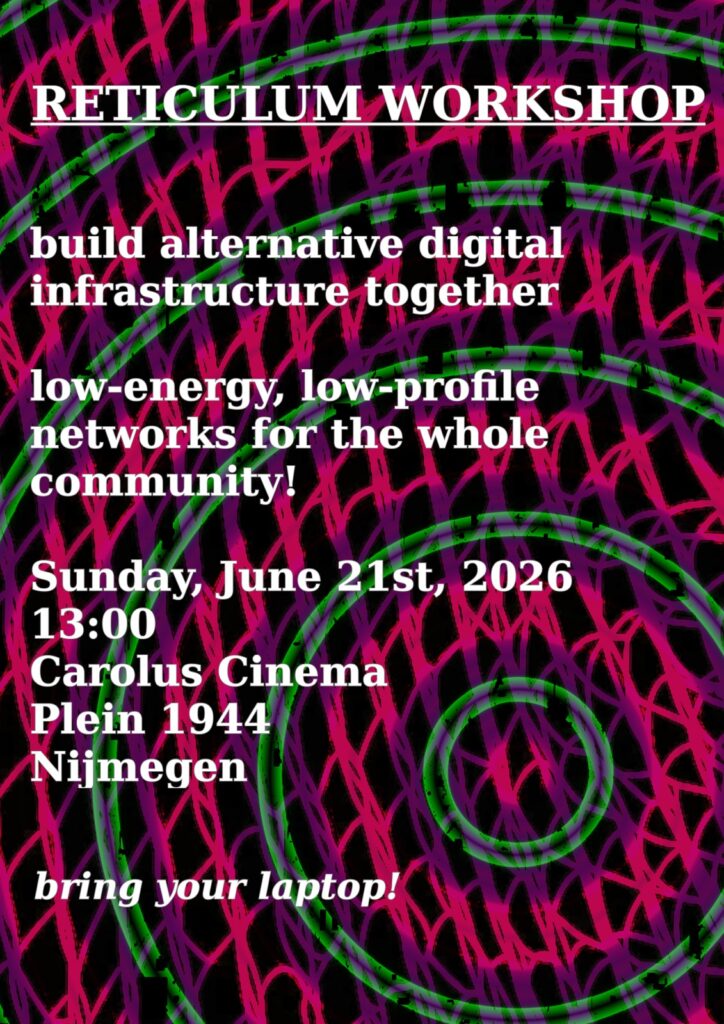
This Sunday (21.06.) from 13:00 onwards at the Carolus Cinema Squat in Nijmegen we will come together to gather the digital needs of our communities and figure out together how to set up secure, autonomous communication networks with the Reticulum Network Stack. We choose to focus on Reticulum because it is designed for heterogeneous networks built from various cheap devices, to be deployed in a bottom up way by small communities. It is a toolkit for building many different networks, with a focus on the decentralisation of power, low energy operation, and security. The event is also an opportunity to reimagine the Internet and our digital dependencies and plot together on how to build towards more self-determination and autonomy.
The mesh network stack runs on various platforms. You can run it on your desktop, your home server, your mobile phone or antennas on the roof. In the workshop, we will explore three layers of networking in dedicated working groups:
(1) The content layer, where communities are building the “social worlds of Reticulum” we can inhabit. What services and information communities and users find fruitful to circulate on an autonomous network? Reticulum networks can host “micron pages”, which are like websites from the 1980s. People around the world make them for both global and local circulation. Unlike on the Internet, anyone connected to the network can also host content and become a service provider.
(2) The radio layer, where information is transmitted through waves of energy in the electro-magnetic spectrum. We use chat apps over local peer-to-peer Bluetooth, WiFi, and Lora (“long range”) links, as well as connecting to Reticulum servers on the Internet. We explore the capabilities of each frequency and protocol: when are they useful, what ranges can they cover, which scenarios they fit well? Who can transmit no which frequencies? What does it mean to operate your own network?
(3) The network and transport layers, where the Reticulum Network Stack integrates into scenes, connects communities over time and space, transforming cities. We make some standalone nodes to deploy around Nijmegen to eventually build out an autonomous communication infrastructure. In the course of this operation, we can discuss how local scenes are organised in space, in terms of social relations and aspirations, cultural codes and interoperable political traditions. How can movements network and transform the city, inhabit urban space and invent new forms of life?
The ultimate goal of the workshop is to work towards a paper zine on community networking, based on the experience of the three work groups that explore different socio-technical layers.
- No prior knowledge is needed!
- Bring your laptop if you can.
- After the session dinner will be provided.
More information about the Reticulum Network Stack for community building can be found on the dedicated website here: https://reticulum.community/
The event is open to all, on donation. We call on participants to reflect on gender dynamics during the event, since critical approaches to technology invite the performance of particular masculinities that tend to reproduce patriarchal power relations, even in the guise of hacker cultures and decentralised political aspirations. Please also be aware that participation implies to accept the safer spaces policy of Jantien, which will be introduced at the beginning of the event.
# workshop Project XLR radio experiments June 2026
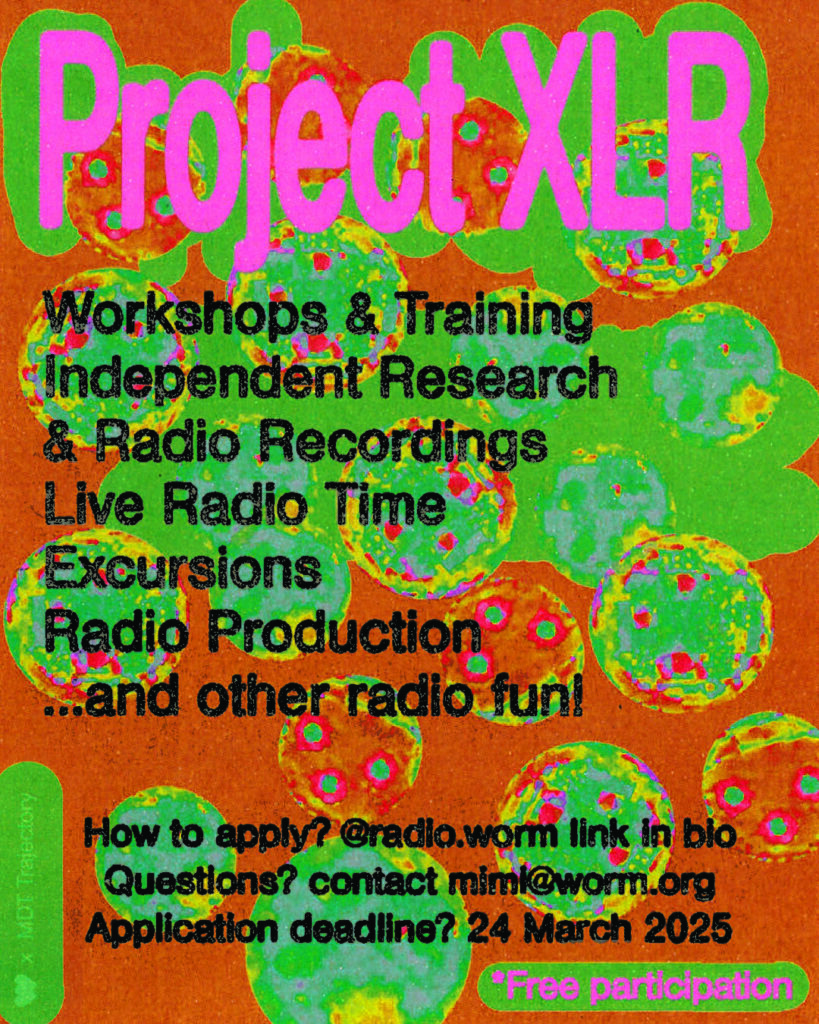
Project XLR collaborative radio experimentation workshop with Christy Westhovens, Radio WORM and the critical infrastructure lab. We will cover the political fundamentals of radio communication, explore the electromagnetic spectrum as a critical natural resource, and meddle in satellite hacking, heterogeneous networking, and signal identification with software defined radios. For the full workshop series see the announcement from WORM. June 12th at the workshop room of the Amsterdam Humanities Hub. Limited number of registrations through xlr@criticalinfralab.net
# talk - presentation - panel The True Cost of ICT: Crisis of Abundance June 2026
ICT4S workshop: Ultra-cheap microchips (<$1) are abundant and account for the vast majority of the >400 billion pieces sold per year. Their numbers keep growing as new technology nodes are released and the older ones (from as far back as the 1980s) continue to produce. These microchips do not exist on their own; they are packaged into every possible gadget around us, whether necessary or not. They make everyday objects ‘smart’, but this also increases their obsolescence. From disposable vapes to smart toys, cheap microchips enable the production of billions of new objects that will be discarded very soon. We want to investigate the environmental consequences of not cutting-edge microchips (as in AI and data centres), but of older generations that keep piling up production volume. In this workshop, we will investigate the enormous production cycle and examine its supply chains from an environmental perspective.
Workshop includes Adrian Friday, Fieke Jansen, Gauthier Rousillhe, and Srinjoy Mitra.
Registration info for the ICT4S conference or only the workshop can be found here https://conf.researchr.org/attending/ict4s-2026/registration
# talk - presentation - panel From India Stack to Euro Stack: Infrastructuring State and Governance June 2026
The UvA wide theme Responsible Digital Transformations hosts a panel discussion on Digital Public Infrastructures (DPIs): digital systems that enable secure interactions between people, businesses, and governments.
Date 2 June 2026
Time 17:00 -18:30
Location SPUI25
Digital Public Infrastructures or DPIs are the latest buzzword in global policy and governance circles, promoted by the United Nations, the World Bank, global philanthropies and governments across Global North and South. DPIs originated from the India Stack model to build meta, stackable digital infrastructures (for identity, payment and data) for seamless flows of public goods and services, where the state is responsible towards building public facing digital infrastructures and actual goods and service delivery are opened up to both public and private sectors. As per recent reports, there are more than 100 countries building DPI or DPI-like infrastructures. While their definition and meaning are fuzzy and contested, they offer new ways of thinking about infrastructures, governance and role of the state in times of crisis for state sovereignty and democratic institutions.
As infrastructures allow the state to translate its political power into everyday features of life and thereby represent its power to its citizens, it thus becomes important to unpack what power constellations DPIs are constituted of, how will they shift existing regulatory, bureaucratic and technical arrangements of governance, and what implication will they hold for state sovereignty and democratic institutions. To address some of these questions, we invite you to a panel discussion with:
Niels Ten Oever Assistant Professor in the European Studies department and co-principal investigator of the critical infrastructure lab at the University of Amsterdam working on how invisible infrastructures shape the socio-technical ordering of information societies and how this influences the distribution of wealth, power, and opportunities
Carolina Maurity Frossard Assistant Professor in the Political & Economic Geographies, and co-director of the Centre for Urban Studies at the Amsterdam Institute of Social Science Research (AISSR), University of Amsterdam examining how digital devices and infrastructures shape socio-spatial politics and inequalities at different scales
Nafis A. Hasan Assistant Professor in the Department of Anthropology, University of Amsterdam studying impacts of digital technology on humans and organizations in the realm of public governance in South Asia
Bidisha Chaudhuri Assistant Professor of Government, Information Cultures and Digital Citizenship in the Department of Media Studies, University of Amsterdam, investigating the political economy of digital infrastructures and governance in the Global South
# workshop Understanding and researching the datafied state June 2026
Workshop at the 4th International Data Justice Conference “The Datafied State”. The event will be held on 1-2 June 2026 at Cardiff University by Jedrzej Niklas (University of Cambridge) and Fieke Jansen (University of Amsterdam).
Day 1 – Monday, June 1st (Room: 1.09)
# talk - presentation - panel Energy, Food and Data Justice June 2026
Panel at the 4th International Data Justice Conference “The Datafied State”. The event will be held on 1-2 June 2026 at Cardiff University.
Day 1 – Monday, June 1st
Energy, Food and Data Justice (Chair: Fieke Jansen, Room: 1.05)
| Josephine Ewoma (University of Manchester) | Transparency or surveillance? How app- and platform-based interventions are shifting visibility across food systems: a case study of Ghanaian farms. |
| Hadley Beresford, Lee Pretlove (University of Sheffield) | ‘Greening AI? Mapping policy recommendations for improving AI’s eco-sustainability and how these relate to invisible energy policies’ |
| Christina Willems (University Erfurt) | Valuing Energy Data: Contested Meanings Between State and Civil Society Actors in Germany |
| Natalia Lisowska (University of Groningen) | Between data justice, its normative uncertainties and importance for the energy sector |
| Sara Garsia, Alexandra Papageorgiou (KU Leuven) | Towards Integrated Justice Frameworks: Data Justice at the Core of Environmental and Energy Justice |
# talk - presentation - panel More computing for a burning planet? A scarcity approach to AI infrastructures June 2026
Academic talk with Fieke Jansen at the 4th International Data Justice Conference “The Datafied State”. The event will be held on 1-2 June 2026 at Cardiff University.
Day 1 – Monday, June 1st
11.15 – 12.45 PARALLEL SESSIONS A: AI and Data Infrastructure (Chair: Jedrzej Niklas, Room: 1.07)
# keynote The ecology of AI May 2026
How do we break something that is already broken?
Virtual Assembly of the Critical AI Network, CPCT (27-29 May, 2026, online)
Guided by the premise that under the hood, AI is simply the same technology whether it is being introduced into education or other domains of life, we ask how we might articulate and analyze the relations forged by AI between vastly different areas that hitherto appeared to be unconnected. What insights might be gained from situating AI within an ecology? How does AI compete with others in this ecology for natural resources, and what can be done to mitigate, contain, or reverse this impact? If, as we propose, AI should be evaluated not as a tool with a use value but rather as the latest symptom of misused infrastructures, how might we articulate the counterproductivity that AI adoption represents within its ecology for any green policy?
# talk - presentation - panel Interlinking sustainability and data management May 2026
Data has become the new gold, and this truism is increasingly holding true. Organisations and society at large are confronted with an ever-growing flood of data — collected, stored, and hoarded as a matter of course. Yet behind the promise of the immaterial “cloud” lies a very material reality, think of data centres straining energy grids and impacting the surrounding communities.
This seminar tackles this interlinkage between data and sustainability and provides avenues for improvement – from a technical and organisational perspective.
Bringing together academic insight and frontline industry experience, this event will explore this most urgent topic. Joining us are:
- Dirk Deridder, CTO of Smals, who will offer his account of navigating these pressures from within a major organisation. Smals is a Belgian ICT organisation delivering digital infrastructure and services to over 300 public institutions in the social security, healthcare, and e-government sectors. In doing so, it operates 4 data centres.
- Fieke Jansen, University of Amsterdam: Dr. Fieke Jansen is co-principal researcher at the critical infrastructure lab, and co-lead of the Green Screen Coalition. Her work investigates how the infrastructure of our digital world, data centres, and AI influence the environment, raw material use, and climate.
- Academic members of the SDM consortium: prof. An Braeken (VUB), prof. Jan Tobias Mühlberg (ULB), prof. Geoffrey Aerts (VUB). They will share their latest insights into how organizations can improve the sustainability of their data management practices.
Audience: The seminar welcomes industry professionals, academics working in related fields, and the wider public interested in the link between data management and sustainability.
Location: Becentral. Upon arrival, register at the main entrance. Event takes place at the FARI auditorium – 4th floor.
Date: 26/05
Time:
· 12:30-13:00 Lunch
· 13:00-15:10 Industry and academic speakers
· 15:10-16:00 Networking drink
This seminar is organised by the SDM (Sufficiency & Data Minimization) consortium, a collaboration between research groups at VUB and ULB. Funded by the Brussels-Capital Region – Innoviris.
Register here: https://www.eventbrite.com/e/seminar-interlinking-sustainability-and-data-management-tickets-1985288060030
# workshop Low-profile and low-energy autonomous networking with Reticulum at AMRO festival, Linz May 2026
AMRO, Art Meets Radical Openness, is a festival, a platform and a community for art, hacktivism and open cultures, organised since 2008 by
servus.at in cooperation with the Linz University of Art, Department of Time-Based Media.
In this workshop, we will explore the possibilities for setting up a decentralized off-grid communications system using the Reticulum communication protocol stack. We choose to focus on Reticulum because it is designed for heterogeneous networks built from various cheap devices, to be deployed in a bottom-up way by small communities.
# call for papers Invitation Abstract Critical Internet Governance Special Issue May 2026
Towards Critical Internet Governance: Centering Power and Struggles for Justice and Distribution
Special Issue Editors: Niels ten Oever, Fieke Jansen, Fernanda Rosa, Roxana Radu
TL;DR: Please submit a 750-word extended abstract outlining your research question, theoretical framework, methodology, and contribution to the field of critical internet governance by July 1 to submission@criticalinfralab.net . We will notify you by September 1 whether your abstract has been accepted, and will inform you of the target journal as soon as possible.
Over the past three decades, the Internet has shifted from an exploratory, experimental space to a densely financialised and highly consolidated infrastructure (Ortiz Freuler 2022). Where the “early Internet” was an unknown place that nonetheless felt like a home to a nascent community actively shaping its ecosystem, there were already many power structures at play (DeNardis 2009, Russell 2014, Carr 2015, Radu 2019). Today’s Internet is intimately familiar to billions, mostly as users and consumers, yet increasingly inhospitable and ungovernable to many (Bhat 2020). This transformation has profound implications for how Internet governance should be understood, practised, and studied.
Internet governance as a field emerged in a period when the Internet was widely perceived as a space for exploration in modes of connection and institutional experimentation, rather than extraction. In this zeitgeist, scholarly interest in the concentration of power in a distributed infrastructure focused primarily on theorizing about its technical coordination, regulatory design, and institutional arrangements. In doing so, scholars often omit to engage with other disciplines that situate these developments within histories of exploitation and extraction, such as decolonial, feminist, environmental, and broader social justice perspectives (Rosa 2022, Jansen 2025).
The contemporary Internet, structured around platform capitalism, corporate concentration, and opaque infrastructural arrangements invites a transformation of Internet governance scholarship. The Internet’s significant social, economic, and environmental dependencies demand dialogue and engagement with a wider set of perspectives that offer critique and imagine “emancipatory alternatives to transcend the status quo” (Gunderson, 2020, p. 89; Ruha, 2024). This Special Issue takes up that challenge by asking: How do critical approaches to internet governance reveal the infrastructural and institutional foundations of power and ideology in the contemporary Internet, and in what ways can these insights generate alternative trajectories and pluriversal perspectives aimed at reconfiguring individual/collective rights, agency, and opportunity?
This Special Issue on Critical Internet Governance builds on a 4S (Society for Social Studies of Science) pre-conference held at the University of Amsterdam in July 2024, and a satellite event at AOIR (Association of Internet Researchers) held in Rio de Janeiro in July 2025, where scholars from around the world convened to rethink what a critical field of Internet governance could be. Participants highlighted how crucial questions of power, materiality, environmental justice, disability, gender, race, ethnicity, socio-economic inequalities, digital colonialism, and sovereignty, along with the role of non-human actors and ecologies, remain marginal in mainstream Internet governance debates, even as they are increasingly central to emerging work on infrastructures, platforms, and AI.
The Special Issue invites contributions that foreground the technopolitics of the Internet and its infrastructures through plural, critical, and situated approaches. We particularly welcome work that:
- Foregrounds the study of power in internet governance, including infrastructural consolidation, materiality, and political economy
- Brings decolonial, Black, anti-racist, feminist, Indigenous, and anti-fascist perspectives to Internet governance institutions, practices, and standards
- Connects Internet governance to environmental justice, resource extraction, and the materialities of digital infrastructures
- Reconsiders sovereignty, jurisdiction, and control in relation to transnational power asymmetries and global South perspectives
- Examines how AI, platforms, and other “applications on top” of the Internet reconfigure governance, responsibility, and accountability
- Centers marginalized actors and “invisible” forms of governance, including community networks, and grassroots initiatives
- Expands the unit of analysis beyond states and corporations to include non-human actors, ecologies, and long-durée historical, social, political, and economic processes
By bringing together Internet governance scholars and researchers from adjacent and intersecting fields (including STS, critical data studies, media studies, communications, political economy, environmental humanities, decolonial, feminist and Indigenous studies, and law), this Special Issue aims to consolidate and amplify a critical turn in Internet governance. The goal is not only to broaden the conceptual and empirical scope of the field, but also to reimagine its sense of community: who counts as an Internet governance scholar, what infrastructures and practices are considered, and which futures of the Internet are rendered thinkable.
We welcome theoretical, empirical, methodological, and positional contributions in the form of full journal articles that engage with Internet governance as a site of contestation over global digital media infrastructures and that propose alternative horizons for governing the Internet otherwise.
Please submit a 750-word extended abstract outlining your research question, theoretical framework, methodology, and contribution to the field of critical internet governance by July 1 to submission@criticalinfralab.net . We will notify you by September 1 whether your abstract has been accepted by the editors, and will inform you of the target journal as soon as possible.
References
Benjamin, Ruha. 2024. Imagination: A Manifesto W. W. Norton & Company
Bhat, R. (2020). The politics of internet infrastructure: Communication policy, governmentality and subjectivation in Chhattisgarh, India [PhD Thesis]. The London School of Economics and Political Science (LSE).
Carr, M. (2015). Power Plays in Global Internet Governance. Millennium, 43(2), 640–659. https://doi.org/10.1177/0305829814562655
DeNardis, Laura. Protocol Politics: The Globalization of Internet Governance. MIT Press, 2009.
Jansen, F. (2025). From growth to scarcity: Can Internet Governance meet the ecological crisis? Critical Internet Governance: From Positions to a Field, 44. https://doi.org/10.5281/zenodo.15627726
Gunderson T. (2020). Making the Familiar Strange: Sociology Contra Reification. Routledge.
Ortiz Freuler, J. (2022). The weaponization of private corporate infrastructure: Internet fragmentation and coercive diplomacy in the 21st century. Global Media and China, doi:https://doi.org/10.1177/20594364221139729
Radu, R. (2019). Negotiating Internet Governance. Oxford: Oxford University Press.
Rosa, F. R. (2022). From community networks to shared networks: The paths of Latin-Centric Indigenous networks to a pluriversal internet. Information, Communication & Society, 26(11), 2326-2344. doi: https://doi.org/10.1080/1369118X.2022.2085614
Russell, A. L. (2014). Open Standards and the Digital Age. Cambridge University Press.
Truscello, M. (2023). The Internet Shutdown and Revolutionary Politics: Defining the Infrastructural Power of the Internet. South Atlantic Quarterly, 122(4), 811–826.
# talk - presentation - panel How to boil a data center? May 2026
A session of lectures and presentations about the current uncontrolled rise of data centres across the globe. Impact on the environment, current project explorations, local examples like Kronstorf, but also in the Netherlands. We’ll discuss then also current resistance modes against datacenter constructions, how to oppose such projects, learn from other experiences and plan to be effective on scale.
https://radical-openness.org/en/programm/2026/morning-session-how-boil-data-center
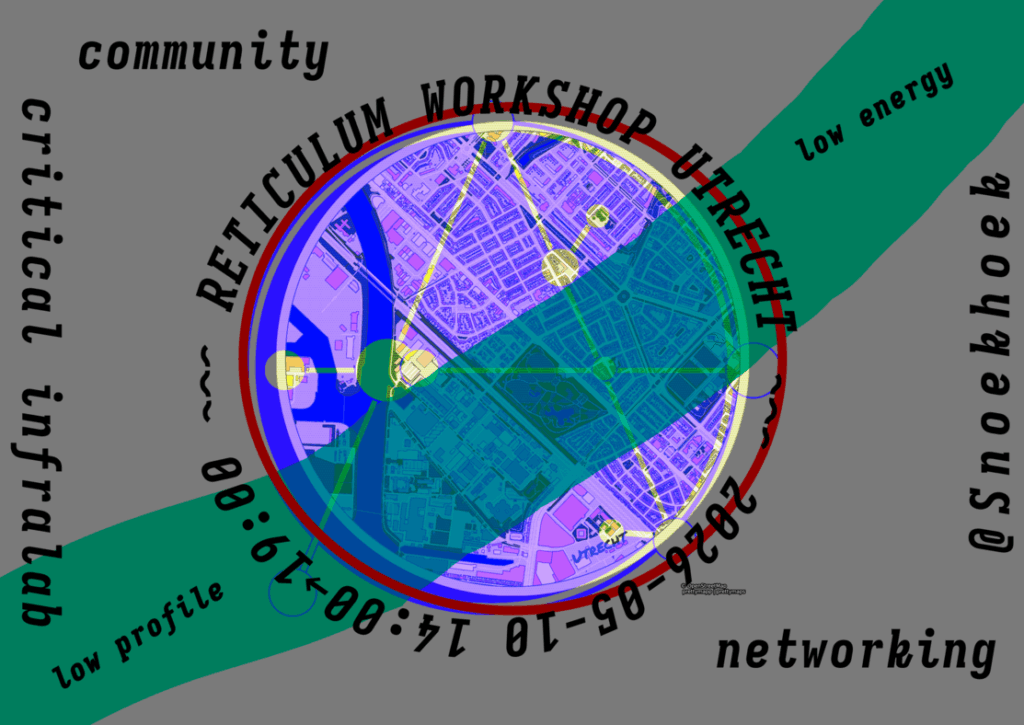
# workshop Reticulum Workshop Utrecht May 2026
Running your own communications infrastructure has obvious benefits. We live in a world of increasing digital censorship, and are rarely completely in charge of our communications. Even if we choose to use “better” alternatives to WhatsApp, Instagram, etc., we are still always completely reliant on the one underlying network, i.e. “The Internet”. With the push of a button, “The Internet” may all of a sudden become unavailable. In places with oppressive regimes, this has not been uncommon. In the current political climate, it would not be surprising if any political system all of a sudden became repressive.
In this workshop, we will explore the possibilities for setting up a decentralized off grid communications system using the Reticulum communication protocol stack. We choose to focus on Reticulum because it is designed for heterogeneous networks built from various cheap devices, to be deployed in a bottom up way by small communities.
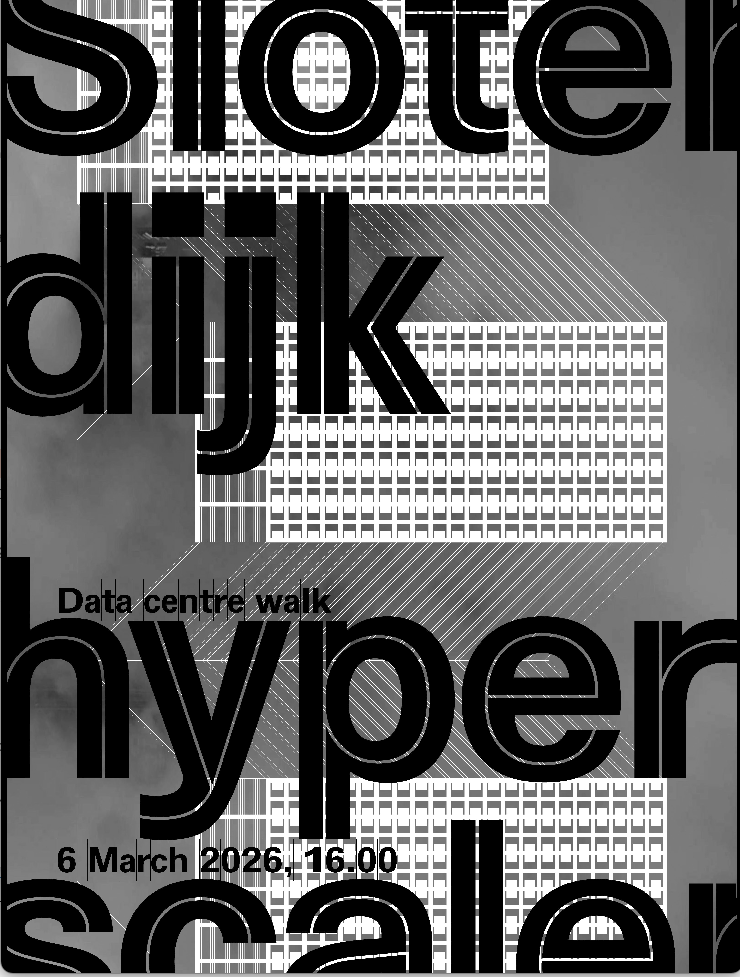
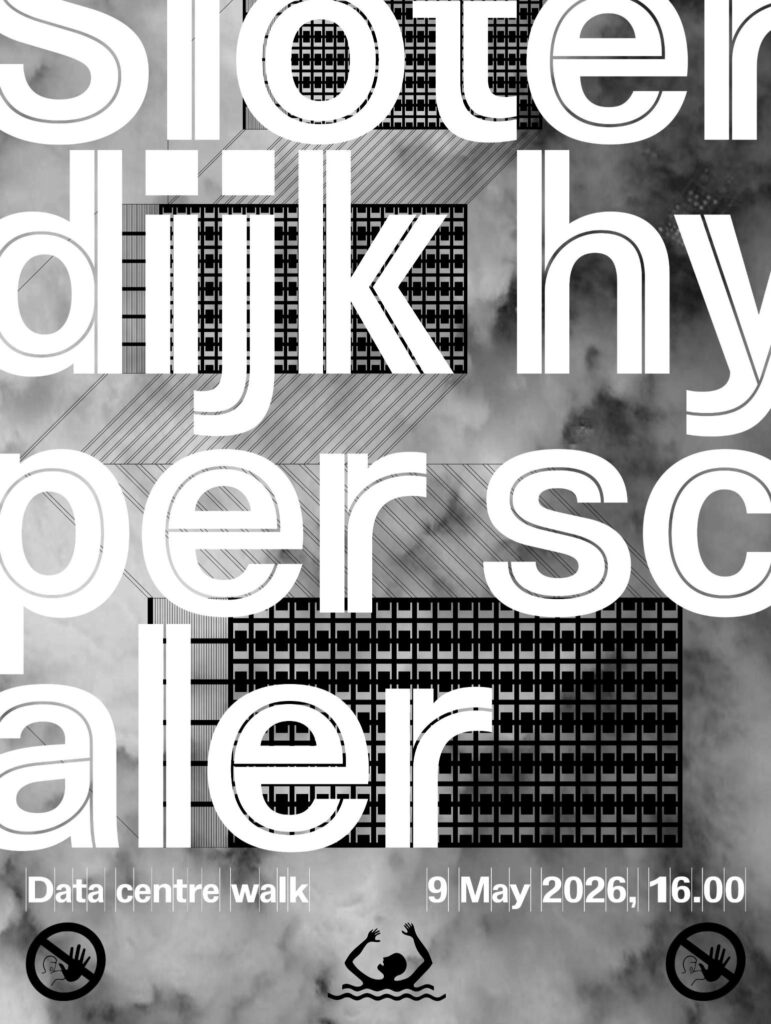
# infrastructure walk Data centre walk Sloterdijk hyperscaler May 9th May 2026
Join us on May 9th at 16.00 for a(nother) data centre walk to the controversial Microsoft hyperscaler under construction on the Plimsollweg, near Sloterdijk station. Infrastructure walks are like guided tours of the city, or birdwatching expeditions – but instead of pointing out noteworthy architectural details of historical buildings or showing participants how to best observe particular species of birds, we will explore the digital public infrastructures that are deployed in public spaces. In this case, a piece of land undergoing an infrastructural transformation into a speculative Cloud factory.
During our previous walk on March 6th, we discussed the 10-year-long financial speculation over this piece of land, the layers of subcontracting that hide Microsoft as the tenant of the hyperscaler, the municipality’s zoning policy, and the implications of such a project on the health of the land, water, local residents, and on our ability to access electricity equitably.
We return to the same site two months later to check on the construction progress, as well as to continue our discussions on these topics. We will end at De Sering with a community dinner, followed by a collaborative session to exchange about ways of responding to the harmful effects of this and comparable Cloud infrastructure projects.
Registration is closed.
# broadcast Global Reticulum Community Videocall No.4 May 2026
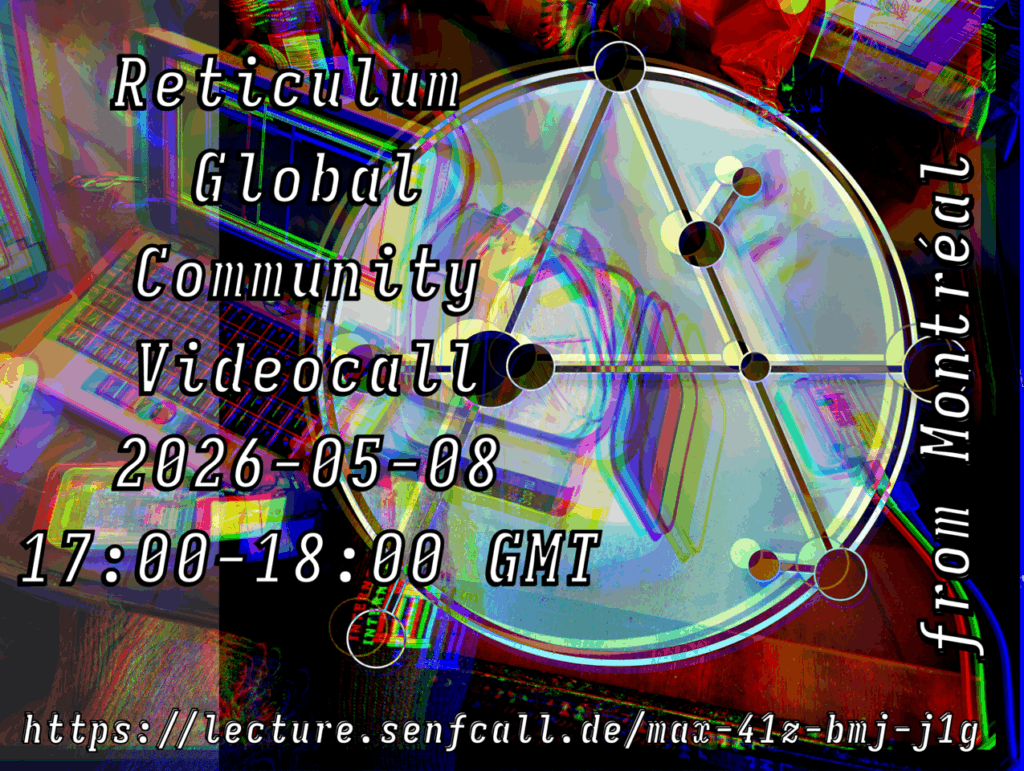
The fourth Reticulum Community Videocall to connect local communities building autonomous networks using the versatile networking stack and its rapidly expanding ecosystem of software and hardware. The featured community this month is in Montréal, Québec.
# talk - presentation - panel Whose interests count in data centre expansion in Europe April 2026
Alex Lutz and Fieke Jansen gave a talk about whose interests count in data centre expansion in Europe at the Festival Le Nuage était sous nos pieds – Déplier la tech.
https://lenuageetaitsousnospieds.org/agenda/#festival-le-nuage-etait-sous-nos-pieds-deplier-la-tech
# workshop Statecraft, Sovereignty and Digital Government April 2026
A two-day symposium, 16-17 April, 2026, Goldsmiths, University of London.
Dmitry Kuznetsov and Alex Gekker will present on Russia’s Sovereign AI strategy.
https://www.gold.ac.uk/media-communications/research/statecraft-sovereignty-and-digital-government-
# keynote The State of the Internet 2026 with Fieke Jansen April 2026
During the State of the Internet, Waag Futurelab takes the annual temperature of the internet. This edition focuses on AI and the limits of our planet. The lecture will be given by Fieke Jansen, co-founder of the Critical Infrastructure Lab.
Generative AI and other AI applications are currently being added to our technology everywhere. From search engines and social media to office software and urban infrastructure: AI is everywhere, whether we like it or not. Our digital landscape is changing significantly, but our physical landscape is perhaps changing even more dramatically. The arrival of large data centres, known as hyperscalers, is putting considerable pressure on our power grid and water supply. Local residents are seeing their energy bills rise and their water supply become less reliable.
This year, we are looking at what lies behind our screens: what impact does the growing appetite for data centres and AI computing power have on our living environment, and what are the consequences for the world outside our screens? The possibilities of AI seem limitless, but our planet’s natural resources are finite.
About Fieke Jansen
This year the keynote lecture will be given by Fieke Jansen, co-principal researcher at the Critical Infrastructure Lab at the University of Amsterdam and co-lead of the Green Screen Coalition. Jansen investigates how the infrastructure of our digital world, data centres and AI influence the environment, raw material use and climate.
About Waag Futurelab
Waag Futurelab is engaged in regenerative technology by developing research and design methods that detach technology from purely extractive models and instead make it restorative and circular. In collaboration with the Critical Infrastructure Lab, Waag investigates how technical systems can be designed in such a way that they not only extract value from natural and social resources, but also give back: think of the use of biomaterials, a focus on repair and extending lifespan, and public values that strengthen local ecosystems and social initiatives. Through practice-oriented research and participatory design processes, Waag brings together knowledge from science, art and citizen initiatives to realise technologies that contribute to long-term regeneration rather than depletion.
https://www.waag.org/en/event/state-internet-2026-fieke-jansen
# newsletter critical infrastructure newsletter: 5 April 2026
Dear friends, colleagues, and comrades,
Welcome to the critical infrastructure lab newsletter, edition number five.
We hope that you have been well. Maxigas hosted another Reticulum workshop at Internet Archive Europe, while Fieke and Niels organized a workshop on making printed circuit boards (PCBs) with wild clay.
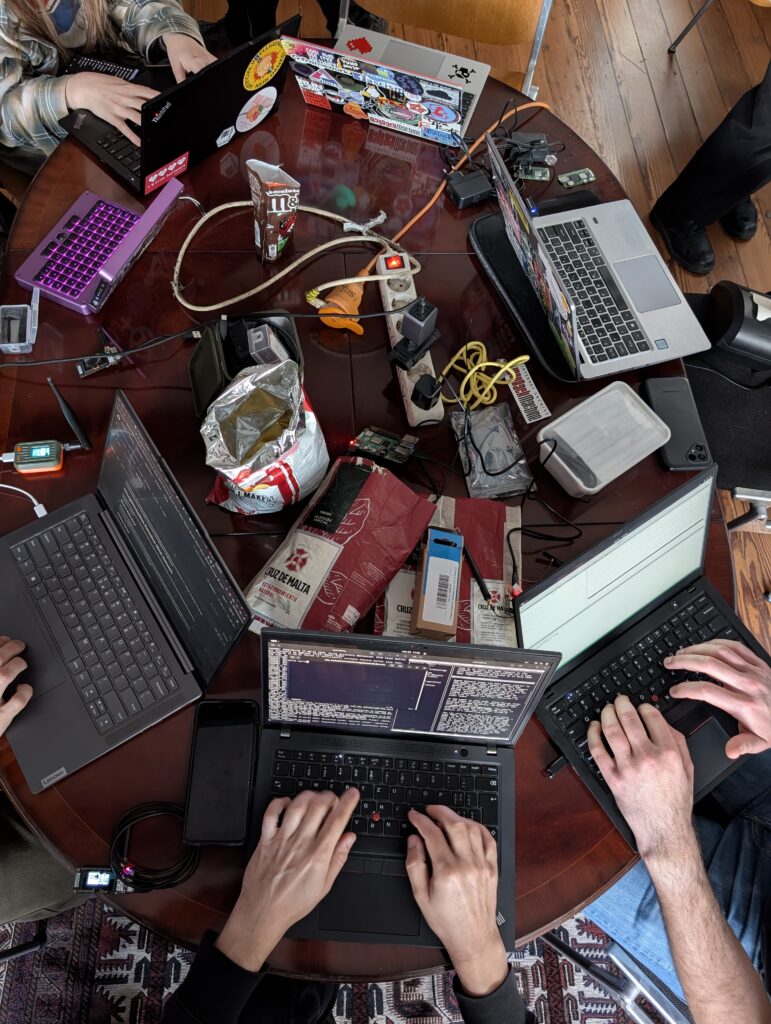
The March Reticulum low-profile, low-energy community networking workshop was all about testing the mesh network with mobile phones (over Bluetooth, WiFi, and LoRa frequencies and protocols), building infrastructure nodes, browsing and making “micron” websites, and experimenting with running the entire protocol stack on single microcontrollers. See below for the next workshops in Den Haag, Utrecht and Linz.
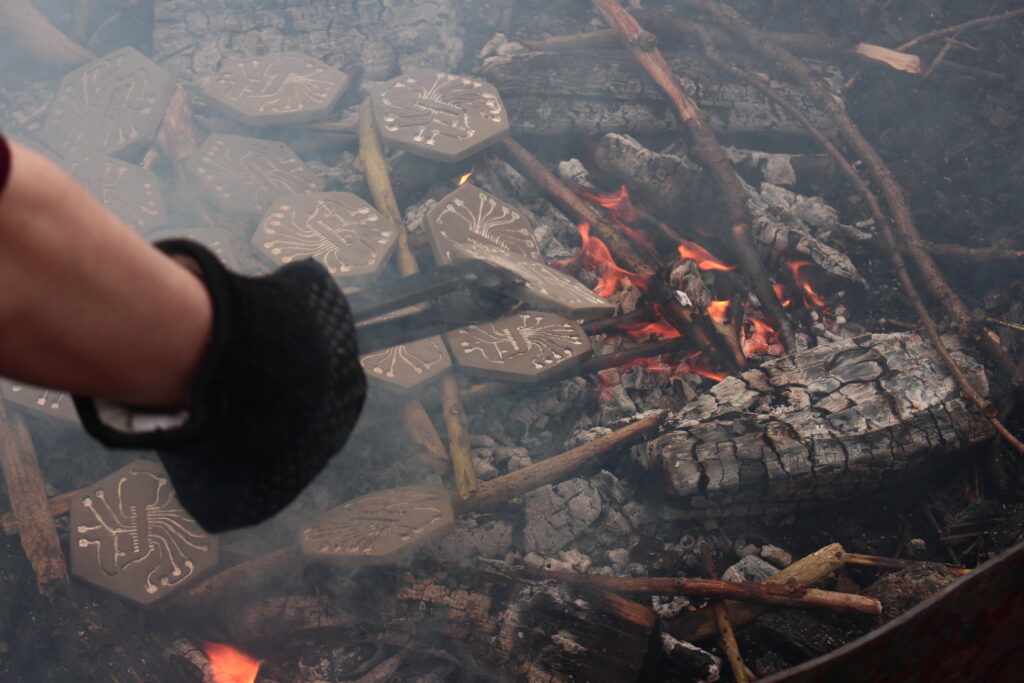
The clay PCB workshop investigated alternative hardware from locally sourced materials and invited participants to reflect on renewable practices for the benefit of both nature and humans. Stefanie Wuschitz and Patrícia J. Reis (in collaboration with Waag) led the participants in processing the clay, shaping it into the PCB form, firing and painting the PCBs, and building a microcontroller.
Publications
We are happy to share:
- Book: AI Infrastructures and Sustainability: Expanding Perspectives on Automation, Communication and Media, which Fieke co-edited with Anne Mollen, Sigrid Kannengießer, and Julia Velkova.
- Fieke and Niels wrote the book chapter, More Compute for a Burning Planet? A Scarcity Approach to AI Infrastructures
- Report: Building a Shared Research Agenda on Submarine Cables, by Fieke, Niels, Dmitry, Valentina, and Jane Ruffino.
- Article: Infrastructural anxiety and digital sovereignty: The perceived loss of control in Dutch communication networks, by Fieke, Niels, Sarah, and Maxigas.
- Report: Clouded Judgments: Problematizing Cloud Infrastructures for News Media Companies, by Agustin Ferrari Braun and Corinne Cath.
In the media
We have been active in the calls for public accountability surrounding the hyperscaler data centre in Amsterdam that is projected to consume as much electricity as all households in Amsterdam combined.
- Press release: Maatschappelijke organisaties uiten zorgen over hyperscaler datacenter bij Amsterdam Sloterdijk (in Dutch).
- Fieke and Corinne spoke to the Amsterdam municipality about the data centre (in Dutch). News article:
- Google en Microsoft houden energiegebruik van hyperscale-datacenters geheim voor de overheid (in Dutch).
- News article: In Amsterdam komt een hyperscale voor Microsoft, ondanks het verbod op hyperscales (in Dutch).
- News article: ‘Zeer onwenselijk’ dat grootste datacenter van Amsterdam helemaal in Amerikaans gebruik komt (in Dutch).
- News article: Datacentertumult: ‘Amsterdam crasht, Microsoft casht’ (in Dutch).
Other news:
- News article: Van dit soort ijzeren reuzen komen er nog meer, dwars door dorpen en over akkers (in Dutch).
- Feature: Van geopolitiek tot geobacter: anders denken over digitale infrastructuur (in Dutch).
- Op-ed: Why the EU Commission’s plan for an AI data-centres boom is short-sighted, by Fieke, Kristina Irion, and Alex Lutz.
Upcoming events
We would like to meet you at one of these events:
- On April 10th, The State of the Internet 2026 with Fieke Jansen at Waag Futurelab. On April 19th Reticulum Workshop at the Opstand in Den Haag.
- On April 28th, our reading group will start reading two news books, namely ‘The Low-Carbon Contradiction: Energy Transition, Geopolitics, and the Infrastructural State in Cuba’ by Gustav Cederlöf and ‘The Deadly Life of Logistics: Mapping Violence in Global Trade’ by Deborah Cowen. All details on joining the reading group can be found on our website.
- On May 10th, Reticulum Workshop at Snoekhoek in Utrecht.
- From May 13-16th in Linz, Art Meets Radical Openness festival. Maxigas is hosting a panel on May 14th “How to cook a data centre?” in the morning and Reticulum Workshop facilitated by the critical infrastructure lab and ]LAG( lab in the afternoon. For low profile, low energy, resilient networks for planetary computation and community participation.
- On June 12th, Project XLR collaborative radio experimentation workshop with Christy Westhovens, WORM and the critical infrastructure lab. We will cover the political fundamentals of radio communication, explore the electromagnetic spectrum as a critical natural resource, and meddle in satellite hacking, heterogeneous networking, and signal identification with software defined radios.
Summer school: Global Power and Technology: Competition, Innovation and Technological Advancement through Standardization in the EU and Beyond. Niels will teach a part of this five-day summer course that offers a deep dive into how some most innovative technologies influence the world around us and how they, in turn, are influenced by global power dynamics. The deadline for registration is 1 June. - At the ICT4S in June, where Fieke, Adrian Friday, Gauthier Rousillhe, and Srinjoy Mitra lead a workshop titled The True Cost of ICT: Crisis of Abundance.
- Summer School: Low-Tech, Luddism and Liberation: reclaiming technology for the collective good in July. The deadline for registration is April 30th.
Visit our website to check out all our publications, upcoming activities, and media appearances.
Highlights from our allies
- Conference: Cables of Resistance – Movements Conference Against Big Tech from April 10th to 12th in Berlin.
- Book: Radical Infrastructure: Imagining the Internet from the Ground Up by Britt Paris. Report: The AI climate hoax. Ketan Joshi finds that the big tech industry’s claim about the climate benefits of artificial intelligence don’t hold up. The research finds that 74% of AI climate benefit claims are unproven.
- Book: The Reticular Society by Ian Alan Paul with introduction by Serene Richards.
- Podcast: Poetic Sadness by Asia Bazdyrieva.
What is inspiring us
In solidarity,
critical infrastructure lab
Niels ten Oever – Fieke Jansen – Maxigas – Dmitry Kuznetsov – Eric Zhang – Felipe Silva Figueiredo – Nora Svensson – Gargi Sharma
The critical infrastructure lab is funded by Ford Foundation, Internet Society Foundation, Open Technology Fund, AI Collaborative, University of Amsterdam, and Utrecht University.
# event Eco-feminist decolonial hardware March 2026
It is an open secret that the hardware in our smart devices contains not only plastics but also conflict minerals such as copper and gold. Technology is not neutral!
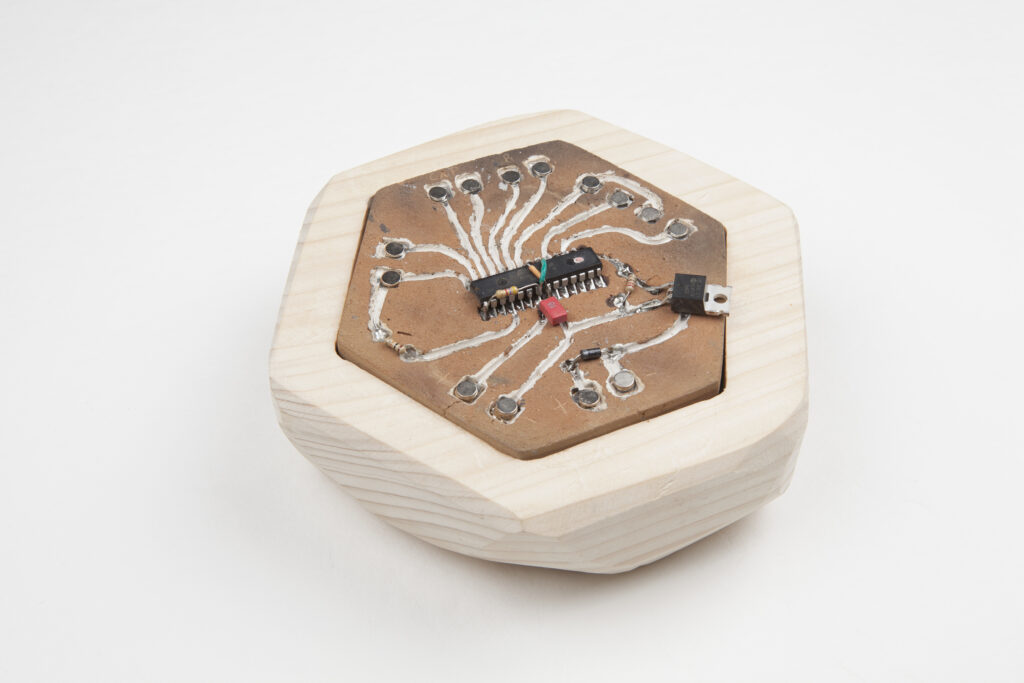
Artists and researchers Patrícia J. Reis and Stefanie Wuschitz investigate on alternative hardware from locally sourced materials, from a feminist perspective, to develop and speculate upon renewable practices. They call it Feminist Hardware!
Through these lenses, they researched on fair-traded, ethical, biodegradable hardware for environmental justice, building circuits that use ancient community-centred crafts encouraging de-colonial thinking, market forces to be disobeyed, and future technologies to be imagined.
In this lecture, they will share their research process behind Feminist Hardware, and present artistic alternatives that aim to reconnect technology with ecology, community, and care.
Join us on March 30th for the lecture and discussion on eco-feminist decolonial hardware with Patrícia J. Reis and Stefanie Wuschitz. The lecture will take place from 17.00 at the Bushuis in room F0.01.
—-
About the speakers
Patrícia J. Reis (b. 1981, Lisbon, PT) is a Vienna-based media artist and researcher whose practice explores human and more-than-human entanglements with technology through feminist hacking, sensory interaction, and embodied interfaces.
Her installations investigate touch, consent, and care, often inviting intimate, activeparticipation. Reis studied Painting (ESAD, 2004), Media Art (MA, Lusófona University, 2011), and completed a Ph.D. in Art at the University of Évora (2016). She was a fellow of the FCT of Portugal (2011–15) and Assistant Professor at the Polytechnic Institute of Beja (2006–12). From 2020–23 she was postdoctoral researcher at the Academy of Fine Arts Vienna within the project Feminist hacking: building circuits as an artistic
practice, and guest researcher at the Weizenbaum Institute, TU Berlin. Since 2015, she has lectured at the Digital Arts Department, University of Applied Arts Vienna, where she currently leads the FWF Elise Richter PEEK project Hacking the body as the black box.
Since 2012, she has been a board member of Mz Baltazar’s Lab*, Vienna’s feminist artist-run space. Reis has exhibited widely, received the Outstanding Artist Award in Media Art (AT, 2021), and participated in international programs and residencies, including IMPACT ART San Francisco, Banff Centre (CA), HWK Delmenhorst, and Edith-Russ-Haus (DE).
Find out more about Patricia: www.patriciajreis.com | https://www.instagram.com/patricia_j_reis/ | https://hackingthebody.org/
Stefanie Wuschitz (b. 1981, Vienna, Austria) is a data-research artist based in Vienna. Her scholarship generates data that shapes her artistic output. She investigates the entanglement of gender, technology and power. Within the young, Eurocentric field of data studies, her current projects focus on a blind spot of South East Asia: Indonesia’s position within fast shifting techno empires. Her degrowth inspired artistic method entails upcyling, salvaging sustainable, locally sourced materials to create ecofeminist interactive art installations. Her drawings and animations explore new forms of storytelling, knowledge transfer and documentary.
She graduated in the MFA program Transmedia Arts in 2006 (Brigitte Kowanz) and completed her Master’s at NYU 2008 at Tisch School of the Arts in NYC. In 2009 she founded the hacklab and collective Mz* Baltazar’s Laboratory. She completed her Doctorate on Feminist Hackerspaces at TU Vienna in 2014. Since then she has held post-doctoral positions at the Academy of Fine Arts in Vienna, TU Vienna, Universität der Künste Berlin, and TU Berlin. She conducted several arts-based research projects as PI (titled Feminist Hacking, Salon of Open Secrets, Coded Feminisms in Indonesia). Her artwork was featured in solo exhibitions, film festivals and international venues.
Find out more about Stefanie: https://stefaniewuschitz.cargo.site/ | https://www.instagram.com/stefanie_wuschitz/
# workshop MaKING Printed Circuit Boards with Wild Clay March 2026
It is an open secret that the hardware in our smart devices contains not only plastics but also conflict minerals such as tungsten, tin, tantalum, silver and gold.
We are investigating alternative hardware from locally sourced materials, so-called ethical hardware, to develop and speculate upon renewable practices for the benefit of both nature and humans.
We are exploring different materials, sentient, low-impact, non-toxic, fair traded, recycled and urban mined means of production.
We aim to challenge the common PCB (printed circuit board) economies in an artistic, creative, positive and responsible way applying feminist hacking as an artistic methodology and critical framework.
https://feministhackerspaces.cargo.site/Clay-PCB-Tutorial – a workshop in partnership with the critical infrastructure lab and Waag from March 30 to April 2, 2026.
# workshop Low-profile and low-energy autonomous networking with Reticulum March 2026
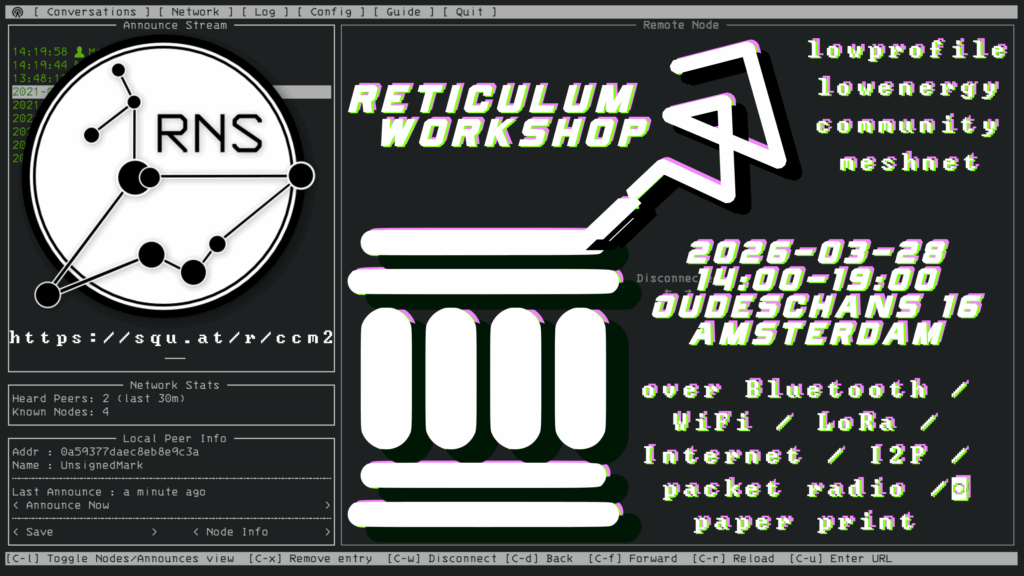
TL;DR: the March workshop is about testing the mesh network with mobile phones (over Bluetooth, WiFi, and LoRa frequencies/protocols), building infrastructure nodes, browsing and making “mu” websites, and hopefully trying out how to run the entire protocol stack on single microcontrollers (with microreticulum).
Running your own communications infrastructure has obvious benefits. We live in a world of increasing digital censorship, and are rarely completely in charge of our communications. Even if we choose to use “better” alternatives to WhatsApp, Instagram, etc., we are still always completely reliant on the one underlying network, i.e. “The Internet”. With the push of a button, “The Internet” may all of a sudden become unavailable. In places with oppressive regimes, this has not been uncommon. In the current political climate, it would not be surprising if any political system all of a sudden became repressive.
In this workshop, we will explore the possibilities for setting up a decentralized off grid communications system using the Reticulum communication protocol stack. We choose to focus on Reticulum because it is designed for heterogeneous networks built from various cheap devices, to be deployed in a bottom up way by small communities. More information is found on the Reticulum Community website.
The mesh network stack runs on various platforms. You can run it on your desktop, your home server, your mobile phone. In the workshop, we will focus on using Reticulum on three scales: (1) as a Bluetooth network for mobile phones messaging in small groups; (2) building some standalone nodes, based on a low power ARM board, that you we can deploy around Amsterdam to build out an autonomous communication infrastructure; (3) and we will also look into connecting cities with more long-range radio links.
Operating the network stack on various scales is possible because it can run on top of different transport layers. It can run on normal IPv4 networks. However, for us the interesting part is that it also runs on high latency, low bandwidth radio links. These can be Internet of Things networks like LoRa, Bluetooth networks made of mobile phones, WiFi access points or packet radio systems using cheap handheld VHF radios. (One such radio is the infamous programmable Baofeng UV-5R.)
We will look at some applications that were build on top of the Reticulum communication protocol stack. There is a simple graphical chat application called Meshchat that can be run locally on your computer. There is also a BBS style forum implementation, called NomadNet that also works over the terminal on servers. Finally, there is a user-friendly Android mobile phone app called Columba. The current services include text, photo, voice and video messaging – as well as audio calls and publishing website-like content called “mu sites” in the “micron format”. No prior experience is needed, but you might benefit from looking into the Reticulum Manual.
The March workshop is hosted by Internet Archive Europe and facilitated by the critical infrastructure lab.
The next (April 2026) workshop will be in Den Haag, hosted by the Anarchist Library Opstand.
# workshop How to Use a Local Small Language Model in Your Research without Losing Your Mind March 2026
Do you want to use a local GenAI on your laptop or PC for your research? Small language models (SLM) are compact alternatives to large language models, and they are ideal for handling specific tasks on your local devices. In this hands-on workshop, Maxigas (critical infrastructure lab), Jenny Chan, Dmitry Kuznetsov (critical infrastructure lab) and Annette Markham (Media and Culture Studies) will show and teach you how to install and use SLMs for your research.
What could you use SLM for? Some researchers want to organise and sift through years of data they’ve been collecting on their own device, maybe to link different research projects together. Other researchers might want to automate part of their workflow. Research institutes or project managers might want to standardise templates and automate research-related tasks. Still others might want to play around with AI, but want to keep the data local, to avoid sharing data through large corporate entities, or to better control what data is being processed by AI.
What to expect
The goal of finding, installing, and effectively using a SLM is wise, if you want to use it in research, but it is massively difficult to achieve in practice. This workshop therefore provides a communal space where we share knowledge. The workshop facilitators will walk participants through some of the steps involved, discuss the benefits and challenges, and then present and demonstrate a physical SLM set-up we have developed. Participants can then connect to this SLM online or offline to test it out.
# infrastructure walk Data centre walk – Sloterdijk hyperscaler March 6 March 2026
Join us on March 6th at 16.00 for a data centre walk of the to-be-built but already controversial hyperscaler on the Plimsollweg, near Sloterdijk station. Infrastructure walks are like guided tours of the city, or birdwatching expeditions – but instead of pointing out noteworthy architectural details of historical buildings or showing participants how to best observe particular species of birds, we would explore the digital public infrastructures that are deployed in public spaces. In this case, an empty piece of land.
While it doesn’t look like much, this vacant piece of land is extremely valuable, as it holds the permits to build three data centre towers. After 10 years of financial speculation, the site was purchased by British data center developer Pure DC, with Microsoft as the intended and sole tenant of a hyperscale data center consisting of three towers. In this walk, we will learn more about this piece of land and discuss the allocation of scarce land, computing power, and electricity supplies to an American hyperscale data centre, which ends up coming at the expense of residents, nature, and local businesses.
Registration is closed