# open reading group The Root & Router Society Reading Group July 2026
bi- weekly tuesday session 16:00 – 17:00 cest/cet* (once every two weeks)
facilitated by niels@criticalinfralab.net, fieke@criticalinfralab.net, maxigas@criticalinfralab.net
meet up here (just show up, no prior notification is needed): https://uva-live.zoom.us/j/6365963924
take notes here: https://pad.criticalinfralab.net/unz6CPM9SpieqIlkXf-Oq
sign up for the mailinglist here (don’t forget to click the link in the confirmation email):
https://lists.ghserv.net/mailman/listinfo/infrastructure-readinggroup
and a calendar event (add to your Google calendar or download an .ics file)
We are currently reading:
– Techno-Negative: A Long History of Refusing the Machine by Thomas Dekeyser
– Machine and Sovereignty: For a Planetary Thinking by Yuk Hui
August 4th – Techno-Negative: Introduction – Machine and Sovereignty: Introduction
August 18th – Techno-Negative: Chapter 1 – Machine and Sovereignty: Chapter 1
September 1st – Techno-Negative: Chapter 2 – Machine and Sovereignty: Chapter 2
September 15th – Techno-Negative: Chapter 3 – Machine and Sovereignty: Chapter 3
September 29th – Techno-Negative: Chapter 4 – Machine and Sovereignty: Chapter 4
October 13th – Techno-Negative: Chapter 5 – Machine and Sovereignty: Chapter 5
October 27th – Techno-Negative: Chapter 6 – Machine and Sovereignty: Chapter 6
November 10th – Techno-Negative: Conclusions – Machine and Sovereignty: Chapter 7
November 24th – Machine and Sovereignty: Conclusion
If you want to see what we have read before, check the page of the previous infrastructure reading group, and the environment reading group. In this reading group, we have previously read:
– The Low-Carbon Contradiction: Energy Transition, Geopolitics, and the Infrastructural State in Cuba by Gustav Cederlöf
– The Deadly Life of Logistics: Mapping Violence in Global Trade by Deborah Cowen
– Extraction: The frontiers of green capitalism by Thea Riofrancos
– Cybernetic Circulation Complex: Big Tech and Planetary Crisis by Nick Dyer-Witheford & Alessandra Mularoni
* We use CEST between the last Sunday of March until the last Sunday of October, then we switch back to CET.
# workshop Community network workshops for the general public October 2026
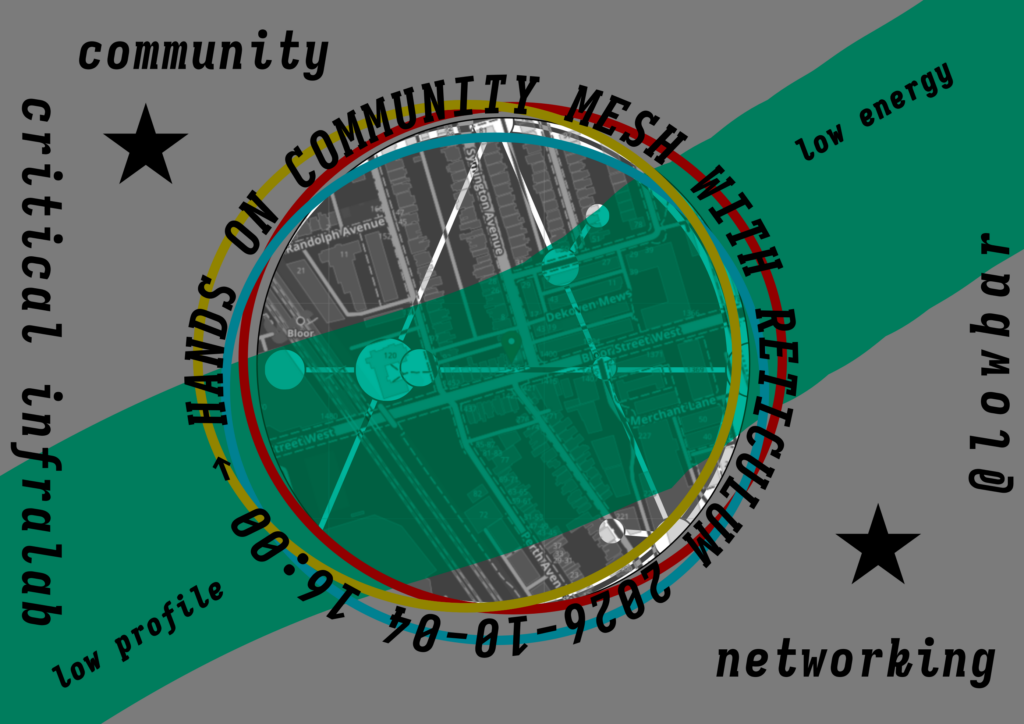
Saturday (2026-10-04) from 16:00 onwards at the Low Bar (https://lowbar.ca/) in Toronto we will come together to build and experiment with community mesh network nodes and discuss digital needs of our communities.
Come around to learn together about how to set up secure, autonomous communication networks with the Reticulum Network Stack!We choose to focus on Reticulum because it is designed for heterogeneous networks built from various cheap devices, to be deployed in a bottom up way by small communities. It is a toolkit for building many different networks (LoRa, WiFi, Bluetooth, amateur radio, etc.), with a focus on the decentralisation of power, low energy operation, and security.
The event is also an opportunity to reimagine the Internet and our digital dependencies and plot together on how to build towards more self-determination and autonomy.
# workshop Let Us Build Networks of Digital Solidarity! October 2026
Community network workshop for the academic and activist participants of the preconference on Critical Internet Governance at the University of Toronto, answering to the theme of Digital Solidarity in contrast to Digital Sovereignty. In the workshop, participants perform the concept of Digital Solidarity by setting up a telecommunications network, transceiving their own content over it, and establishing autonomous links with other groups. The experience will foster further reflections to enrich the next day of academic and policy-oriented discussions over technological dominance and alternative technological trajectories.
Expressions of interest can be mailed to maxigas@criticalinfralab.net with the Subject: line “Let Us Build Networks”.
# infrastructure walk Reverse Infrastructure Walk October 2026
The Reverse Infrastructure Walk is about inspecting and extending the public telecommunications networks that are deployed in public spaces in the context of the built environment. In this experiment, we walk between two venues while refining our infrastructural literacy and connecting them with radio hardware. The event connects the preconference on Critical Internet Governance with the 4S conference (the annual meeting of the Society for the Social Studies of Science) that will start on the next day.
Start: Daphne Cockwell Complex (DCC) at Toronto Metropolitan University (TMU) 288 Church St, Toronto, ON M5B 1Z5, Canada.
Finish: Sheraton Centre Toronto Hotel, 123 Queen St W, Toronto, ON M5H 2M9, Canada.
# workshop Critical Internet Governance – From Digital Sovereignty to Digital Solidarity October 2026
The workshop takes place over two days, comprising day 1 for practical experiments and day 2 for theoretical debates. The rituals and experiments of the first day provide food for thought for the debates of the second day. The structure of the workshop aims to provide common experiences and inspirations for the participants in order to help with developing coherent arguments together.
Internet governance as a research area addresses how power is exercised over and through communication networks via technical, social, economic and political means. The proposition of the workshop is that discussions within internet governance scholarship have exhausted their explanatory and interpretive limits. Thus, we need to look for inspiration towards integrating critical strands of investigations into internet governance from anticolonial, feminist, materialist and ecological investigations. Furthermore, we need to make internet governance relevant to current debates in society, culture and technology. The participants would take up this challenge by starting with the debates on digital sovereignty and asking how the alternative perspective of digital solidarity could produce critical internet governance scholarship, renewing the field and enriching adjacent fields of research.
The workshop would prepare further discussions the following days at the annual meeting of the Society for the Social Studies of Science (4S), which will take place in Toronto just after this proposed gathering. The initiative builds on previous collaboration between the critical infrastructure lab and the network of Internet governance scholars in Brasil, REDE (the Research Network on Internet Governance). The institutional aim of the workshop is to integrate international and Toronto area scholars into this fruitful and ongoing collaboration.
Two keynote speakers will introduce the theme (digital solidarity). Stanislav Budnitsky (Research Fellow at the Consortium for History of Science, Technology, and Medicine) will discuss how digital solidarity have been used by policy actors so far, including during the World Summit on Information Society, by the European Commission, and in foreign policy of the United States of America. Rafael Grohmann (Assistant Professor at University of Toronto) will introduce the perspective of social movements based on his recent research into Digital Solidarity Economies.
# talk - presentation - panel Making and Doing exhibition stall: Grassroots Communication Infrastructures October 2026
Maxigas and Christy Westhovens will be at the Making and Doing exhibition stall on Grassroots Community Infrastructures at 4S, the annual meeting of the Society for the Social Studies of Science, Toronto 2026.
# workshop Infrastructural ideologies of alternative technological trajectories: Community Mesh Networking October 2026
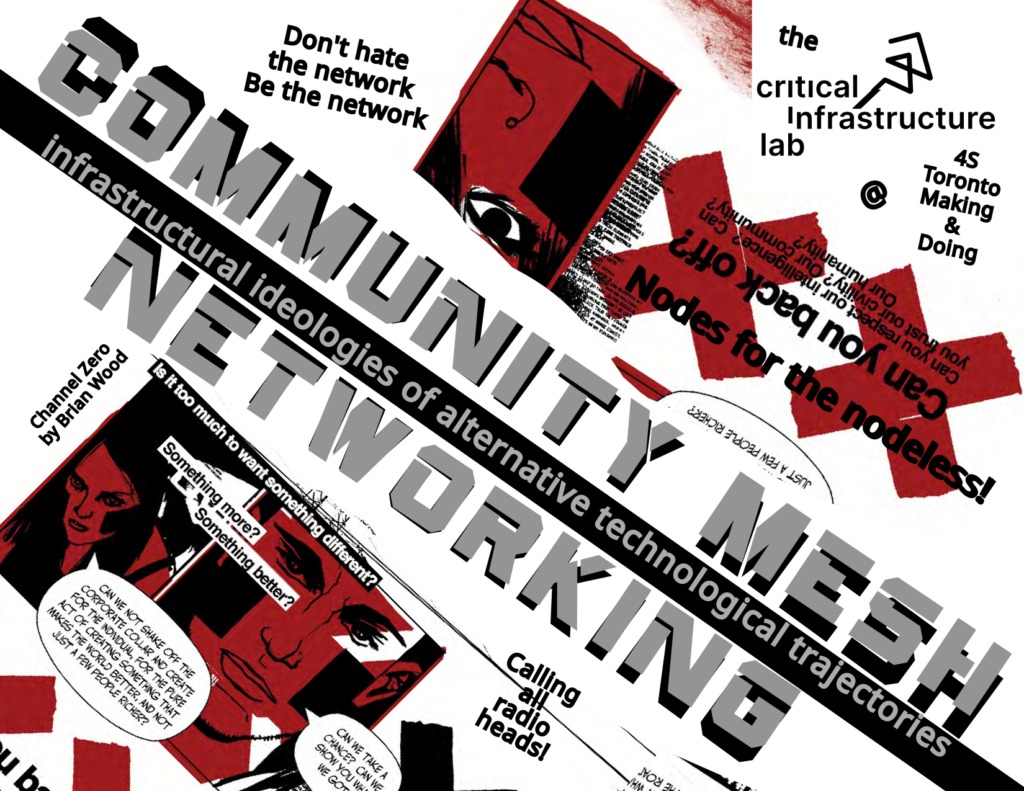
Making and Doing session at 4S, the annual meeting of the Society for the Social Studies of Science, Toronto 2026.
—
In this workshop, we will field test a decentralized off grid communications system using the Reticulum communication protocol stack. We choose to focus on Reticulum because it is designed for heterogeneous networks built from various cheap devices, to be deployed in a bottom up way by small communities. More information is found here: https://reticulum.community/
The experiment will provide food for thought for tactical and theoretical discussions of the so-called infrastructural ideologies (Maxigas and ten Oever 2023), answering questions such as “How do digital communication infrastructures and network protocols produce subject positions and interpellate users?”; “How do infrastructural ideologies turn into digital materialities?”; and “How do infrastructures organise space and time to redistribute power in particular ways?”.
The latter question addresses the conference theme of TechnoPower, which we extend towards Technoscientific Futures by collaboratively mapping the conditions of possibilities for an alternative technological trajectory where planetary computation is performed by heterogeneous community mesh networks rather than the current global and singular Internet.
The workshop enacts rather than describes the contributions of mesh networks to infrastructural futures that centre people and planet over capital and control, so we bring and deploy networking hardware, install and repair networking software, and reproduce a collective material infrastructure in the course of the workshop.
Facilitated by the critical infrastructure lab and friends, building on the experience of monthly mesh moshes since 2025 January.
https://www.xcdsystem.com/4sonline/program/342Jv8n/index.cfm?pgid=571
# talk - presentation - panel “Indigenous 5G networks” for digital sovereignty: A non-aligned technological trajectory? October 2026
Panel presentation in the open panel “How can the study of dependency theory enhance digital sovereignty?” at 4S, the annual meeting of the Society for the Social Studies of Science, Toronto 2026.
—
The presentation offers an analysis of “indigenous 5G networks” in India as an example of non-aligned technological trajectories, understood on a longer timeline extending to the New World Information and Communication Order, the Non-Aligned Movement Centre for South-South Technical Cooperation, and other examples of anti-imperialist industrial policy. The results are based on critical supply chain analysis and infrastructure ethnography of the standardisation, implementation and deployment of domestically produced 5G in the context of ongoing field work. The interpretations are supported by archival research on technology transfer in the non-aligned movement.
“Indigenous 5G networks” in India were proposed as a transformation of supply chains and knowledge networks driving unequal exchange, geopolitical alignments and technology transfer. In particular, the industrial policy, research and innovation enacted to realise indigenous 5G networks downscales supply chains to match sovereign territories. The motivation behind downscaling supply chains is to steer clear of geopolitical rivalries. The digital infrastructural dominance of the great powers shows in that currently, the leading telecommunications suppliers are Ericsson and Nokia in the West, as well as Huawei and ZTE in the East, representing distinct challenges to India’s technological sovereignty. A non-aligned technological trajectory breaks India’s dependency on core economies in the domain of telecommunications, and allows subsequent reintegration into the international division of labour as a developmental supplier for the periphery.
https://www.xcdsystem.com/4sonline/program/342Jv8n/index.cfm?pgid=571
# talk - presentation - panel Why build digital solidarity? – lessons from the Non-Aligned Movement and indigenous 5G networks October 2026
“Closed panel on “”Critical Internet Governance: Digital Solidarities”” at 4S, the annual meeting of the Society for the Social Studies of Science in Toronto 2026.
Digital sovereignty is the name of the game in geopolitical struggles and industrial policies of the contemporary historical moment. Issues such as secure access to connectivity and computation, previously treated under the rubric of digital rights, are now being reframed as political-economical questions of sovereignty. In this paper presentation, I argue for digital solidarity as a normative alternative to both digital sovereignty and digital rights.
Top-down policies of digital sovereignty aim to increase control over supply chains and infrastructural dependencies to enable the self-reliance and self-sufficiency of privileged actors, pitching them against others, especially perceived hegemons. Older, bottom-up demands for digital rights petition the same powerful actors to grant and guarantee the security and well-being of digital subjects. Digital solidarity — as an alternative to these two options – is not concerned with capillaries of vertical power dynamics. Rather, digital solidarity is about building coalitions for cooperation on collective empowerment, reaching out horizontally in the spirit of mutual aid.
I demonstrate the workings and limitations of digital solidarity on two examples of industrial policy and geopolitical cooperation; one historical and one contemporary. The historical example is the New World Information and Communication Order (NWICO) that lead to setting up the Non-Aligned Movement Centre for South-South Technical Cooperation (NAM CSSTC) intergovernmental institution in Jakarta. The contemporary example is the present ecosystem of indigenous 5G networks in India, comprised of industrial policy, research capacity and actually deployed telecommunications infrastructures. These enable launching non-aligned technological trajectories.”
https://www.xcdsystem.com/4sonline/program/342Jv8n/index.cfm?pgid=571
# event Radical Infrastructures: Building a People’s Internet October 2026
TL;DR Please join us for these events, if you would like to join day 2 and/or 3, please fill-out this form: https://files.criticalinfralab.net/apps/forms/s/k6Cfsz8pQdbnYsDtkF6X2ZRW
Tickets for Day 1 at De Balie can be bought on their website: https://debalie.nl/programma/the-politics-of-the-internet-14-10-2026/
The politics of the internet
The internet is often presented as an open, distributed, and decentralized space. Yet behind the platforms, networks and digital services we use every day lies an architecture that is anything but neutral.
From social media feeds and AI systems to data centres and undersea cables, the digital world is built on infrastructures that shape how information flows, who gets heard and who holds power. Decisions made by engineers, companies and governments do not just determine how technology works; they influence how we work, communicate, participate and imagine the world around us.
Over three days, we bring together researchers, policymakers, practitioners and the public to examine these infrastructures from multiple angles: as sites of political struggle, as objects of research and policy, and as things we can build differently ourselves.
Wednesday 14 October, evening: Public event at De Balie
To open the programme, researcher Britt Paris examines the architecture of power embedded in the internet. She will explore how digital infrastructures shape society, how technological systems reflect political and economic interests, and what happens when essential parts of public life become dependent on private platforms.
The occasion is the launch of Britt Paris’s new book, Radical Infrastructures: Building Possibilities for a People’s Internet (University of California Press, 2026), which draws on eight years of research into alternative internet infrastructure projects, from rural and Indigenous internet cooperatives to community-run networks and broad-based tech and social justice organizing, to ask what it would take to build a genuinely people-centered internet.
The evening includes an artistic intermezzo by Jen Liu, whose work investigates the ecological, social, and political implications of computing technologies and infrastructures. She is also one of the driving forces behind SwampNet in New Orleans https://swampnet.info/
Who builds our digital world? Whose interests does it serve? And what would it mean to create an internet that is organized around public values rather than private interests?
When: Evening of 14 October
Where: De Balie, Amsterdam
Thursday 15 October: Workshop
The day after the public event, we move from diagnosis to agenda-setting in a closed workshop with researchers, practitioners and policymakers.
Morning: A research agenda for future physical infrastructures
A discussion on the open questions that should shape research into the physical layer of the internet: the cables, data centres, spectrum and hardware that make digital life possible, and how we study them critically.
Afternoon: A policy agenda for digital infrastructure
A conversation with representatives from the City of Amsterdam and other stakeholders on what a public-values approach to digital infrastructure could look like in practice, and how research, policy and civic action can reinforce each other.
When: 15 October, morning and afternoon sessions
Where: BG1, room 0.16
Friday 16 October: Open hackathon at the critical infrastructure lab
We close the programme with a hands-on, open hackathon at the critical infrastructure lab. Everyone is welcome to join and work with us on a variety of hardware, software and computing projects exploring alternative internet infrastructures.
Bring your own project, or join one of the projects on offer and learn as you build. No prior experience required, just curiosity about how digital infrastructures work and a willingness to get your hands dirty.
Some examples of projects we will be working on:
- Building a battery from the mud from Amsterdam canals
- Setting up a mudbattery measurement station (Picolog)
- Building a 5G network with the RAK All-in-One 5G (M320)
- Doing AI edge computing
- Antenna building for the SbitX v3 for SW https://hermes.radio/
- Setting up Reticulum Nodes on an ESP32
- Circuit building to power an ESP32 with mud batteries
When: 16 October, all day
Where: BG1, rooms 0.12 and 0.16
Radical Infrastructures is organized by the critical infrastructure lab, ARTES Cluster on Digital Networks, Communications, and Technologies, and the ACES Tech, Power, Policy theme group.
# event Squatters’ Network Operator Training for Grassroots Communication Infrastructures in the Low Countries October 2026
Montréal Anarchist Technology Convergence — Presentation and discussion of community organising efforts in the Netherlands for grassroots communication infrastructures linking autonomous spaces and providing public services. Our aim is to collectively reformulate our communication needs and relationship to everyday technologies that we rely on. We need to be able to use existing hardware and legacy protocols as well as adopt to novel developments in the information environment. Meanwhile, we need to cater for both usability and security concerns. Deployment and development needs to happen through the involvement of a wide range of different people including but not limited to techies. The technology has to align with our political values, in terms of intentional outcomes being reflected in design choices and documentation efforts. For these reasons we focus on the Reticulum Network Stack that is so much more than a LoRa messaging protocol.
# guest teaching Methodological approaches from data walking to radioscape ethnography November 2026
Maxigas will be a guest teacher in the Qualitative Methods in Digital Worlds course and organise an infrastructure walk in Bern, Switzerland with interdisciplinary students of the University of Bern.