# Press: A web-to-print pipeline for generating our document series August 2026
- Service: https://press.criticalinfralab.net/ (requires username and password)
- Code: https://codeberg.org/criticalinfralab/publication-pipeline
Press is our homegrown publication pipeline for generating the critical infrastructure lab document series. It is for writing plain text markdown sources and turning them into print-ready PDFs. In the spirit of *learning in the open*, we share the means of production behind it.
Bracketing the three research tracks that define the public identity of the critical infrastructure lab — i.e. standards, geopolitics and the environment — a fourth track has been just as significant for establishing a singular institution: and that is the lab itself as an infrastructure. As the lab was going to serve as an interface between academic, activist, and policy practices and knowledges, we felt that it needs its custom-crafted mode of disclosure, able to bridge cultural worlds and work for different audiences. We hope that our publication pipeline can fulfil such a purpose, as a key to unlock and connect multiple ways of knowing and doing, not just for the infralab, but for all who might need to travel between dimensions.
Our publication pipeline is an implementation made possible through free/libre web-to-print culture. It was originally created by Ulrike Uhlig, who composed a command-line toolchain primarily based on pandoc, which is still the core component of its inner workings, and is now maintained by Anders Aarvik and maxigas with a focus on usability and maintainability.
Focus on the everyday user
The pipeline, as many technical endeavours begin, was a tool that could only be used by people comfortable with the command-line and comfortable managing a vast amount of disparate software dependencies. The publication pipeline is an attempt to reflect, build and dream about the different scopes of interfaces, and thereby usability, that can make web-to-print usable for a wide range of backgrounds: to enable the user to dabble between the different interfaces, entrance points, and skillsets that each of the interfaces require.
Interfaces
Web interface
The web interface lets a wider range of users run the publication pipeline than those who prefer the command-line or the API. It includes a minimal file explorer for basic file management that extends functionality beyond the API. By navigating the web interface, you can list, view, create, delete, edit and render reports, upload images and markdown files, create directories, and edit files using a simple built-in markdown editor with a live preview.
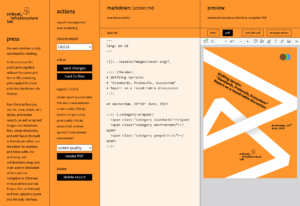
Screenshot: web interface, 2026-07-26
CLI
For those who prefer working in a terminal, the publication pipeline includes a command-line interface (CLI). The CLI is a wrapper around the API and it sends the same requests under the hood, but lets you interact with the pipeline using shell commands instead of constructing HTTP requests, listing reports, listing the files within one, creating, rendering and deleting.
API
The web interface and the command-line interface do not handle report management directly. They communicate with the underlying API that does the work of creating and deleting reports, managing files, and invoking pandoc to render your markdown into PDFs. You can also call the API directly using any HTTP client, such as `curl`, a browser, or API-specific tools, which is useful for automation, scripting, or integrating the publication pipeline into other workflows.
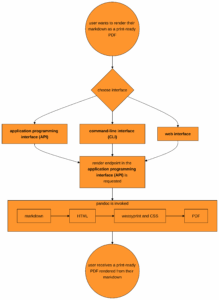
Diagram: the three interfaces are means to the same end
Technical notes
The source code can be found on [Codeberg](https://codeberg.org/criticalinfralab/publication-pipeline), and the core architecture has been the same since the beginning. pandoc does conversion from Markdown to HTML, and WeasyPrint renders that HTML to PDF with CSS that can altered through the interface or your editor of choice. WeasyPrint is not reliant on a full browser engine but rather built from bits and pieces, thereby smaller, with fewer dependencies, and written in Python like the interfaces of our toolchain, avoiding introducing one more programming language into the pipeline, as well as enabling OS diversity as it can run on any OS with pandoc and a typical Python toolchain installed.
Whitebox adoption
It is possible to adapt the publication pipeline for your organisation, both in terms of the document output, but also the visual identity of the wider tooling such as the web interface itself. The document structure, series prefix, rendering quality, styling, the name and the logo, can be customised. The immediate advantages of running such a pipeline can be – depending on the use case ̣- economic [continous and autonomous production of design artefacts], privacy [run it on your own servers], collaborative [researchers, editors, programmers and designers can overlap on an equal footing to produce publications] and political [for the cause of decentralized and free/libre web-to-print culture and software].
# Country and Regional Graphs of Internet Networks May 2026
# EU digital legislation timeline February 2026
# data center walks and infrastructure walks February 2025
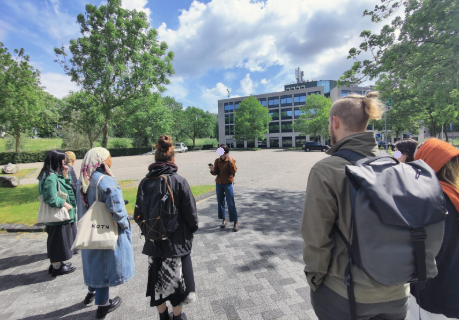
Join us for amateur exploration into the visibility of wireless equipment and services dotted around the city! We collectively map, observe and measure the techno-diversity of digital infrastructure in urban spaces. Data and infrastructure walks are a creative method and a social practice, which can be used to reflect on data power through critical infrastructure studies. It serves a variety of purposes, from public engagement, education, and artistic research to empirical studies.
Data center walks
We started data center walks with a simple question about how to make the invisible visible. People tend to forget about the infrastructure that lies beneath the data. For instance, the cloud remains a concept reduced to a depiction of a cloud, stripping data from its materiality. We usually do not see data centers, nor do we think about them in a material sense. By taking groups into data centers with us, we explore the resources, politics, and human labor that sustains them. To do so, we walk around and inside the data centers, observing physical traces as well as user-generated information online.
Infrastructure walks
We hold a series of “infrastructure walks” in Amsterdam and Berlin, exploring the visibility of digital infrastructures deployed in public spaces. The experience allows us to uncover data flows and to study datafication in urban areas. By engaging with the infrastructures around us, we seek to expose reconfigurations of power relations in the city through emerging technologies and protocols. Infrastructure walks address the question of what media technologies may mean “after all”, that is in the context of the life world, lived experiences and action possibilities of end users as embodied citizens. Insights can countermap the spatial control exercised through the electromagnetic spectrum in urban spaces. Often, us and the groups find that infrastructures should be (1) noticeable, (2) observable, (3) contestable or programmable to their users.
Upcoming walks and related events: Data Walk Workshop: Sensing Digital Materiality in Urban Public Spaces
Walking the infrastructure walk and dancing the frequency dance — You only see it when you get it
# mud batteries and regenerative infrastructures February 2025
Living Infrastructures and Organic Data Centers: Toward Ecological and Post-Extractive Computing
The environmental costs of computation have become impossible to ignore. Data centers, AI models, and communication infrastructures demand vast amounts of energy and minerals, intensifying extractive relations with both human and nonhuman worlds. In response, sustainability discourses in the technology sector promise greener energy, circular economies, and digital efficiency. Yet these solutions remain anchored in the same paradigm of accumulation that drives the ecological crisis in the first place.
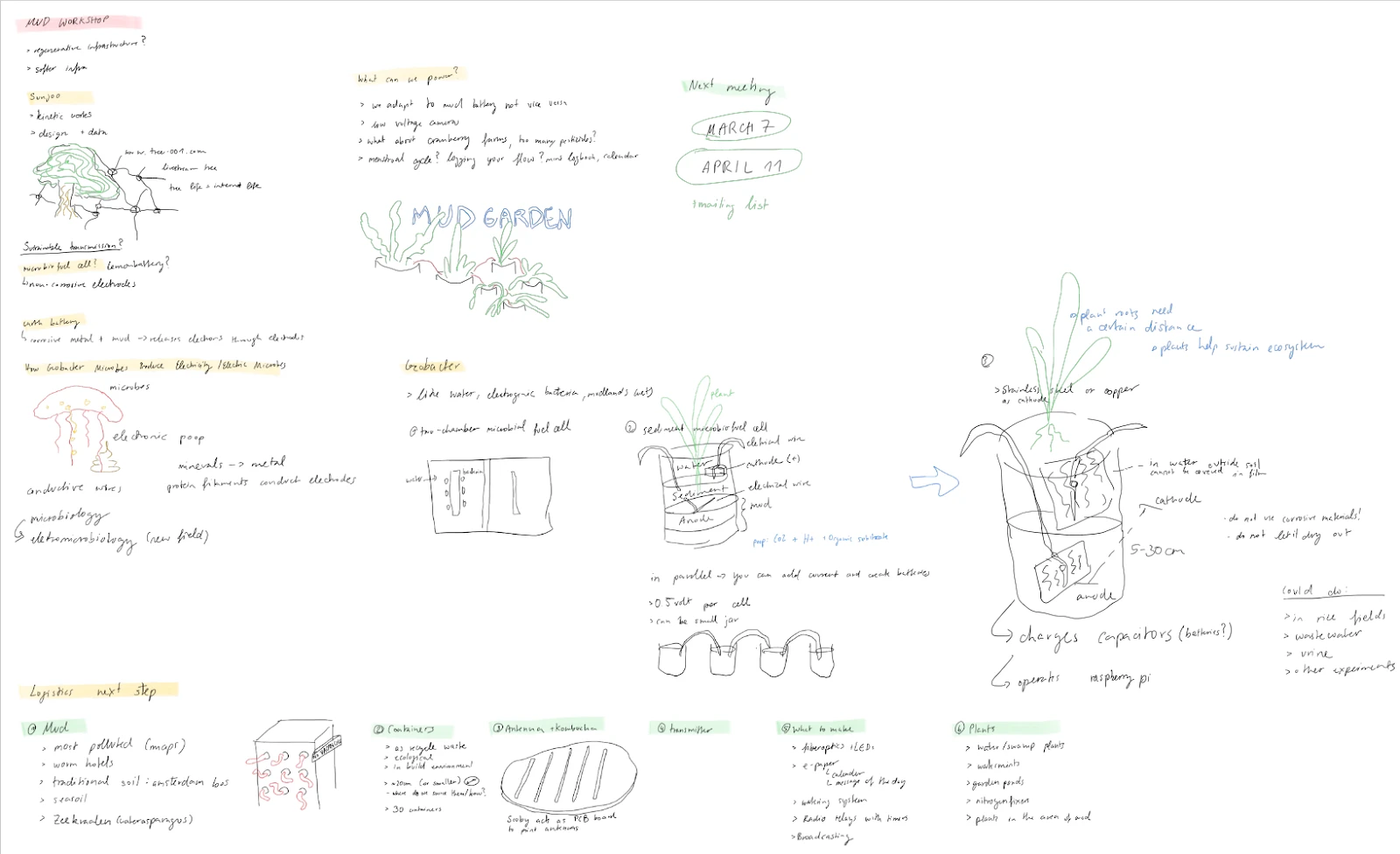
In our lab, we take a different approach. We explore how computing might be reimagined from the ground up—literally—by engaging with living materials such as soil, microbes, and kombucha SCOBYs. These experiments aim not to optimize computation, but to decenter it, to ask what infrastructures might emerge when we take ecological entanglement rather than extraction as a design principle. On this page you will find impressions of our experiments.
Biological Power: Mud and Microbial Batteries
Together with artist Sunjoo Lee, we created an electrical gardan on the docks of the UvA. A series of mud batteries generate electricity through microbial fuel cells. These cells capture electrons produced by anaerobic bacteria in wet soil as they metabolize organic matter. The voltage is minimal—often between 0.3 and 0.7 volts per cell—but continuous, depending on the vitality of the microbial community. The continuous fluctuations in energy intensity sparked our curiosity — beyond the idea of mud as a power source — toward a space where voltage itself becomes an organic expression of computation. The soil thus becomes both the site and the medium of computation: energy is produced only as long as the ecosystem remains alive.
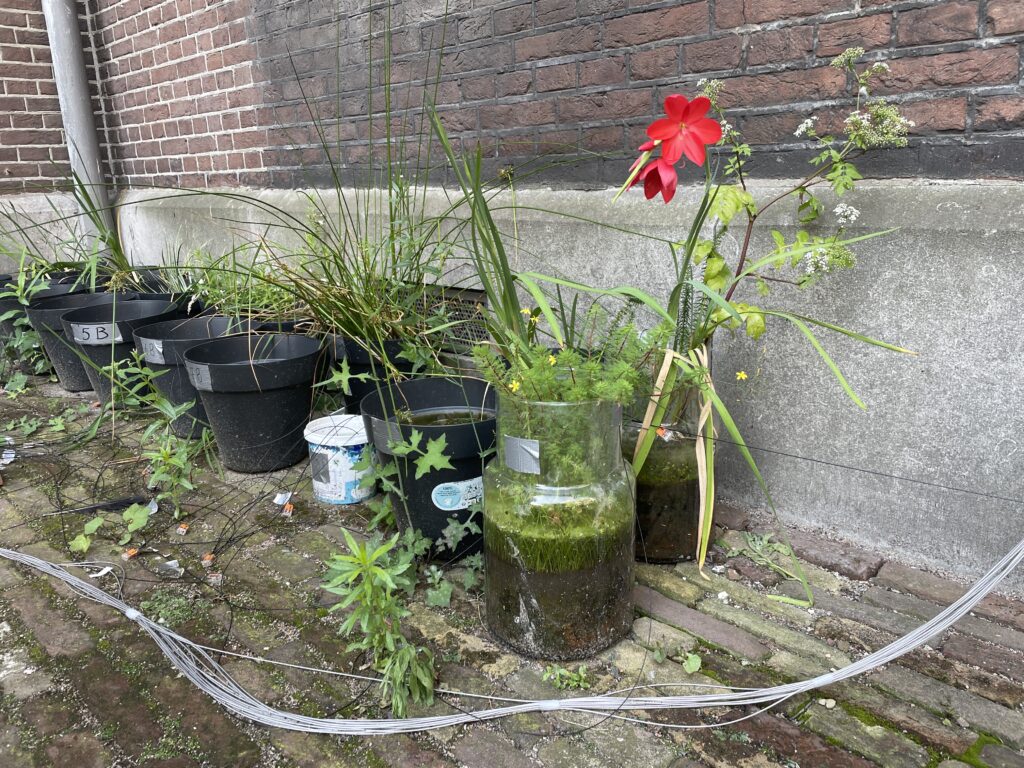
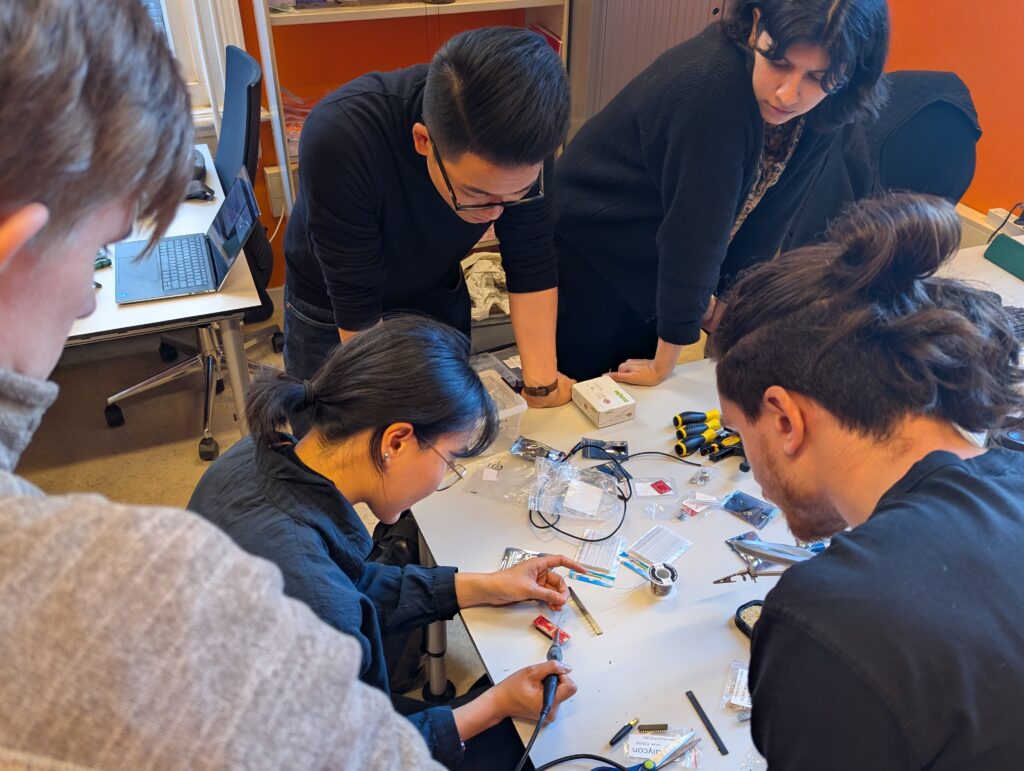
This project extends earlier artistic and scientific explorations of microbial electricity, but reframes them within the question of ecological infrastructures. Rather than treating biology as an alternative energy source to power existing systems, we ask how it could inspire new relations of maintenance, temporality, and dependency in digital systems.
Organic Substrates: Kombucha and Clay
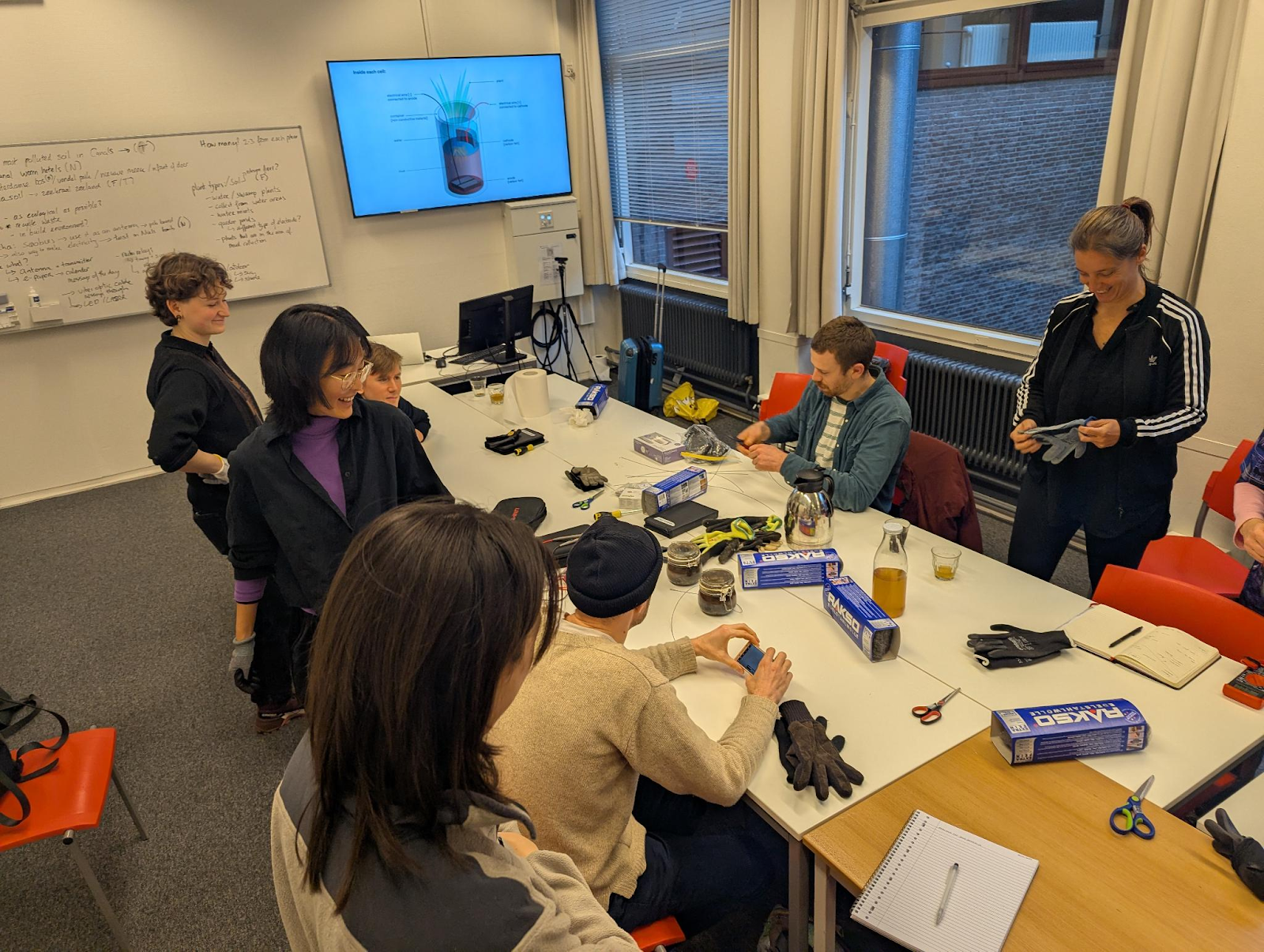
We are also exploring kombucha SCOBYs—symbiotic cultures of bacteria and yeast—as living materials for circuit design. The cellulose-rich surfaces of dried SCOBYs are conductive when infused with certain electrolytes and can host sewn or printed traces. Alongside this, we draw inspiration from clay-based printed circuit boards, which uses local soil as both substrate and metaphor: the ground becomes circuitry. These material practices invite us to rethink electronics as earthbound and circular, materials that will eventually returning to the soil.
Sensing, Powering, and Communicating
To connect these experiments, we use a LabJack U3 interface to continuously measure voltage and current across the microbial and SCOBY cells. Our goal is to power a small web server directly through this living power source—a website whose uptime literally depends on the health of its microbial community. The fluctuating readings are logged and visualized in real time, making the metabolism of the mud and SCOBY visible as a communicative process.
Beyond measurement we see soil as the medium of computation. A first step is to enable distributed communication through the Reticulum Network Stack between the microbial and SCOBY cells. This stack enables resilient, peer-to-peer data exchange without reliance on central servers or the global internet. In a next phase, we plan to integrate the sBitx v3 transceiver to transmit microbial compute over shortwave radio. The Hermes.radio protocol, allows us to link biological power, local measurement, and planetary communication through low-power open infrastructures.
Computing Otherwise
These prototypes are small in scale but large in implication. They suggest that computing need not depend on extraction, nor sustainability on efficiency. Instead, we experiment with ecological computation as a mode of care, reciprocity, and coexistence—where systems live and die with the materials that sustain them.
By experimenting with mud, microbes, SCOBYs, and clay, we seek to develop new relations to computing and to decenter dominant theories of technological progress. This work aligns with broader debates in science and technology studies on digital sovereignty, infrastructural power, and ecological media, asking how infrastructures might evolve beyond capital’s logics of expansion toward restorative and regenerative practices.
In short, our aim is to imagine what computing could become if it were not only in the world, but also of it.
# phase shift: the antennas and us February 2025
an interactive art intervention
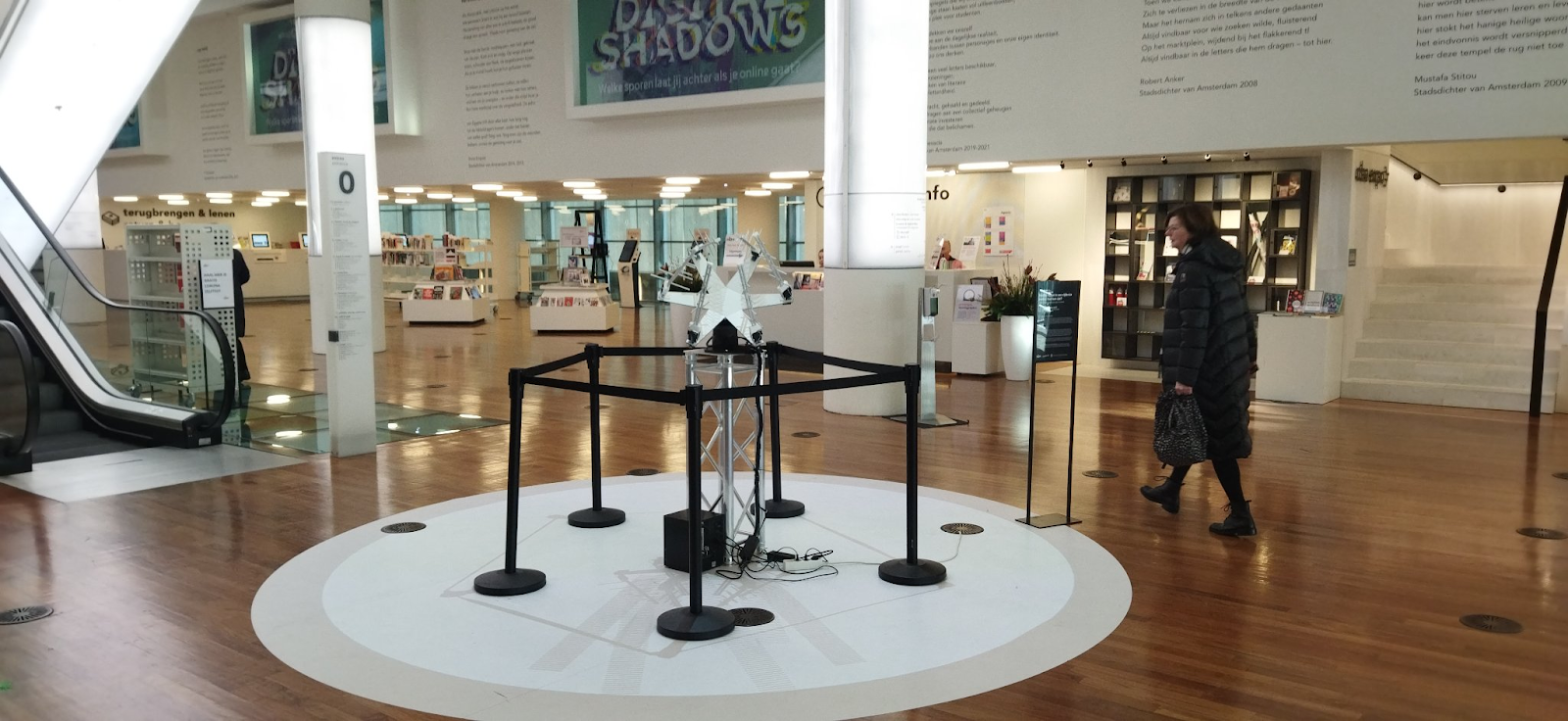
Together with the artist collective weise7, we produced an exhibit called “antennas and us” in the OBA Amsterdam public library. The artistic intervention, phase shift, is an interactive representation of a 5G antenna. It follows library visitors through motion sensors in a similar way that 5G antennas do in a process called ‘beamforming’. The antenna representation drew visitors into conversations with us about the experience of communication infrastructures in their everyday lives.
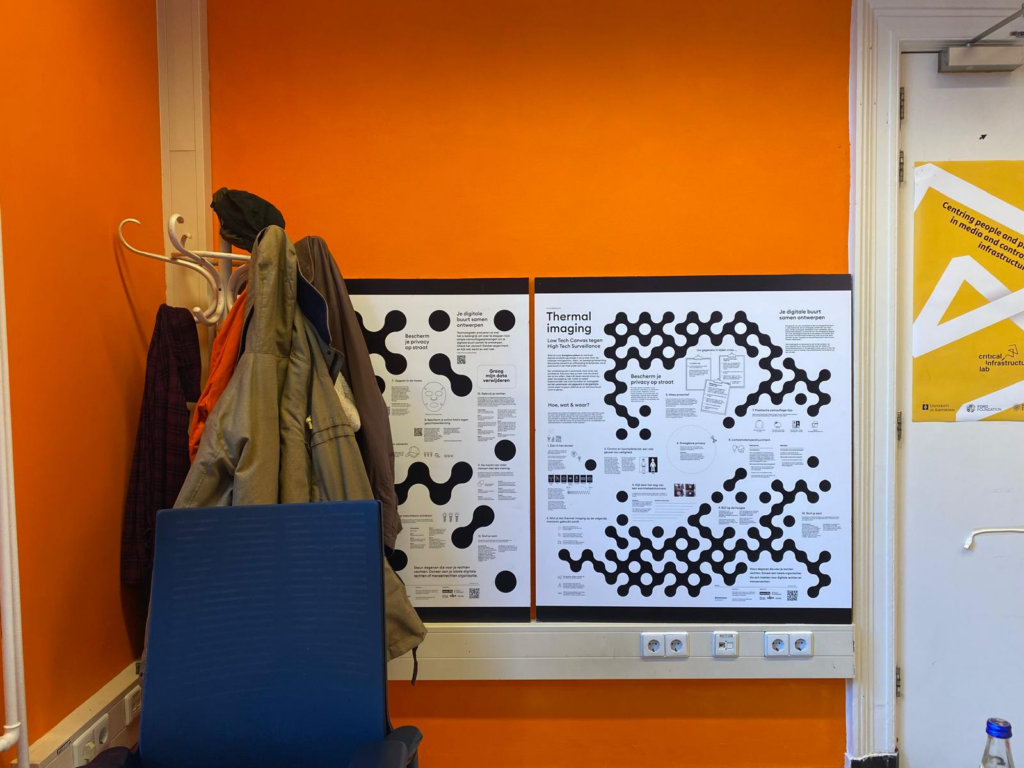
Visitors were also intrigued by the low tech guides against high tech surveillance created by fieke jansen in collaboration with design collective idiotēs. The guides framed the exhibit and provided a rich context for it. The guides display information on Wifi-tracking, Thermal imaging and Facial recognition, which can be used to become a digital explorer of your city. The artistic interventions travelled the library of Amsterdam, the “frictions and frequencies” exhibition in Berlin, our office, and hopefully, your neighbourhood.