# activity | talk - presentation - panel De fysieke achterkant van AI en Europese rekenkracht November 2026
Deze editie staat in het teken van de wereld achter datacenters, AI en ICT. De digitale infrastructuur speelt een belangrijke rol in Haarlemmermeer en in ons dagelijks leven. We werken in de cloud, vergaderen via Teams en gebruiken steeds vaker AI. Daarvoor zijn datacenters, internetverbindingen en veel rekenkracht nodig. De snelle groei van AI biedt economische kansen, maar roept ook vragen op over energie, ruimte, water, netcongestie en duurzaamheid. Tijdens deze SHARE Meets kijken we naar wat er achter onze digitale toepassingen gebeurt en wat deze ontwikkeling betekent voor Haarlemmermeer.
woensdag 11 november 2026
15.30 | De wereld achter datacenters, AI en digitale infrastructuur
Gesprek onder leiding van Bart Krull met Fieke Jansen University of Amsterdam, Olof van der Gaag Nederlandse Vereniging Duurzame Energie, en Olav Steffers SADC. Over rekenkracht, AI, energie, economie en de toekomst van digitale infrastructuur.
15.45 | Break-out sessies
U kiest twee van de drie deelsessies.
1) De fysieke achterkant van AI en Europese rekenkracht. Door Fieke Jansen.
AI en digitale diensten draaien op een fysieke infrastructuur van datacenters, kabels, chips, energie, water en grondstoffen. Wat betekent de groeiende vraag naar rekenkracht voor Nederland en Europa? En welke keuzes brengt dat met zich mee voor Haarlemmermeer?
2) Energie, netcongestie en restwarmte. Door Olof van der Gaag.
Datacenters en AI vragen veel elektriciteit, terwijl het stroomnet steeds voller raakt. Welke kansen zijn er voor flexibel energiegebruik, energieopslag en restwarmte? En kan een datacenter ook onderdeel worden van een lokaal energie- en warmtesysteem?
3) Economie, ruimte en duurzaamheid. Door Olav Steffers.
Haarlemmermeer heeft door zijn ligging, internationale verbindingen en infrastructuur een sterke positie binnen de digitale economie. Welke economische kansen biedt deze sector? En hoe kunnen economie, ruimte, energie, duurzaamheid en publieke belangen samenkomen in een gezamenlijke roadmap?
17.00 | Terugkoppeling deelsessies
Bart Krull bespreekt met Fieke Jansen, Olof van der Gaag en Olav Steffers de belangrijkste punten uit de deelsessies. Welke kansen en knelpunten zien zij voor Haarlemmermeer? En wat is nodig om economische ontwikkeling, rekenkracht, energie, ruimte en duurzaamheid goed met elkaar te verbinden?
17.10 | Afronding
17.15 | Netwerkborrel en proeverij
Praktische informatieLocatie: Vison Plaza Boeing Avenue 220, Schiphol-Rijk | RichPort Business Park
Tijd: 15.00–17.15 uur, inloop vanaf 14.30 uur. Aansluitend netwerkborrel tot 18.00 uur.
Aanmelden
Wij willen graag vooraf weten of u komt. Aanmelden kan via deze link. Na aanmelding ontvangt u kort voor de bijeenkomst een bevestiging met meer informatie.
# media | interview Bureau Buitenland (in Dutch) November 2026
Fieke was interviewed by the Dutch broadcaster about data centre development in the Netherlands. Watch here.
# publication | paper A scalar mismatch: the IETF’s sustainability approaches in a framework of infinite growth and abundance October 2026
Until recently, environmental harms were largely absent from internet governance discussions and their study. This article offers an analyses of how the environmental impact of internet infrastructure is discussed within the Internet Engineering Task Force (IETF) arguing that sustainability becomes a justification regime for the internet’s continued existence and growth in a world in crisis. Taking a discard studies approach, I explore what is and what must be discarded for the internet to continue to operate through a thematic analysis of 26 position papers submitted to the Internet Architecture Board (IAB) e-impact workshop. These insights allow me to expand on Liboiron’s (2014, 2021) concept of scalar mismatch to illuminate how limits to growth are directly at odds with the values that have shaped the internet. The internet governance community has not come to grips with the idea that the network is an environmental problem in itself; rather, a belief in growth, abundance of natural resources, and sustainability through innovation shapes their understanding of sustainability. This paper straddles infrastructure studies, internet governance studies, and environmental social sciences, showing how an environmental lens on infrastructure studies allows us to connect global governance debates with local conflict over resources. Read more.
# activity | talk - presentation - panel Wat hebben data centers met klimaat te maken October 2026
Waarom zijn datacenters een bedreiging voor ons klimaat? En wie mag beslissen of we ze wel nodig hebben? In deze webinar gaan we in gesprek met onderzoeker Fieke Jansen over datacenters en klimaat.
Ook komt aan bod hoe jij in actie kunt komen om de wildgroei aan datacenters te stoppen✊. En er is natuurlijk ruimte voor jouw vragen!
https://www.linkedin.com/posts/meld-je-aan-voor-onze-webinar-share-7510645285417725952-vxf6/
# activity | infrastructure walk Data centre walk Sloterdijk Oct 16th October 2026
The people have said no to the Microsoft hypescale data centre in Sloterdijk, and yet the build continues. Join us on Oct 16th at 16.30 for another data centre walk to this controversial development. This time around we want to use this hyperscale data centre to discuss how these computing infrastructures are part of infrastructures of surveillance and militarisation, and to discuss democracy and local agency in the face of global capital.
Infrastructure walks are like guided tours of the city, or birdwatching expeditions – but instead of pointing out noteworthy architectural details of historical buildings or showing participants how to best observe particular species of birds, we will explore the digital infrastructures deployed in public spaces. In this case, a piece of land undergoing an infrastructural transformation into a speculative cloud factory. A transformation that places significant strain on Amsterdam’s land, energy, and water systems, and the city’s housing aspirations for the export of compute and profits to overseas territories.
Registration is closed
The walk will include different stops and interactive activities around the data centre development area. We will end around 18.30 (and no later than 19:00). After the walk, there is the option for self-organised drinks in the local area or in the city centre.
# activity | call for contributions Call for Position Papers September 2026
Deconstructing Infrastructural Expansion: Circulation across Sea, Land, and Sky
critical infrastructure lab at the University of Amsterdam
Centre for Internet and Society at CNRS
Inria
University of Lille
In the geopolitical race for technological hegemony, regimes are using digital sovereignty policies to enact control and grow their own digital economy. A central element of these industrial policies is the creation of an enabling environment for infrastructural expansion: targeted investment in the technology sector, deprioritization of environmental and social protection, and creation of new electricity infrastructures are all meant to underwrite the build-out of submarine cables, data centres, telecommunication infrastructures, and satellite constellations. Industrial policies are proposed to derisk supply chains on which national and economic security depend. Infrastructure space itself becomes a medium of statecraft (Easterling 2014), where power is reconfigured through design, finance, technology, and circulation.
The world becomes ever further enmeshed in a circulation complex that both encases nature and society for generations to come. In this workshop, circulation offers a lens to understand both the workings of the entire market and its relation to that of specific industries (Kjøsen 2018). It allows for theorization about how the externalisation of costs, regulatory capture, corporate power, and the generation of financial power that propels infrastructural expansion outward and downward, from the seabed to low earth orbit, and how these dynamics are encoded into routing decisions, protocol design, and systems architecture.
Topics of Interest
In this second infrastructure workshop, we are interested in thinking through the consequences of the increasing private ownership of expanding communication infrastructure from the sea to the sky and methods of measuring it. We attend to the territories, people, natural resources, and environments being sacrificed in the name of progress, economic growth, and control (Mollen et al. 2026), the violence that circulation and logistics carry with them (Cowen 2014), and critical quantitative and qualitative methods to foreground underpinning patterns. We ask what technical inquiry can reveal that other approaches cannot: how the measurement of interconnection and autonomous systems exposes the concentration of ownership; how the materiality of compute, spectrum, and orbit decides who gets to build and who does not; and how shifting ownership structures and modalities translate, operationally, across submarine cables, data centres, and low-orbit satellites. We therefore welcome contributions that bring network measurement, systems design, and security research into contact with political economy and critical theory, alongside work that asks how people engage with and contest these configurations, whether alternative architectures are possible, and what it is that we want from our communication infrastructures in the first place.
Themes and topics
The 2nd INFRASTRUCTURE Workshop brings together researchers from Science and Technology Studies (STS), Political Economy, Social and Human Geography, Computer Science, and related fields to critically examine the material, environmental, political, and socio-technical foundations of today’s computing systems. We invite contributions that address, but are not limited to:
- Sea, land, and sky as infrastructural frontiers: submarine cables, terrestrial data centres, and low-orbit satellite constellations as sites of expansion, and how the three domains are being knitted into a single circulation complex.
- Infrastructure as asset class: the financialisation of connectivity and computation; firms as financial instruments and infrastructures as investment objects; venture capital, private equity, and the conditions of public listings.
- Externalisation and its costs: the environmental, territorial, and labour costs displaced onto people, ecologies, and resources; energy and water demand, mineral extraction, and land use; regulatory capture and algorithmic control as mechanisms of cost-shifting.
- Digital sovereignty as industrial policy: state investment, deregulation, and subsidy regimes that build an enabling environment for expansion; the US-China race for technological hegemony and its peripheries.
- Circulation as concept and method: theoretical and empirical engagements with circulation (Kjøsen 2018; Dyer-Witheford and Mularoni 2025); the circuit linking labour, data, advertising, logistics, and the production of desire; and what the concept reveals that other frames miss.
- Logistics, ownership, and the state: logistical power and the violence of global trade (Cowen 2014); shifting ownership structures across cables, data centres, and satellites; public, private, and hybrid arrangements; and the material limits of sovereignty claims.
- The stack as a site of power: routing and peering, protocol standards, autonomous systems, and default configurations as the places where ownership and control are quietly enacted; and what network measurement, interconnection analysis, and the study of traffic and dependency can reveal about concentration, chokepoints, and the limits of sovereignty at the technical layer.
- Counter-infrastructures and building otherwise: how engineers, communities, and publics contest, repair, and reimagine these systems; commons-based, federated, and decentralised architectures; and the technical and political conditions under which alternative designs become viable or are foreclosed.
Submission
We are looking for short position papers of about 3-pages (maximum 1500 words) that engage with infrastructural expansion and circulation. In general, a position paper outlines a stance on a particular issue or topic and provides arguments and evidence to support this view. There will be no formal presentation of the papers, but they will shape the agenda and the discussion. Following the workshop, we will discuss the possibility of a joint publication that can serve as an intervention into the field.
Submit your position papers as PDF by sending it attached to an email to submission@criticalinfralab.net with the subject line ‘[sea|land|sky] paper title’
Important dates
- Short Position Paper Submission Deadline: 30th September 2026
- Notification of Acceptance: 1st of November 2026
- Workshop: 28 – 29th of January 2027
Other information
This 2nd Infrastructure workshop is hosted by the critical infrastructure lab at the University of Amsterdam. It builds on and follows from the 1st INFRASTRUCTURE Workshop organized by LS2N and CNRS.
Please note that we have limited funds to support people travelling to Amsterdam. This option is intended to support those who could not otherwise participate in the event, especially early career researchers.
References
Cowen, D. (2014). The deadly life of logistics: Mapping violence in global trade. University of Minnesota Press.
Dyer-Witheford, N., & Mularoni, A. (2025). Cybernetic circulation complex: Big tech and planetary crisis. Verso.
Easterling, K. (2014). Extrastatecraft: The power of infrastructure space. Verso.
Kjøsen, A. M. (2018). Circulation. In A. Pendakis, I. Szeman, & J. Diamanti (Eds.), The Bloomsbury companion to Marx (pp. 281–288). Bloomsbury Academic.
Mollen, A., Jansen, F., Kannengießer, S., & Velkova, J. (2026). AI infrastructures and sustainability: Expanding perspectives on automation, communication and media. Springer. https://doi.org/10.1007/978-3-032-09748-4
Steinhoff, J., Kjøsen, A. M., & Dyer-Witheford, N. (2024). Stagnation, circulation, and the automated abyss. In J. Fehrle, M. Lieber, & J. J. Ramirez (Eds.), (De)Automating the future: Marxist perspectives on capitalism and technology (pp. 288–310). Brill.
# activity | talk - presentation - panel Digital Arctic Futures September 2026
Shaping Sustainable and Sovereign Digital Futures in the Nordic and Arctic Region
Resilient Infrastructure Futures: Keeping Compute Within Planetary Boundaries
AI is driving demand for more and more data centres – and that is creating resource conflicts around the world. In her talk, Fieke Jansen asks how the data centre industry could be governed differently, treating compute as a finite resource that needs to be kept within planetary boundaries and distributed fairly. She looks at who gets access, on what terms, and in whose interest – and what policies could ensure that computing serves the public good, not just those with the deepest pockets.
# activity | infrastructure walk Sept 4th data centre walk September 2026
Join us on Sept 4th at 16.00 for a(nother) data centre walk to the controversial Equinix hyperscaler under construction in Amsterdam Zuid Oost. Infrastructure walks are like guided tours of the city, or birdwatching expeditions – but instead of pointing out noteworthy architectural details of historical buildings or showing participants how to best observe particular species of birds, we will explore the digital infrastructures deployed in public spaces. In this case, a piece of land undergoing an infrastructural transformation into a speculative cloud factory. A transformation that places significant strain on the community of Amsterdam Zuid Oost, Amsterdam’s land, energy, and water systems, and the city’s housing aspirations.
Sign up for the data centre walk here.
The weather forecast is looking quite humid and it’s quite possible that there will be rain during the walk. Please bring an umbrella and appropriate clothing. We will walk only on paved surfaces, so mud won’t be an issue.
There are two meeting point options. Be on time to not miss the start of the walk:
City centre/University: 16.00 at UvA Bushuis, Kloveniersburgwal 48.
Amsterdam-Zuidoost: 16.30 at Bullewijk metro station, northern entrance (the one closer to Bijlmer ArenA)
The walk will include different stops and interactive activities around the data centre development area. We will end around 18.30 (and no later than 19:00) at Bullewijk metro station. After the walk, there is the option for self-organised drinks in the local area or in the city centre.
# activity | event Memory, fantasy, and technology September 2026
Join us on Thursday evening, September 3rd, for the first try out of Green Clouds, followed by a lecture on Sci-fi, fantasy, and Marxism.
Try out: Green Clouds, Remember To Forget Me
Can we still be forgotten? In this immersive lecture, Mamamess takes you on a journey exploring the tension between fragile human memory and the permanence of digital data storage. She asks: What happens to us when machines no longer forget—even after we are gone? Can forgetting become an act of resistance against today’s surveillance economy, where data about us is continuously collected, stored, and analysed? Set against the backdrops of a hospital waiting room, data centres, and outer space, this collective experience invites us to contemplate the meaning of forgetting and to reflect on the collective right to be forgotten.
Sci-fi, Fantasy, and Marxism
Following the immersive lecture, Jelle Klaas explores what science fiction and fantasy can teach us about capitalism, class, feminism, and racism. Through images and film clips, he examines how imagined worlds shape our political imagination and everyday lives, and how popular culture helps us imagine alternative futures and negotiate social change.
About the event
September 3rd from 19.00-21.00
University Library UvA
Places are limited, please register here
About the speakers
Nirit Peled is an independent filmmaker and writer based in the Netherlands. She weaves stories across multiple media to examine societal structures, both intimate and institutional. Educated as an artist at the Rietveld Academy and a designer at the Sandberg Institute, she has also worked as a concept developer and script writer for commercial agencies and public broadcasters.
Jelle Klaas is a human rights lawyer at PILP, working on cases concerning the right to protest, anti-discrimination, privacy and socio-economic rights on behalf of NGOs, communities and activists. With an activist and Marxist background, he draws inspiration from science fiction and fantasy, genres he has followed passionately through his life as a consumer, Dungeon Master, player, fan, and critical observer.
# activity | event AI, Infrastructures and Sustainability September 2026
Why are we rapidly expanding AI infrastructures? What is the social and environmental impact of rapidly expanding AI infrastructures? Who benefits from the AI–hype and who bears the costs? How do metaphors used to describe technology restrict our understanding of these questions?
Join us for the book launch ‘AI, Infrastructures and Sustainability’, an event that explores the material, political, and environmental realities behind today’s AI systems. The book explores critical issues, such as the environmental degradation, economicconcentration, and social justice of AI infrastructure, areas that have often been overlooked in discussion on sustainability.
The environmental impacts of data centres, the factories of AI, have been extensively documented. Despite this, the European Commission aims to triple the number of data centres operating within the EU, relying primarily on efficiency–based measures to control environmental harm. This “sustainability through optimization” approach flawed and does not account for AI’s supply chain of violence. So why are we deepening conflicts across the globe to build places where machines thrive?
During this event, editors Anne Mollen and Fieke Jansen, will introduce the ideas and motivations behind ‘AI, Infrastructure, and sustainability’, reflecting on what the material nature, political economy, and governance of AI reveal about its broader societal consequences. Contributing authors Anne Mollen, Patrick Brodie, and Gerwin van Schie will further explore the power structures, environmental impact, and knowledge implications of AI infrastructures.
Speakers
Anne Mollen is a postdoctoral researcher at the Institute of Communication Studies at the University of Münster. She conducts research on automation, algorithms and “Artificial Intelligence“, specifically on the sustainability of AI, automation and public opinion formation, and the use of automated decision–making systems in the workplace.
Patrick Brodie is an Assistant Professor and Ad Astra Fellow in the School of Information and Communication Studies at University College Dublin. His research focuses on the political ecology of digital infrastructures. He is the co–author of From the Bog to the Cloud: Dependency and Eco–Modernity in Ireland (Bristol UP, 2025).
Gerwin van Schie works as an Assistant Professor in the Media and Culture Department at Utrecht University, where he investigates how plant, soil, flower, and tree metaphors are operationalised in various forms of algorithmic culture, ranging from government data systems to academic discourse on platform infrastructures.
Fieke Jansen is Assistant Professor at the Media Studies department of the University of Amsterdam. She is the co-PI of the critical infrastructure lab and her research focusses on how the material impact of expanding infrastructures is shaping the management, distribution, and depletion of natural resources.
https://spui25.nl/programma/ai-infrastructures-and-sustainability
# activity | talk - presentation - panel Big Tech and AI Systems in Global Climate Governance August 2026
Screens and Streams in the Age of Climate Crisis
26+27 august 2026
Vrije Universiteit Amsterdam
panel 5: junior scholars
Ischa Borger, Vrije Universiteit Amsterdam
Carbon Capture Capitalism: Against the Aesthetics of Profitable Post-Apocalyptics
Tessa Holscher, Utrecht University
“Whatever is Capable of Breaking our Hearts is also Capable of Moving us to Change”: Invoking the Eco-Eschatology of Honeyland and “From Atop A Mountain”
Valentina Ochner, Vrije Universiteit Amsterdam
Big Tech and AI Systems in Global Climate Governance
# activity | talk - presentation - panel Securing the Market: AI, Predicting Hazards, and Managing Vulnerability August 2026
Screens and Streams in the Age of Climate Crisis
26+27 august 2026
Vrije Universiteit Amsterdam
panel 2: digital
Fieke Jansen, University of Amsterdam
Securing the Market: AI, Predicting Hazards, and Managing Vulnerability
Michał Pabiś-Orzeszyn, University of Lodz
Intertwining Scopes: Assessing the Environmental Footprint of an AI-Driven Art Project
Hunter Vaughan, Emerson College, Boston
Sustainable Digitalisation? The Social Threats and Environmental Costs of a Digital Screen Culture
Fieke will present a paper titled ‘Securing the market: AI, predicting hazards, and managing vulnerability‘. This paper is part of a research project with Iliana Depounti.
# media | interview Wat zijn de gevolgen van het toenemende aantal datacenters in Nederland? (in Dutch) August 2026
Wat zijn de gevolgen van het toenemende aantal datacenters in Nederland?
In Nederland komen steeds meer datacenters, maar ze leggen een enorm beslag op ons elektriciteitsnetwerk. De grootste datacenters van ons land gebruiken net zoveel stroom als bijna een kwart van alle woningen. Ook de opkomst van AI speelt een rol in de komst van deze datacenters. Hoe neemt data technologie de wereld over, en met welke gevolgen? Fieke Jansen, assistant professor en medeoprichter van het Critical Infrastructure Lab aan de telefoon, en Pieter Sellies, campaigner datacenters bij Fossielvrij, spraken erover bij Met Clarice!
# media | op-ed The Case for a Temporary Moratorium on Large Data Centers in Europe July 2026
The Case for a Temporary Moratorium on Large Data Centers in Europe, by Michelle Thorne, Aurora Gomez Delgado, Fieke Jansen, and Rosi Leonard.
The European Commission says expanding AI infrastructure is essential to Europe’s technological sovereignty. Yet, it has not shown why Europe needs to triple data center capacity, nor how existing infrastructure is being used, nor how rapid expansion can be reconciled with Europe’s climate, energy and democratic commitments.
There is no solid evidence for the need to triple data center capacity, with evidence to suggest that many data centers in Europe are underutilized and that new data center development will be dominated by US tech and co-location firms who prioritize serving the largest multinational corporate cloud providers, most of which are US-based.
Nevertheless, the European Commission is aggressively dismantling environmental protections and democratic oversight to achieve this target. Read more.
# media | podcast Datacenters en schaarste: wie krijgt de rekenkracht? July 2026
Datacenters en schaarste: wie krijgt de rekenkracht? (in Dutch)
Fieke Jansen, onderzoeker aan de Universiteit van Amsterdam en leider van het Critical Infrastructure Lab, brengt de volledige materiële keten achter Artificial Intelligence in kaart: van kobaltmijnen in Congo tot e-waste in Ghana. Het probleem is dat de discussie over AI-infrastructuur vrijwel altijd gaat over groei, terwijl de vragen over verdeling, toegang en publieke belangen nauwelijks worden gesteld. Ze laat zien waarom efficiëntie het probleem niet oplost — meer efficiëntie leidt tot meer gebruik, niet minder — en waarom AI als klimaatoplossing vaak een manier is om structurele verandering uit te stellen.
In Noord-Holland verbruikt één hyperscaler evenveel energie als alle Amsterdamse huishoudens samen, terwijl gemeentes geen wegingskader hebben om te sturen op gebruik. Morgen kun je beginnen met drie vragen bij elk AI-gebruik: staat dit gehost bij een Europese partij, is generatieve Artificial Intelligence hier echt nodig of volstaat een kleiner model, en wat is de netto milieuimpact inclusief het energieverbruik van de AI zelf?
# activity | call for contributions Workshop Announcement and Call for Position Papers June 2026
Deconstructing Infrastructural Expansion: Circulation across Sea, Land, and Sky
critical infrastructure lab at the University of Amsterdam
Centre for Internet and Society at CNRS
Inria
University of Lille
In the geopolitical race for technological hegemony, regimes are using digital sovereignty policies to enact control and grow their own digital economy. A central element of these industrial policies is the creation of an enabling environment for infrastructural expansion: targeted investment in the technology sector, deprioritization of environmental and social protection, and creation of new electricity infrastructures are all meant to underwrite the build-out of submarine cables, data centres, telecommunication infrastructures, and satellite constellations. Industrial policies are proposed to derisk supply chains on which national and economic security depend. Infrastructure space itself becomes a medium of statecraft (Easterling 2014), where power is reconfigured through design, finance, technology, and circulation.
The world becomes ever further enmeshed in a circulation complex that both encases nature and society for generations to come. In this workshop, circulation offers a lens to understand both the workings of the entire market and its relation to that of specific industries (Kjøsen 2018). It allows for theorization about how the externalisation of costs, regulatory capture, corporate power, and the generation of financial power that propels infrastructural expansion outward and downward, from the seabed to low earth orbit, and how these dynamics are encoded into routing decisions, protocol design, and systems architecture.
Topics of Interest
In this second infrastructure workshop, we are interested in thinking through the consequences of the increasing private ownership of expanding communication infrastructure from the sea to the sky and methods of measuring it. We attend to the territories, people, natural resources, and environments being sacrificed in the name of progress, economic growth, and control (Mollen et al. 2026), the violence that circulation and logistics carry with them (Cowen 2014), and critical quantitative and qualitative methods to foreground underpinning patterns. We ask what technical inquiry can reveal that other approaches cannot: how the measurement of interconnection and autonomous systems exposes the concentration of ownership; how the materiality of compute, spectrum, and orbit decides who gets to build and who does not; and how shifting ownership structures and modalities translate, operationally, across submarine cables, data centres, and low-orbit satellites. We therefore welcome contributions that bring network measurement, systems design, and security research into contact with political economy and critical theory, alongside work that asks how people engage with and contest these configurations, whether alternative architectures are possible, and what it is that we want from our communication infrastructures in the first place.
Themes and topics
The 2nd INFRASTRUCTURE Workshop brings together researchers from Science and Technology Studies (STS), Political Economy, Social and Human Geography, Computer Science, and related fields to critically examine the material, environmental, political, and socio-technical foundations of today’s computing systems. We invite contributions that address, but are not limited to:
- Sea, land, and sky as infrastructural frontiers: submarine cables, terrestrial data centres, and low-orbit satellite constellations as sites of expansion, and how the three domains are being knitted into a single circulation complex.
- Infrastructure as asset class: the financialisation of connectivity and computation; firms as financial instruments and infrastructures as investment objects; venture capital, private equity, and the conditions of public listings.
- Externalisation and its costs: the environmental, territorial, and labour costs displaced onto people, ecologies, and resources; energy and water demand, mineral extraction, and land use; regulatory capture and algorithmic control as mechanisms of cost-shifting.
- Digital sovereignty as industrial policy: state investment, deregulation, and subsidy regimes that build an enabling environment for expansion; the US-China race for technological hegemony and its peripheries.
- Circulation as concept and method: theoretical and empirical engagements with circulation (Kjøsen 2018; Dyer-Witheford and Mularoni 2025); the circuit linking labour, data, advertising, logistics, and the production of desire; and what the concept reveals that other frames miss.
- Logistics, ownership, and the state: logistical power and the violence of global trade (Cowen 2014); shifting ownership structures across cables, data centres, and satellites; public, private, and hybrid arrangements; and the material limits of sovereignty claims.
- The stack as a site of power: routing and peering, protocol standards, autonomous systems, and default configurations as the places where ownership and control are quietly enacted; and what network measurement, interconnection analysis, and the study of traffic and dependency can reveal about concentration, chokepoints, and the limits of sovereignty at the technical layer.
- Counter-infrastructures and building otherwise: how engineers, communities, and publics contest, repair, and reimagine these systems; commons-based, federated, and decentralised architectures; and the technical and political conditions under which alternative designs become viable or are foreclosed.
Submission
We are looking for short position papers of about 3-pages (maximum 1500 words) that engage with infrastructural expansion and circulation. In general, a position paper outlines a stance on a particular issue or topic and provides arguments and evidence to support this view. There will be no formal presentation of the papers, but they will shape the agenda and the discussion. Following the workshop, we will discuss the possibility of a joint publication that can serve as an intervention into the field.
Submit your position papers as PDF by sending it attached to an email to submission@criticalinfralab.net with the subject line ‘[sea|land|sky] paper title’
Important dates
- Short Position Paper Submission Deadline: 15th September 2026
- Notification of Acceptance: 1st of November 2026
- Workshop: 28 – 29th of January 2027
Other information
This 2nd Infrastructure workshop is hosted by the critical infrastructure lab at the University of Amsterdam. It builds on and follows from the 1st INFRASTRUCTURE Workshop organized by LS2N and CNRS.
Please note that we have limited funds to support people travelling to Amsterdam. This option is intended to support those who could not otherwise participate in the event, especially early career researchers.
References
Cowen, D. (2014). The deadly life of logistics: Mapping violence in global trade. University of Minnesota Press.
Dyer-Witheford, N., & Mularoni, A. (2025). Cybernetic circulation complex: Big tech and planetary crisis. Verso.
Easterling, K. (2014). Extrastatecraft: The power of infrastructure space. Verso.
Kjøsen, A. M. (2018). Circulation. In A. Pendakis, I. Szeman, & J. Diamanti (Eds.), The Bloomsbury companion to Marx (pp. 281–288). Bloomsbury Academic.
Mollen, A., Jansen, F., Kannengießer, S., & Velkova, J. (2026). AI infrastructures and sustainability: Expanding perspectives on automation, communication and media. Springer. https://doi.org/10.1007/978-3-032-09748-4
Steinhoff, J., Kjøsen, A. M., & Dyer-Witheford, N. (2024). Stagnation, circulation, and the automated abyss. In J. Fehrle, M. Lieber, & J. J. Ramirez (Eds.), (De)Automating the future: Marxist perspectives on capitalism and technology (pp. 288–310). Brill.
# activity | talk - presentation - panel Lunch lecture: The Cloud in the Land of Fire and Ice June 2026
What are the political ecologies of data centers in times of environmental crisis? Drawing from ethnographic fieldwork in the Icelandic data center industry, this talk will address how the relationship between digital and energy infrastructures shapes corporate sustainability, materialities and limits of computation. Over the last two decades, data centers expanded in Iceland powered by abundant and inexpensive hydro and geothermal electricity, and cool climate – perks of Icelandic infrastructures that are strategically used to portrait the sub-arctic island as the ‘natural fit’ (Johnson 2023) for data and sustainability. Today, the industry scores the second highest rates of electricity consumption in the country – only behind aluminum smelters – and is expected to double its size in the next decades to absorb new demand for generative AI. At the same time, droughts affect the main reservoirs of hydropower plants, constraining the electricity generation in the island, and shifting imaginaries from abundancy to scarcity. Ultimately, this talk articulates the entanglements of state, corporations and the environment within forms of extractivism enabled by digital technologies and their infrastructures.
Details: June 24 12.00-14.00 at the University of Amsterdam. Please register here and we will send you the details.
About the speaker
Felipe Silva Figueiredo is a visiting researcher at the critical infrastructure lab. he is a phd student at the it university of copenhagen, in denmark. he has background in anthropology and science and technology studies. felipe’s current phd research focuses on the political ecology of data centers and energy infrastructures in iceland, and how electricity shapes the sustainability and the limits of computation. his general interests lie in the intersection between infrastructure development and environmental crisis, and ways of resisting capitalism.
# activity | infrastructure walk Data centre walk Sloterdijk hyperscaler May 9th May 2026
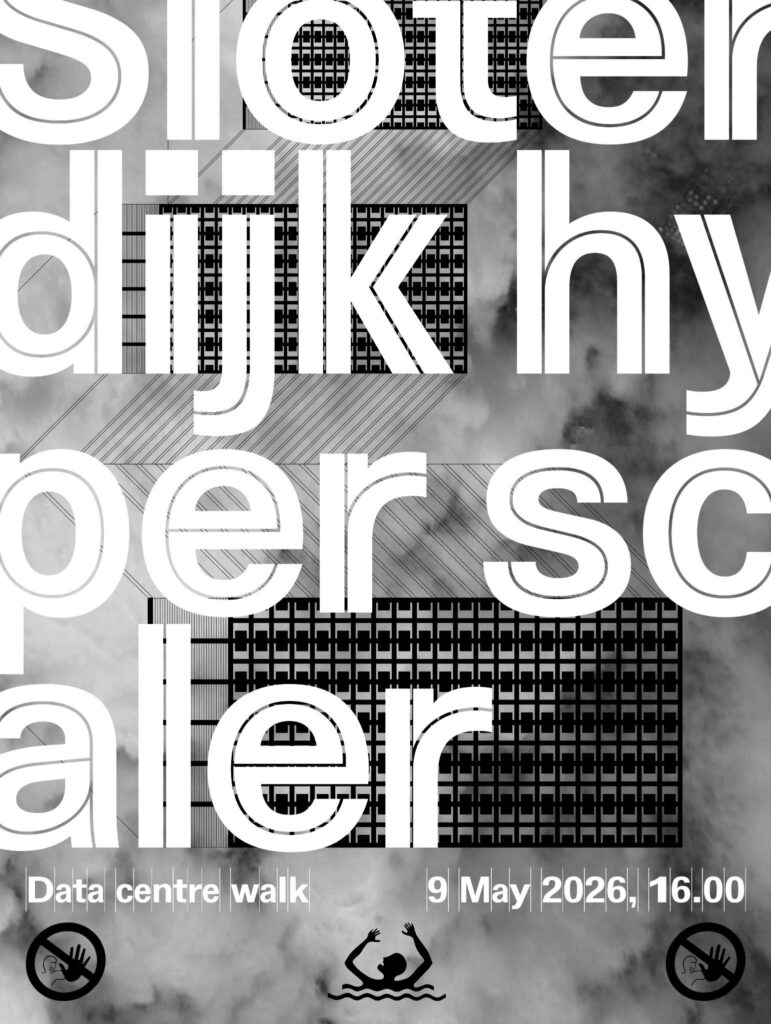
Join us on May 9th at 16.00 for a(nother) data centre walk to the controversial Microsoft hyperscaler under construction on the Plimsollweg, near Sloterdijk station. Infrastructure walks are like guided tours of the city, or birdwatching expeditions – but instead of pointing out noteworthy architectural details of historical buildings or showing participants how to best observe particular species of birds, we will explore the digital public infrastructures that are deployed in public spaces. In this case, a piece of land undergoing an infrastructural transformation into a speculative Cloud factory.
During our previous walk on March 6th, we discussed the 10-year-long financial speculation over this piece of land, the layers of subcontracting that hide Microsoft as the tenant of the hyperscaler, the municipality’s zoning policy, and the implications of such a project on the health of the land, water, local residents, and on our ability to access electricity equitably.
We return to the same site two months later to check on the construction progress, as well as to continue our discussions on these topics. We will end at De Sering with a community dinner, followed by a collaborative session to exchange about ways of responding to the harmful effects of this and comparable Cloud infrastructure projects.
Registration is closed.
# media | feature Data centers: quelle souveraineté numérique? April 2026
Les États-Unis ont une longueur d’avance dans le développement des infrastructures d’IA et implantent leurs data centers jusqu’en Europe. Pour rester dans la course à l’intelligence artificielle et garantir sa souveraineté numérique, l’UE veut tripler leur nombre sur le territoire européen. Alors même que ces data centers suscitent la controverse là où ils sont installés. C’est le cas notamment à Marseille.
Fieke was interviewed by the French-German broadcaster about her data centres work at an event in Marseille: Data centers: quelle souveraineté numérique?, by ARTE
# publication | article From critique to hope: Infrawalking, defamiliarisation, transgressive infrastructuring and utopian engineering April 2026
This article explores how methodological innovation can move media and infrastructure studies from critique toward hope. Building on the infrastructural turn in media studies, we argue that research must go beyond diagnosing power asymmetries to co-creating utopian alternatives that centre people and planet over capital and control. Drawing on experiments from the critical infrastructure lab, we reflect on four methods: infrastructure walks, transgressive infrastructuring, defamiliarisation, and utopian engineering. In these methods, we swap the pairs of infrastructure/governance, discourse/materiality, and values/objects in order to cultivate alternative technological trajectories, thereby unsettling assumptions that current technological developments are inevitable. Rather than treating infrastructures as closed systems, these approaches invite participants, including researchers, policymakers, activists, artists, and industry actors into collaborative processes of relational knowledge production. We argue that such methods embody ‘utopia as a method’ by creating spaces of uncertainty and experimentation that render infrastructures visible, contestable, and reconfigurable. In doing so, they generate not only critique but also openings for collective utopian agendas in an attempt to co-develop alternative infrastructural futures that centre people and planet over capital and control.
From critique to hope: Infrawalking, defamiliarisation, transgressive infrastructuring and utopian engineering, by Fieke Jansen, Maxigas, & Niels ten Oever
# publication | report Building a Shared Research Agenda on Submarine Cables April 2026
Submarine cables, both for data and power transmission, constitute the hidden backbone of digital and energy interconnectivity. As global infrastructures, they link continents, economies, and political regions, yet their routes, ownership structures, and strategic significance often remain opaque. On October 2, 2025, the critical infrastructure lab and Milan Babić organised a Submarine Cable Workshop at the University of Amsterdam to develop a shared research agenda on submarine cables.
During this one-day event, practitioners and researchers presented their work, shared insights, and openly discussed the challenges of studying submarine cables. Together, we reflected on the availability and accessibility of data and identified possible next steps. This report provides an overview of what was discussed and what we took away from these conversations. In this report, we use the term submarine cables to refer to internet connectivity cables that traverse oceans and lakes.
Building a Shared Research Agenda on Submarine Cables by Fieke Jansen, Niels ten Oever, Dmitry Kuznetsov, Valentina Ochner, & Jane Ruffino. critical infrastructure lab document series CIL#014. https://doi.org/10.5281/zenodo.19368835
# activity | workshop MaKING Printed Circuit Boards with Wild Clay March 2026
It is an open secret that the hardware in our smart devices contains not only plastics but also conflict minerals such as tungsten, tin, tantalum, silver and gold.
We are investigating alternative hardware from locally sourced materials, so-called ethical hardware, to develop and speculate upon renewable practices for the benefit of both nature and humans.
We are exploring different materials, sentient, low-impact, non-toxic, fair traded, recycled and urban mined means of production.
We aim to challenge the common PCB (printed circuit board) economies in an artistic, creative, positive and responsible way applying feminist hacking as an artistic methodology and critical framework.
https://feministhackerspaces.cargo.site/Clay-PCB-Tutorial – a workshop in partnership with the critical infrastructure lab and Waag from March 30 to April 2, 2026.
# publication | book chapter More Compute for a Burning Planet? A Scarcity Approach to AI Infrastructures March 2026
The real problem of our times is not developing more AI but ensuring sustainable futures. Imaginaries of AI for sustainability present logics of progress, smartness, and efficient use of natural resources, whilst rarely acknowledging the environmental impact of these systems. In this chapter, we use the method of defamiliarisation, making the familiar unfamiliar, to explore governance approaches to AI infrastructure that stay within planetary boundaries. We argue that centring nature in AI governance debates opposes Europe’s current state-market entanglements. Rather, it positions the state as the key power-holder, which should wield its economic and technological statecraft for the public interest and counter the accumulation of capital in the hands of the few. This chapter contributes to the understanding of the state’s role in AI infrastructure governance and straddles the fields of infrastructure studies and critical data centre studies.
More Compute for a Burning Planet? A Scarcity Approach to AI Infrastructures by Fieke Jansen & Niels ten Oever
# publication | book AI Infrastructures and Sustainability: Expanding Perspectives on Automation, Communication and Media March 2026
This open access book assembles cutting-edge research in media and communication exploring AI infrastructures and sustainability. It builds upon and expands perspectives on media infrastructure, addressing critical issues such as environmental impacts, economic concentration, and social justice – areas that have not been comprehensively examined under the umbrella term “sustainability” within discussions on AI. The authors explore the complex social, economic and material processes through which AI formations take shape, and offer novel perspectives on the entanglement of digital media, AI and sustainability discourses as they manifest in the shaping of futures with AI.
AI Infrastructures and Sustainability: Expanding Perspectives on Automation, Communication and Media, edited by Anne Mollen, Fieke Jansen, Sigrid Kannengießer, Julia Velkova
# media | op-ed Why the EU Commission’s plan for an AI data-centres boom is short-sighted March 2026
Across Europe, conflicts over data centres’ demand for water, energy, and land are now playing out.
In Spain, the Your Cloud Dries Up My River movement exposes water-hungry data centres.
In Ireland, households were put on water rations to ensure data centres could keep on cooling their servers.
In the Netherlands, a new school building struggled to be connected to the electricity grid due to capacity pre-committed to a data centre.
These local conflicts will only worsen now that the European Commission plans to triple data centre capacity in Europe over the next five to seven years.
Why the EU Commission’s plan for an AI data-centres boom is short-sighted by Fieke Jansen, Kristina Irion and Alex Lutz
# media | news article Datacentertumult: ‘Amsterdam crasht, Microsoft casht’ March 2026
Datacentertumult: ‘Amsterdam crasht, Microsoft casht’ by Binnenlands Bestuur (Dutch)
# media | feature Van geopolitiek tot geobacter: anders denken over digitale infrastructuur March 2026
Digitale infrastructuren spelen een steeds grotere rol in geopolitieke conflicten. Tegelijkertijd worden de infrastructuren van onze samenleving zelf steeds sterker gepolitiseerd. Hoe kunnen we anders leren kijken naar digitale systemen die zo bepalend zijn voor onze economie, veiligheid en communicatie? Het critical infrastructure lab, opgericht door Fieke Jansen, Maxigas en Niels ten Oever, probeert een antwoord op deze vragen te vinden.
Van geopolitiek tot geobacter: anders denken over digitale infrastructuur by Amsterdam Humanities Hub (Dutch)
# publication | statement Hyperscaler datacenter bij Sloterdijk is onwenselijk February 2026
Hyperscaler datacenter bij Sloterdijk is onwenselijk, by critical infrastructure lab and Leitmotiv (in Dutch)
# media | news article Van dit soort ijzeren reuzen komen er nog meer, dwars door dorpen en over akkers January 2026
Van dit soort ijzeren reuzen komen er nog meer, dwars door dorpen en over akkers by Loek Buter (Dutch)
# media | news article ‘Zeer onwenselijk’ dat grootste datacenter van Amsterdam helemaal in Amerikaans gebruik komt January 2026
‘Zeer onwenselijk’ dat grootste datacenter van Amsterdam helemaal in Amerikaans gebruik komt by Bart van Zoelen (Dutch)
# media | press release Maatschappelijke organisaties uiten zorgen over hyperscaler datacenter bij Amsterdam Sloterdijk January 2026
# media | news article In Amsterdam komt een hyperscale voor Microsoft, ondanks het verbod op hyperscales January 2026
In Amsterdam komt een hyperscale voor Microsoft, ondanks het verbod op hyperscales by Carola Houtekamer and Merijn Rengers (Dutch)
# media | news article Google en Microsoft houden energiegebruik van hyperscale-datacenters geheim voor de overheid January 2026
Google en Microsoft houden energiegebruik van hyperscale-datacenters geheim voor de overheid by Merijn Rengers and Carola Houtekamer featuring fieke jansen (Dutch)
# media | news article Datacenters zijn niet meer weg te denken: ‘Maar we moeten selectiever zijn’ December 2025
Datacenters zijn niet meer weg te denken: ‘Maar we moeten selectiever zijn’ by Jeroen Kraan featuring fieke jansen (Dutch)
# publication | op-ed De ware prijs van AI: groei ten kost van de planeet Samenleving & Politiek November 2025
De ware prijs van AI: groei ten kost van de planeet Samenleving & Politiek by Fieke Jansen
# publication | report Pathways through the Polycrisis: Proceedings of the critical infrastructure lab retreat October 2025
Pathways through the Polycrisis: Proceedings of the critical infrastructure lab retreat critical infrastructure lab document series CIL#012, https://doi.org/10.5281/zenodo.17417380
# publication | blog What are we sustaining, the internet or the planet? August 2025
What are we sustaining, the internet or the planet? PITG, by Fieke Jansen
# publication | blog Sustainable and Equitable Infrastructures: Moving from Extraction to Regeneration July 2025
Sustainable and Equitable Infrastructures: Moving from Extraction to Regeneration, Branch Issue 9, by Fieke Jansen
# publication | special issue Issue 9: Attunement – Designing in an Era of Constraints July 2025
Issue 9: Attunement – Designing in an Era of Constraints, by Fershad Irani, Fieke Jansen & Michelle Thorne (ED), and Hannah Smith & Katrin Fritsch (Producers)
# publication | report Critical Internet Governance: From Positions to a Field June 2025
Critical Internet Governance: From Positions to a Field by critical infrastructure lab and Research Network on Internet Governance (REDE) https://doi.org/10.5281/zenodo.15627726
# publication | report Putting Money Where Your Mouth Is? Insights into EU R&I Funding for Digital Technologies April 2025
Putting Money Where Your Mouth Is? Insights into EU R&I Funding for Digital Technologies by Zuzanna Warso & Meret Baumgartner https://doi.org/10.5281/zenodo.15263223
# media | interview We moeten anders nadenken over onze vervuilende digitale economie April 2025
‘We moeten anders nadenken over onze vervuilende digitale economie’ by Loys Bakker featuring fieke jansen (Dutch)
# media | news article Back to life, back to reality April 2025
Back to life, back to reality with Fieke Jansen
# media | news article Energy, Water & Data: Could Google Make AI Sustainable? April 2025
Energy, Water & Data: Could Google Make AI Sustainable?, by Chloe Williment
# media | news article Deciphering AI Water Consumption: How Amazon Hides How Much Water Its Cloud Consumes in Spain March 2025
Deciphering AI Water Consumption: How Amazon Hides How Much Water Its Cloud Consumes in Spain, by Pablo Jiménez Arandia featuring Fieke Jansen (Spanish)
# publication | statement Within Bounds: Limiting AI’s environmental impact. Joint statement from civil society for the AI Action Summit February 2025
Within Bounds: Limiting AI’s environmental impact. Joint statement from civil society for the AI Action Summit, prepared by Green Screen Coalition, Green Web Foundation, Beyond Fossil Fuels, Aspiration, and the critical infrastructure lab and signed by 100 civil society organizations
# publication | report chapter predatory delay and other myths of “sustainable ai”, redirecting europe’s ai industrial policy; from competitiveness to public interest October 2024
# media | podcast Buy Your AI A Drink, It’s Thirsty! October 2024
Buy Your AI A Drink, It’s Thirsty! with Fieke Jansen, Çağ Akarken podcast
# publication | white paper White Paper “How to Meet Europe’s Digital Infrastructure Needs? June 2024
white paper White Paper “How to Meet Europe’s Digital Infrastructure Needs? (in Dutch) – consultation submission by the critical infrastructure lab
# publication | report Down with Data Centres: Developing Critical Policy – report on a workshop organised at Privacy Camp 2024 March 2024
Down with Data Centres: Developing Critical Policy – report on a workshop organised at Privacy Camp 2024 by University of Delft and the critical infrastructure lab, Fieke Jansen & Corinne Cath, https://doi.org/10.5281/zenodo.11059837
# publication | book Eaten by the Internet October 2023
Eaten by the Internet, edited by Corinne Cath
# publication | report Digital infrastructures and environmental justice: policies, practices, and visions October 2023
# publication | special issue branch magazine: issue #6 green screen September 2023
branch magazine: issue #6 green screen, Katrin Fritsch, Fieke Jansen, Maya Richman, and Katherine Waters
# publication | paper the climate crisis is a digital rights crisis: exploring the civil-society framing of two intersecting disasters July 2023
fieke jansen, merve gülmez, becky kazansky, harriet kingaby, claire fernandez, and jan tobias mühlberg. the climate crisis is a digital rights crisis: exploring the civil-society framing of two intersecting disasters. ninth workshop on computing within limits
# publication | report building a relational infrastructure; the launch of the critical infrastructure lab May 2023
building a relational infrastructure; the launch of the critical infrastructure lab, fieke jansen, niels ten oever, maxigas, et al
# media | podcast We wonnen: de NCTV wordt teruggefloten April 2023
podcast by bits of freedom featuring fieke jansen introducing the lab
# publication | report chapter Article 37 Environment protection, internet infrastructure and the data economy April 2023
fieke jansen. Article 37 Environment protection, internet infrastructure and the data economy, in Giannopoulou (ed) digital rights are charter rights. digital freedom fund, pp. 50-52