EU digital legislation timeline February 2026
data center walks and infrastructure walks February 2025
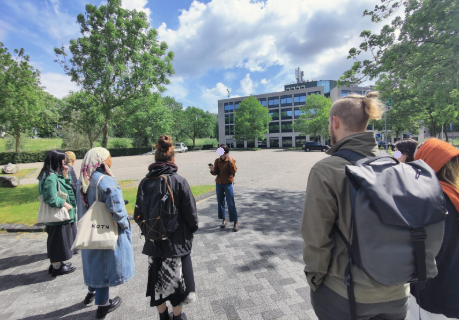
Join us for amateur exploration into the visibility of wireless equipment and services dotted around the city! We collectively map, observe and measure the techno-diversity of digital infrastructure in urban spaces. Data and infrastructure walks are a creative method and a social practice, which can be used to reflect on data power through critical infrastructure studies. It serves a variety of purposes, from public engagement, education, and artistic research to empirical studies.
Data center walks
We started data center walks with a simple question about how to make the invisible visible. People tend to forget about the infrastructure that lies beneath the data. For instance, the cloud remains a concept reduced to a depiction of a cloud, stripping data from its materiality. We usually do not see data centers, nor do we think about them in a material sense. By taking groups into data centers with us, we explore the resources, politics, and human labor that sustains them. To do so, we walk around and inside the data centers, observing physical traces as well as user-generated information online.
Infrastructure walks
We hold a series of “infrastructure walks” in Amsterdam and Berlin, exploring the visibility of digital infrastructures deployed in public spaces. The experience allows us to uncover data flows and to study datafication in urban areas. By engaging with the infrastructures around us, we seek to expose reconfigurations of power relations in the city through emerging technologies and protocols. Infrastructure walks address the question of what media technologies may mean “after all”, that is in the context of the life world, lived experiences and action possibilities of end users as embodied citizens. Insights can countermap the spatial control exercised through the electromagnetic spectrum in urban spaces. Often, us and the groups find that infrastructures should be (1) noticeable, (2) observable, (3) contestable or programmable to their users.
Upcoming walks and related events: Data Walk Workshop: Sensing Digital Materiality in Urban Public Spaces
Walking the infrastructure walk and dancing the frequency dance — You only see it when you get it
mud batteries and regenerative infrastructures February 2025
Living Infrastructures and Organic Data Centers: Toward Ecological and Post-Extractive Computing
The environmental costs of computation have become impossible to ignore. Data centers, AI models, and communication infrastructures demand vast amounts of energy and minerals, intensifying extractive relations with both human and nonhuman worlds. In response, sustainability discourses in the technology sector promise greener energy, circular economies, and digital efficiency. Yet these solutions remain anchored in the same paradigm of accumulation that drives the ecological crisis in the first place.
In our lab, we take a different approach. We explore how computing might be reimagined from the ground up—literally—by engaging with living materials such as soil, microbes, and kombucha SCOBYs. These experiments aim not to optimize computation, but to decenter it, to ask what infrastructures might emerge when we take ecological entanglement rather than extraction as a design principle. On this page you will find impressions of our experiments.
Biological Power: Mud and Microbial Batteries
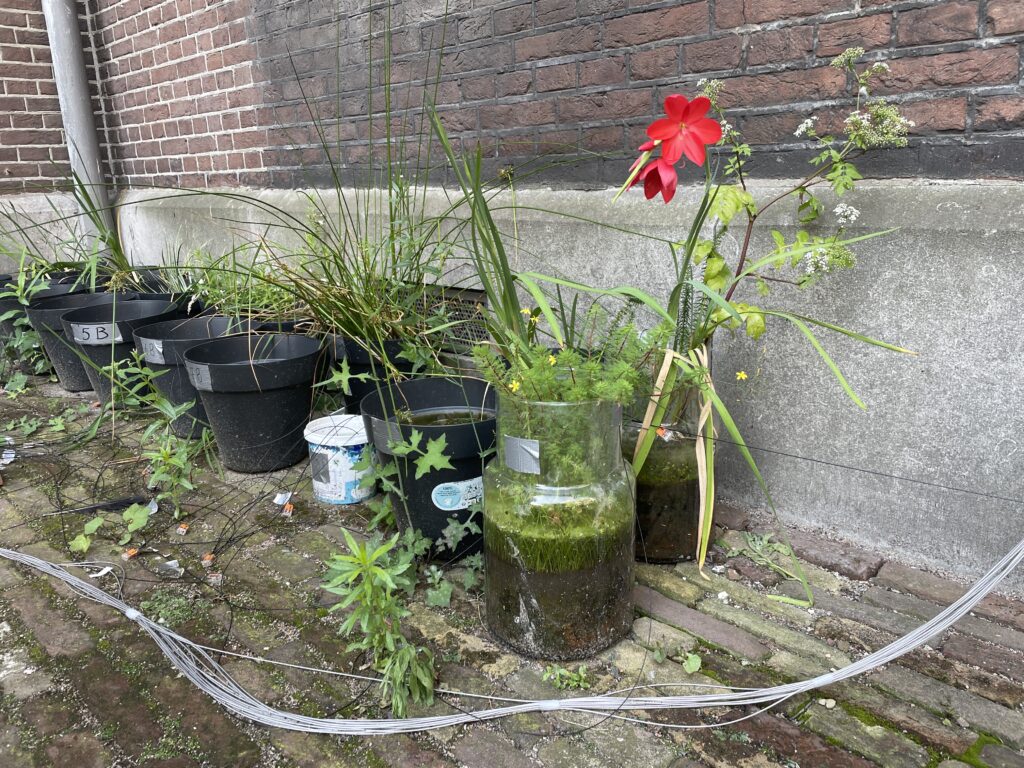
Together with artist Sunjoo Lee, we created an electrical gardan on the docks of the UvA. A series of mud batteries generate electricity through microbial fuel cells. These cells capture electrons produced by anaerobic bacteria in wet soil as they metabolize organic matter. The voltage is minimal—often between 0.3 and 0.7 volts per cell—but continuous, depending on the vitality of the microbial community. The continuous fluctuations in energy intensity sparked our curiosity — beyond the idea of mud as a power source — toward a space where voltage itself becomes an organic expression of computation. The soil thus becomes both the site and the medium of computation: energy is produced only as long as the ecosystem remains alive.
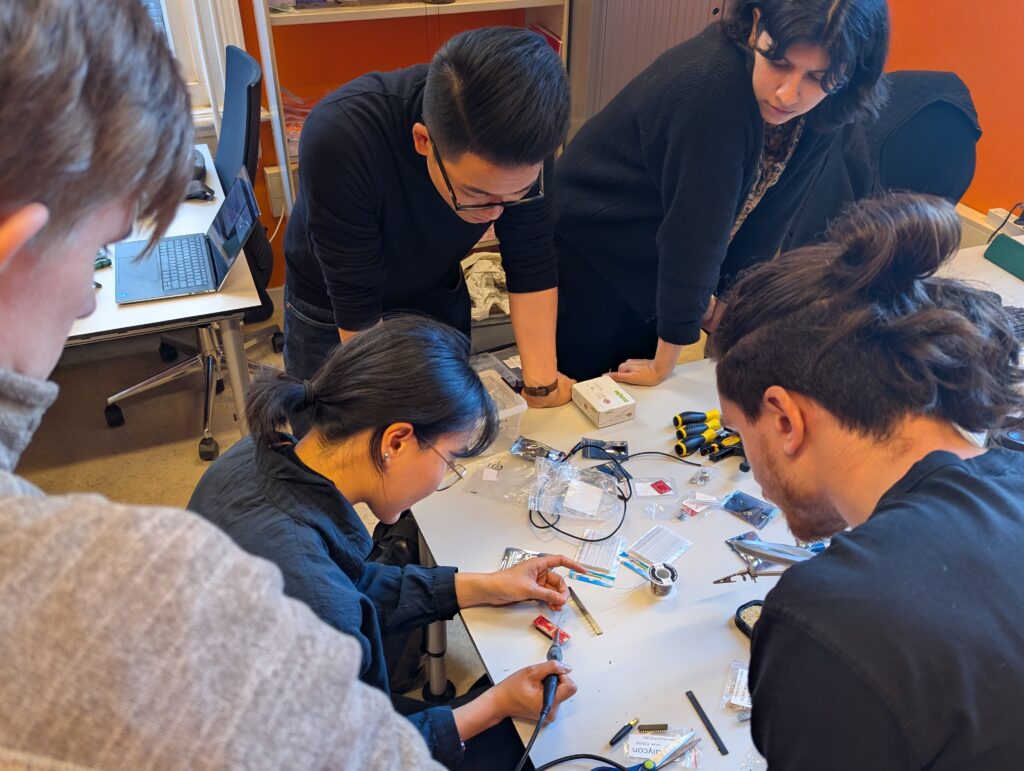
This project extends earlier artistic and scientific explorations of microbial electricity, but reframes them within the question of ecological infrastructures. Rather than treating biology as an alternative energy source to power existing systems, we ask how it could inspire new relations of maintenance, temporality, and dependency in digital systems.
Organic Substrates: Kombucha and Clay
We are also exploring kombucha SCOBYs—symbiotic cultures of bacteria and yeast—as living materials for circuit design. The cellulose-rich surfaces of dried SCOBYs are conductive when infused with certain electrolytes and can host sewn or printed traces. Alongside this, we draw inspiration from clay-based printed circuit boards, which uses local soil as both substrate and metaphor: the ground becomes circuitry. These material practices invite us to rethink electronics as earthbound and circular, materials that will eventually returning to the soil.
Sensing, Powering, and Communicating
To connect these experiments, we use a LabJack U3 interface to continuously measure voltage and current across the microbial and SCOBY cells. Our goal is to power a small web server directly through this living power source—a website whose uptime literally depends on the health of its microbial community. The fluctuating readings are logged and visualized in real time, making the metabolism of the mud and SCOBY visible as a communicative process.
Beyond measurement we see soil as the medium of computation. A first step is to enable distributed communication through the Reticulum Network Stack between the microbial and SCOBY cells. This stack enables resilient, peer-to-peer data exchange without reliance on central servers or the global internet. In a next phase, we plan to integrate the sBitx v3 transceiver to transmit microbial compute over shortwave radio. The Hermes.radio protocol, allows us to link biological power, local measurement, and planetary communication through low-power open infrastructures.
Computing Otherwise
These prototypes are small in scale but large in implication. They suggest that computing need not depend on extraction, nor sustainability on efficiency. Instead, we experiment with ecological computation as a mode of care, reciprocity, and coexistence—where systems live and die with the materials that sustain them.
By experimenting with mud, microbes, SCOBYs, and clay, we seek to develop new relations to computing and to decenter dominant theories of technological progress. This work aligns with broader debates in science and technology studies on digital sovereignty, infrastructural power, and ecological media, asking how infrastructures might evolve beyond capital’s logics of expansion toward restorative and regenerative practices.
In short, our aim is to imagine what computing could become if it were not only in the world, but also of it.
phase shift: the antennas and us February 2025
an interactive art intervention
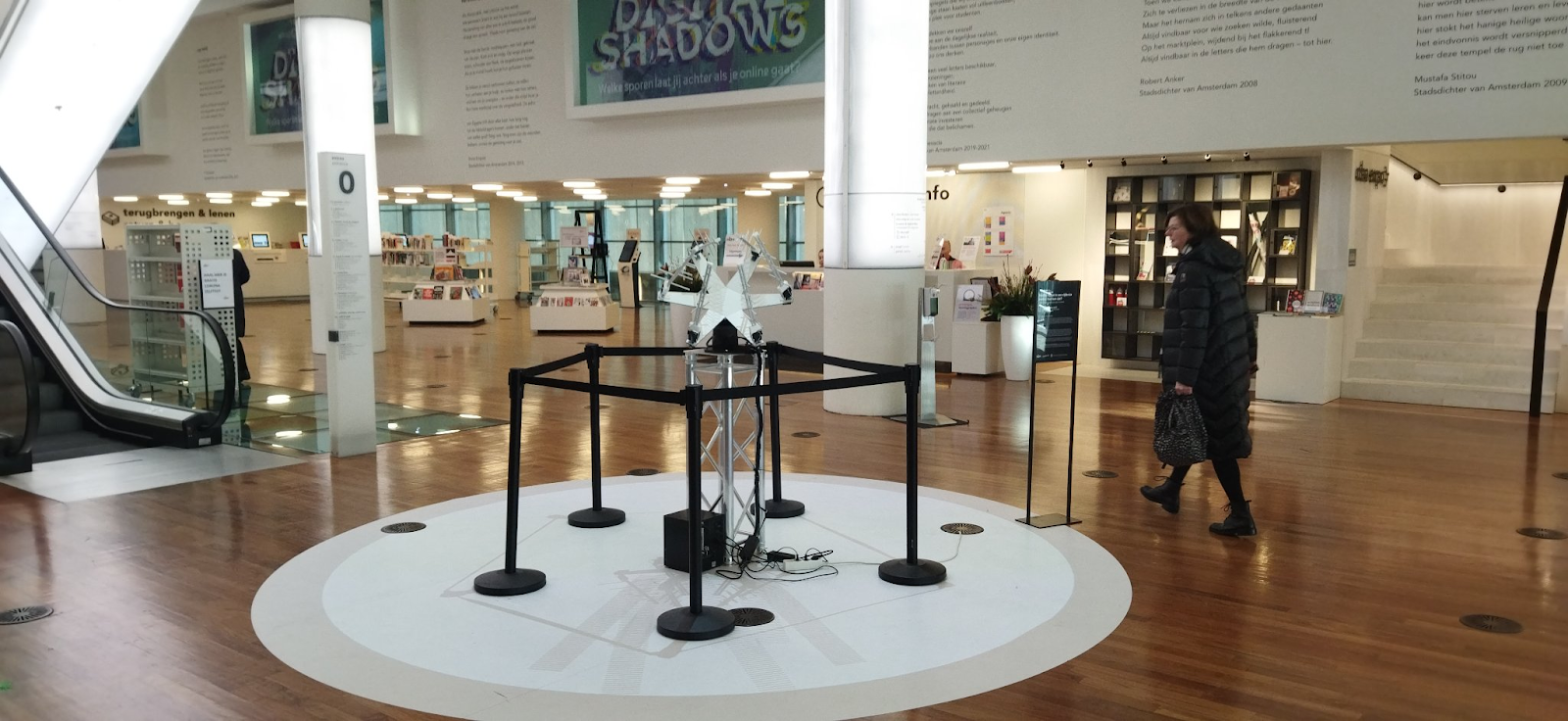
Together with the artist collective weise7, we produced an exhibit called “antennas and us” in the OBA Amsterdam public library. The artistic intervention, phase shift, is an interactive representation of a 5G antenna. It follows library visitors through motion sensors in a similar way that 5G antennas do in a process called ‘beamforming’. The antenna representation drew visitors into conversations with us about the experience of communication infrastructures in their everyday lives.
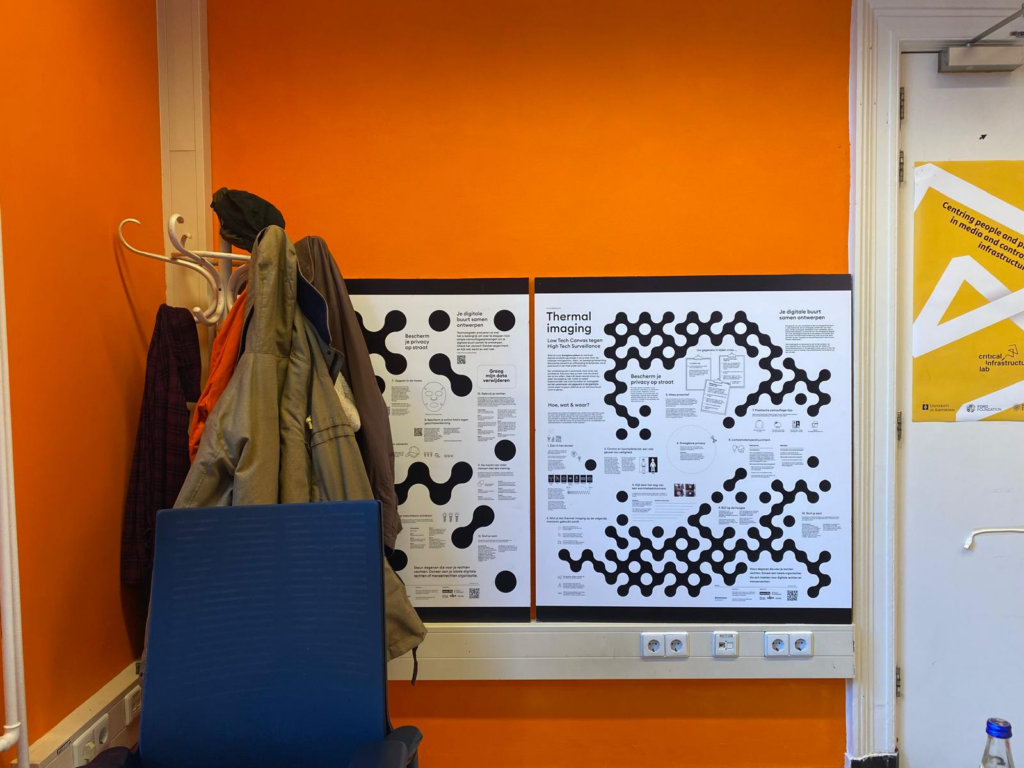
Visitors were also intrigued by the low tech guides against high tech surveillance created by fieke jansen in collaboration with design collective idiotēs. The guides framed the exhibit and provided a rich context for it. The guides display information on Wifi-tracking, Thermal imaging and Facial recognition, which can be used to become a digital explorer of your city. The artistic interventions travelled the library of Amsterdam, the “frictions and frequencies” exhibition in Berlin, our office, and hopefully, your neighbourhood.