newsletter critical infrastructure newsletter: 5 April 2026
Dear friends, colleagues, and comrades,
Welcome to the critical infrastructure lab newsletter, edition number five.
We hope that you have been well. Maxigas hosted another Reticulum workshop at Internet Archive Europe, while Fieke and Niels organized a workshop on making printed circuit boards (PCBs) with wild clay.
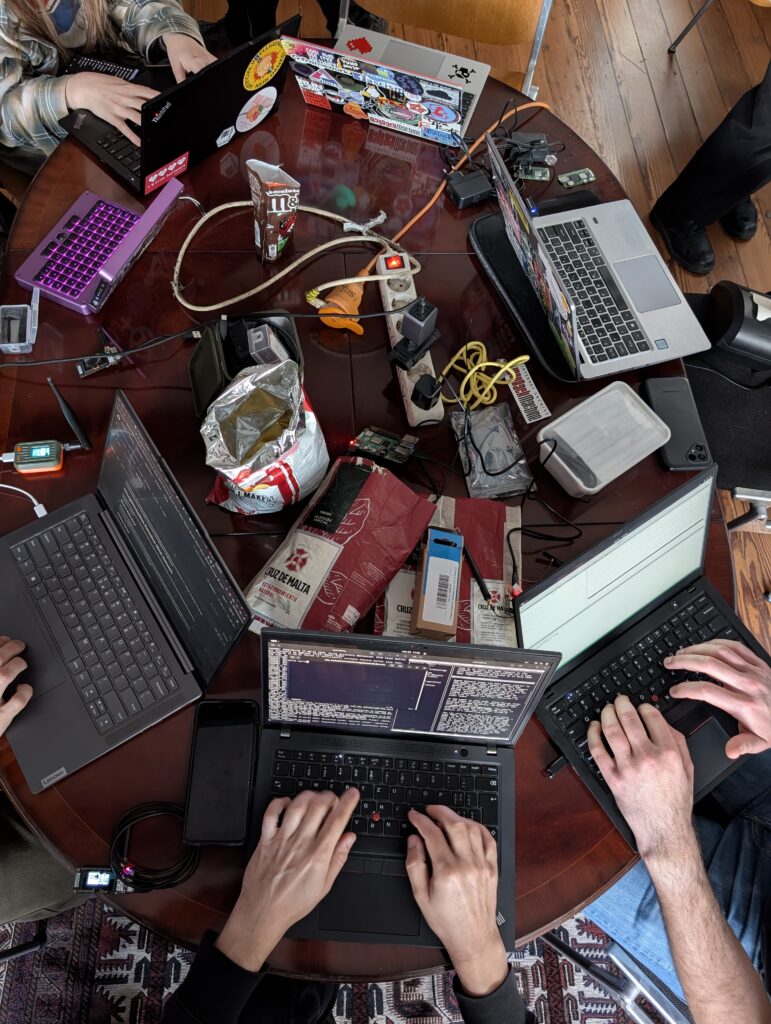
The March Reticulum low-profile, low-energy community networking workshop was all about testing the mesh network with mobile phones (over Bluetooth, WiFi, and LoRa frequencies and protocols), building infrastructure nodes, browsing and making “micron” websites, and experimenting with running the entire protocol stack on single microcontrollers. See below for the next workshops in Den Haag, Utrecht and Linz.
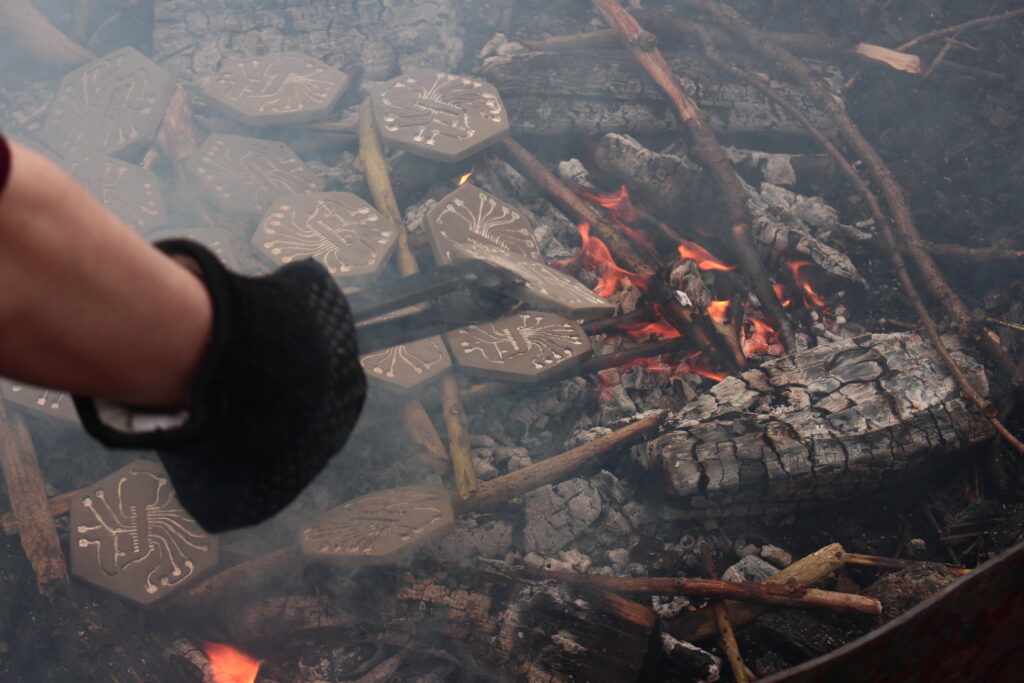
The clay PCB workshop investigated alternative hardware from locally sourced materials and invited participants to reflect on renewable practices for the benefit of both nature and humans. Stefanie Wuschitz and Patrícia J. Reis (in collaboration with Waag) led the participants in processing the clay, shaping it into the PCB form, firing and painting the PCBs, and building a microcontroller.
Publications
We are happy to share:
- Book: AI Infrastructures and Sustainability: Expanding Perspectives on Automation, Communication and Media, which Fieke co-edited with Anne Mollen, Sigrid Kannengießer, and Julia Velkova.
- Fieke and Niels wrote the book chapter, More Compute for a Burning Planet? A Scarcity Approach to AI Infrastructures
- Report: Building a Shared Research Agenda on Submarine Cables, by Fieke, Niels, Dmitry, Valentina, and Jane Ruffino.
- Article: Infrastructural anxiety and digital sovereignty: The perceived loss of control in Dutch communication networks, by Fieke, Niels, Sarah, and Maxigas.
- Report: Clouded Judgments: Problematizing Cloud Infrastructures for News Media Companies, by Agustin Ferrari Braun and Corinne Cath.
In the media
We have been active in the calls for public accountability surrounding the hyperscaler data centre in Amsterdam that is projected to consume as much electricity as all households in Amsterdam combined.
- Press release: Maatschappelijke organisaties uiten zorgen over hyperscaler datacenter bij Amsterdam Sloterdijk (in Dutch).
- Fieke and Corinne spoke to the Amsterdam municipality about the data centre (in Dutch). News article:
- Google en Microsoft houden energiegebruik van hyperscale-datacenters geheim voor de overheid (in Dutch).
- News article: In Amsterdam komt een hyperscale voor Microsoft, ondanks het verbod op hyperscales (in Dutch).
- News article: ‘Zeer onwenselijk’ dat grootste datacenter van Amsterdam helemaal in Amerikaans gebruik komt (in Dutch).
- News article: Datacentertumult: ‘Amsterdam crasht, Microsoft casht’ (in Dutch).
Other news:
- News article: Van dit soort ijzeren reuzen komen er nog meer, dwars door dorpen en over akkers (in Dutch).
- Feature: Van geopolitiek tot geobacter: anders denken over digitale infrastructuur (in Dutch).
- Op-ed: Why the EU Commission’s plan for an AI data-centres boom is short-sighted, by Fieke, Kristina Irion, and Alex Lutz.
Upcoming events
We would like to meet you at one of these events:
- On April 10th, The State of the Internet 2026 with Fieke Jansen at Waag Futurelab. On April 19th Reticulum Workshop at the Opstand in Den Haag.
- On April 28th, our reading group will start reading two news books, namely ‘The Low-Carbon Contradiction: Energy Transition, Geopolitics, and the Infrastructural State in Cuba’ by Gustav Cederlöf and ‘The Deadly Life of Logistics: Mapping Violence in Global Trade’ by Deborah Cowen. All details on joining the reading group can be found on our website.
- On May 10th, Reticulum Workshop at Snoekhoek in Utrecht.
- From May 13-16th in Linz, Art Meets Radical Openness festival. Maxigas is hosting a panel on May 14th “How to cook a data centre?” in the morning and Reticulum Workshop facilitated by the critical infrastructure lab and ]LAG( lab in the afternoon. For low profile, low energy, resilient networks for planetary computation and community participation.
- On June 12th, Project XLR collaborative radio experimentation workshop with Christy Westhovens, WORM and the critical infrastructure lab. We will cover the political fundamentals of radio communication, explore the electromagnetic spectrum as a critical natural resource, and meddle in satellite hacking, heterogeneous networking, and signal identification with software defined radios.
Summer school: Global Power and Technology: Competition, Innovation and Technological Advancement through Standardization in the EU and Beyond. Niels will teach a part of this five-day summer course that offers a deep dive into how some most innovative technologies influence the world around us and how they, in turn, are influenced by global power dynamics. The deadline for registration is 1 June. - At the ICT4S in June, where Fieke, Adrian Friday, Gauthier Rousillhe, and Srinjoy Mitra lead a workshop titled The True Cost of ICT: Crisis of Abundance.
- Summer School: Low-Tech, Luddism and Liberation: reclaiming technology for the collective good in July. The deadline for registration is April 30th.
Visit our website to check out all our publications, upcoming activities, and media appearances.
Highlights from our allies
- Conference: Cables of Resistance – Movements Conference Against Big Tech from April 10th to 12th in Berlin.
- Book: Radical Infrastructure: Imagining the Internet from the Ground Up by Britt Paris. Report: The AI climate hoax. Ketan Joshi finds that the big tech industry’s claim about the climate benefits of artificial intelligence don’t hold up. The research finds that 74% of AI climate benefit claims are unproven.
- Book: The Reticular Society by Ian Alan Paul with introduction by Serene Richards.
- Podcast: Poetic Sadness by Asia Bazdyrieva.
What is inspiring us
In solidarity,
critical infrastructure lab
Niels ten Oever – Fieke Jansen – Maxigas – Dmitry Kuznetsov – Eric Zhang – Felipe Silva Figueiredo – Nora Svensson – Gargi Sharma
The critical infrastructure lab is funded by Ford Foundation, Internet Society Foundation, Open Technology Fund, AI Collaborative, University of Amsterdam, and Utrecht University.